Guinness Cheddar Sourdough Bread
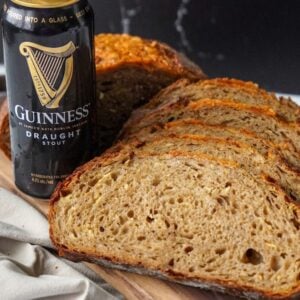
INGREDIENTS
Initial Dough Mix
- 350 g Guinness beer (cold is fine)
- 120 g active sourdough starter
- 300 g bread flour (King Arthur unbleached, 12.7% protein)
- 200 g whole wheat flour (Cairnspring whole grain expresso bread flour, 14-15% protein)
Added Later
- 10 g sea salt
- 30-50 g Guinness beer (cold is fine)
- 200 g cheddar cheese shredded | (Kerrygold Dubliner Irish Cheese)
Equipment
- Oval Dutch oven ($15 off with code REBEKAH15)
- Oval banneton (5% off with code TSG5) | Size I'm Using: Oval – Spiral MD
Instructions
Feed Your Starter
- To make this bread, you need 120g total of active sourdough starter. If you want to make this dough in the morning, I suggest feeding your starter before bed: 13g starter, 65g flour, 65g water. This will give you a little more than you need.
Mix the Dough
- This dough takes longer than usual to bulk ferment, so I suggest starting in the morning. In a bowl, whisk together 350 g Guinness beer and 120 g active sourdough starter. Then, add 300 g bread flour and 200 g whole wheat flour. Mix with a Danish dough whisk or your hands until no dry flour bits remain (about 3-4 minutes). Cover with plastic wrap or a damp kitchen towel and let rest 1 hour.Tip: This process of delaying the salt is called a fermentolyse. It gives the fermentation a jumpstart, which is helpful since we're using cold beer, which slows it down.
- Dimple in 10 g sea salt and 30-50 g Guinness beer, squeezing the salt and liquid into the dough. Start with the lower amount of beer – we can add more after mixing if needed. After 1-2 minutes of squeezing the dough, switch to slap and folds, which brings the dough together really quickly.If the dough still feels stiff, add the remaining amount of beer, squeezing it into the dough and then switching to slap and folds to fully incorporate. Cover and rest 30 minutes.
Stretch and Folds
- Shred 200 g cheddar cheese. Add a quarter of the cheese at a time during the stretch and folds, layering them evenly as you perform each fold to ensure even distribution. Cover and let rest 30 minutes.Optional tip: Feel free to reserve a small amount of the cheese for topping the loaf tomorrow!
- Perform another set of stretch and folds. Cover and let rest 30 minutes. Then, perform a final round – I prefer coil folds for the last round as it's gentler on the dough.
Bulk Fermentation
- Cover the dough and let it ferment at room temperature until it is puffy, jiggly, and has visible bubbles on the surface and sides. The exact amount of time this takes will vary. The temperature of your environment is the biggest factor. For reference, it took my dough about 10 hours – my dough ended up at 74°F (23°C), and my kitchen was 72.5°F (22.5°C).
Shaping & Cold Retard
- Mist your work surface with water (or lightly flour it if you prefer). Gently turn the dough out of the bowl. Using a push and pull motion, shape the dough ball into a round shape. We want the surface to be taut. Let rest, uncovered, for about 20 minutes, or just until the dough relaxes a bit.
- Flip the dough and use the caddy clasp final shaping technique to fold it into a boule or batard.
- Cold proof overnight. Place the shaped dough into a floured banneton, cover with a flour sack towel or plastic wrap, and refrigerate overnight (8-24 hours). This enhances flavor, digestibility, and makes the dough easier to score before baking.
Score & Bake
- Preheat your oven to 450°F (230°C) with a Dutch oven inside for at least 30 minutes. (I use convection.) When ready to bake, carefully transfer the cold dough onto parchment paper or a bread sling, score the top with a bread lame, and place it into the preheated Dutch oven. Cover and bake for 25 minutes, then uncover and top with additional shredded cheese, if desired.Bake for another 10 minutes. Then, lower the oven temperature to 375°F, cover the bread with foil, and bake another 10-15 minutes, or until the internal temperature reaches 205-210°F (96-99°C).
Video
