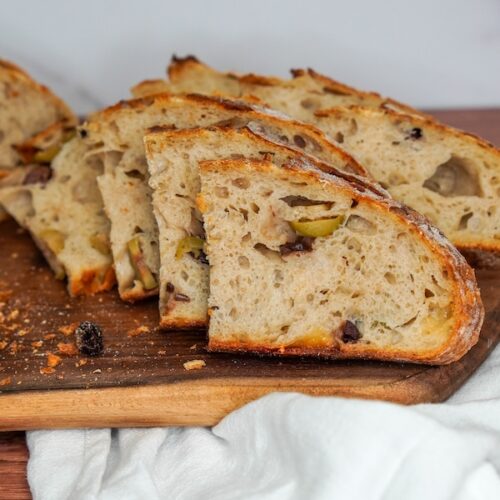
Olive Parmesan Artisan Sourdough Bread Recipe
INGREDIENTS
Sourdough Starter
- 8 g sourdough starter (active or discard)
- 40 g water
- 40 g King Arthur bread flour 12.7% protein
Main Dough
- 375 g warm water
- 75 g active starter from above
- 450 g King Arthur bread flour 12.7% protein
- 50 g King Arthur whole wheat flour 13.2% protein
- 10 g sea salt
Inclusions
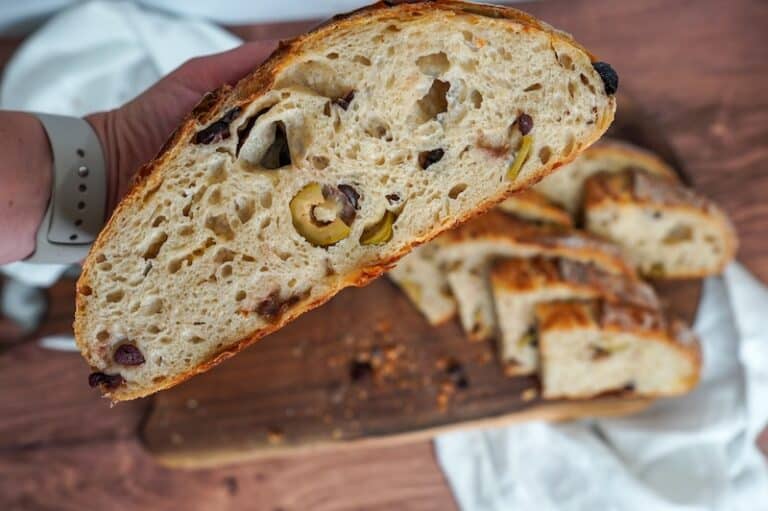
- 130 g sliced olives I like a mix of green (castelvetrano) and purple (kalamata)
- 75 g Parmigiano-Reggiano cheese freshly grated
Equipment
- Rice flour (for dusting your banneton)
- Oval Dutch oven ($15 off with code REBEKAH15)
Instructions
- Make the sourdough starter the night before. In a jar, mix 8 g sourdough starter, 40 g water, and 40 g King Arthur bread flour. Stir until fully combined, then cover loosely and let it ferment overnight at room temperature (about 10-12 hours). By morning, it should be peaked. You'll have a little more than you need (feed the leftovers or add it to your discard jar in the fridge).
- Mix the dough. In a glass mixing bowl, combine 375 g warm water and 75 g active starter, stirring gently to dissolve the starter. Add 450 g King Arthur bread flour, 50 g King Arthur whole wheat flour, and 10 g sea salt. Mix with a Danish dough whisk or your hands until no dry flour remains. The dough will be shaggy and sticky – that’s normal! Cover with plastic wrap or a bowl cover and let rest for 30 minutes.
- Perform a set of stretch and folds. To do this, grab one side of the dough, stretch it upward, then fold it over itself. Rotate the bowl and repeat on all four sides. Keep going until the dough resists being stretched. Cover and let rest for 30 minutes.
- Incorporate the inclusions during the second set of stretch and folds. Mix together 130 g sliced olives and 75 g Parmigiano-Reggiano cheese. Add a quarter of the inclusions at a time during the second set of stretch and folds, layering them evenly as you perform each fold to ensure even distribution. Cover and let rest for 30 minutes.
- Perform a third set of stretch and folds in the same way, followed by another 30 minute rest.
- Final coil fold. Perform a final coil fold to build additional dough strength. To do this, lift the center of the dough, allowing the edges to drape down, then tuck them underneath as you set the dough back down. If you feel the dough is slack or not strong enough, you can do an additional coil fold after another 30-minute rest.
- Bulk ferment. Cover the dough and let it ferment at room temperature until it is puffy, jiggly, and has visible bubbles on the surface and sides. The exact amount of time this takes will vary. The temperature of your dough is the biggest factor. For reference, it took my dough about 7 hours at 75°F (24°C). The timing begins when we mix our dough.
- Pre-shape the dough. Lightly mist your work surface, hands, and bench scraper with water. Gently turn the dough out of the bowl. Using a push and pull motion, shape the dough ball into a round shape. We want the surface to be taut. Let rest, uncovered, for about 20 minutes, or just until the dough relaxes a bit.
- Final shaping. Flip the dough and use the caddy clasp final shaping technique to fold it into a boule or batard. See the Notes section for video tutorials.
- Cold proof overnight. Place the shaped dough into a floured banneton (rice flour works best), cover with a flour sack towel or plastic wrap, and refrigerate overnight (8-24 hours). Don't refrigerate more than 4 days.
- Score and bake. Preheat your oven to 450°F (230°C) with a Dutch oven inside for at least 30 minutes. (I use convection.) When ready to bake, carefully transfer the cold dough onto parchment paper or a bread sling, score the top with a bread lame, and place it into the preheated Dutch oven. Cover and bake for 25 minutes. Uncover the loaf bake for another 10-15 minutes until golden brown and the internal temperature reaches 205-210°F (96-99°C).
Notes
There is wiggle room in this recipe for substituting flours. Feel free to substitute bread flour for the all-purpose flour. I like having a little whole wheat flour in the recipe to give more nutrition to the sourdough starter, but you could omit that and add more bread or all-purpose flour in its place.
Caddy clasp for a batard shape
Caddy clasp for a boule shape
