Cinnamon Swirl Sourdough Bread Recipe

INGREDIENTS
Sourdough Starter
- 15 g sourdough starter
- 75 g water
- 75 g bread flour
Main Dough
- 325 g water
- 120 g active starter that you made, from above
- 10 g sea salt
- 400 g bread flour See Recipe Notes
- 100 g whole wheat flour
Filling
- 57 g softened butter
- 8 g cinnamon
- 65 g brown sugar
- 16 g bread flour
Equipment
- Oval Dutch oven ($15 off with code REBEKAH15)
- Oval banneton (5% off with code TSG5) | Size I'm Using: Oval – Spiral MD
Instructions
Feed Your Starter
- The night before making your dough, feed your starter a 1:5:5 feeding ratio by mixing 15 g sourdough starter, 75 g water, and 75 g bread flour. This gives you a little extra, so you don’t have to scrape the jar clean (use the leftovers to maintain your starter). At this ratio, your starter should peak in 10-12 hours.Starting in the morning instead? Use a 1:1:1 ratio for a faster peak (4-6 hours). Combine 50 g starter, 50 g water, and 50 g bread flour for one loaf.
Make the Dough
- In the morning, when your starter has peaked (see Recipe Notes for help), mix 325 g water, 120 g active starter, 10 g sea salt, 400 g bread flour, and 100 g whole wheat flour in a bowl. Mix until the ingredients are fully combined and the dough is shaggy. Cover the bowl with plastic wrap, a shower cap, or a cloth, and let it rest for 30 minutes. (This is the beginning of the bulk fermentation.)
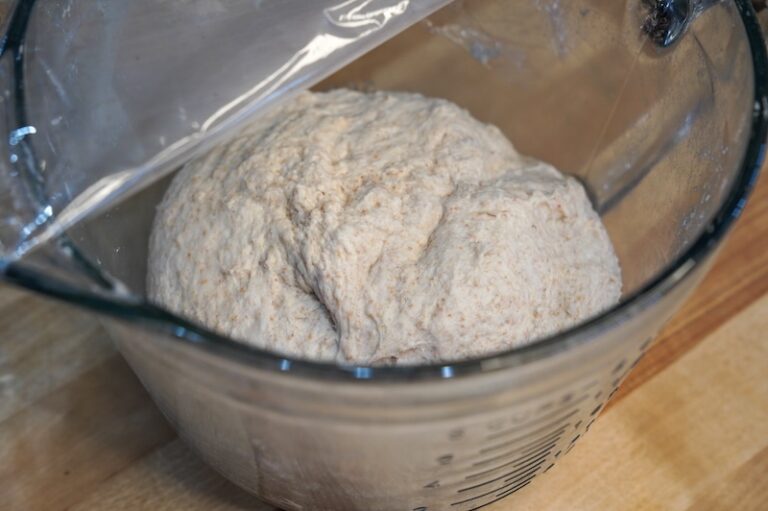
- Set your butter on the counter to soften for later.
- After 30 minutes, perform your first set of stretch and folds (or coil folds). Repeat this every 30 minutes for a total of 3-5 rounds, until the dough becomes smoother, holds its shape better, and stretches with a little resistance instead of feeling loose. If you’re unsure, aim for 4 rounds to be safe. Once finished, cover the dough and let it rest until bulk fermentation is complete.

- Bulk fermentation is done when the dough is visibly larger (the exact percentage rise is not as important as the other visual signs), with bubbles all around the sides and underneath the surface. The dough should jiggle like jello when you shake the bowl and feel light, airy, and puffy to the touch. It should be domed on the edges where the dough meets the bowl. Don’t worry about exact timing; trust these visual and tactile cues to guide you. Warmer dough ferments faster, colder dough takes longer, but slightly overproofed dough often makes better bread than underproofed. Don't be afraid to push the limits. For this recipe, my bulk fermentation took 8 hours at a 70°F (21°C) average temperature. Another test at 75°F (24°C) took just under 6 hours.
- When the bulk fermentation is done, lightly mist your work surface with water and dump out the dough. Gently stretch it into a 13" x 16" rectangle with the long side at the bottom.
Add the Filling, Shape, & Cold Retard
- In a small bowl, mix 57 g softened butter, 8 g cinnamon, 65 g brown sugar, and 16 g bread flour.

- Using a silicone spatula, spread half the cinnamon sugar mixture evenly down the center of the dough, leaving about 4 inches clear along each short side.

- Fold the dough’s sides to the center and pinch all the seams closed.

- Spread the rest of the cinnamon sugar filling evenly over the top, leaving about an inch on each side for sealing.
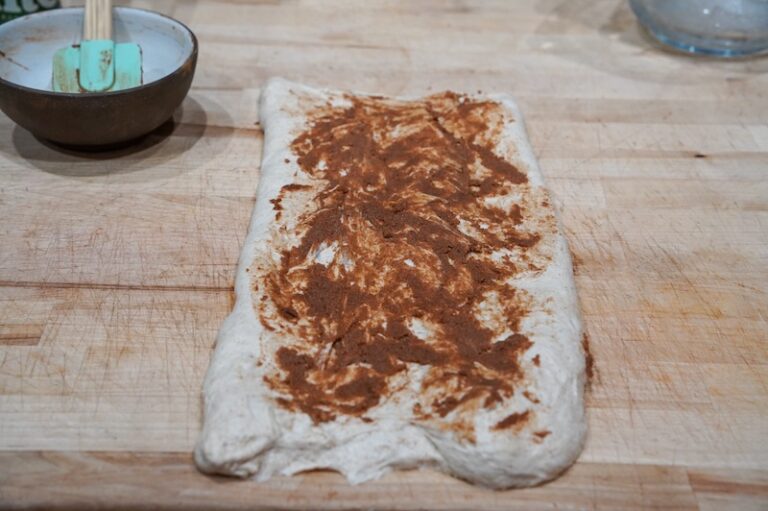
- Roll the dough tightly into a log, pinching the edges to seal as you roll. When you get to the end, gently pinch the seam to close it up.

- Place seam-side up into a floured, towel-lined banneton. Cover and refrigerate overnight (8 hours up to 4 days; overnight is best).

Score & Bake
- The next day (or after at least 8 hours in the fridge), preheat your oven to 450°F (230°C) with a Dutch oven or bread dome inside.
- Flip the dough onto parchment paper, score the top, and bake for 30 minutes covered and 10–15 minutes uncovered (watch closely to prevent burning).

- The bread is done when it reaches an internal temperature of 205–210°F (96–99°C).

Video
Notes
Bread Flour: A higher-protein bread flour (12.5–14%) gives the best results. I love Central Milling High Mountain (13.5%), Ballerina Farms Farm Flour (14%), or King Arthur Bread Flour (12.7%). If using a lower-protein flour like Costco All-Purpose (11.5%), reduce the water slightly or add 1 tbsp of vital wheat gluten to compensate. When in doubt, trust the dough — if it feels unusually stiff, add water a little at a time.
Whole Wheat Flour: If you prefer, you can use 500g of bread flour instead of the bread + whole wheat flour combo. No other adjustments to the recipe are needed!
Nutrition Facts: This is for the entire loaf. Divide by the number of slices you cut for the nutritional value of one slice. For example, if you cut 12 slices, divide all numbers by 12 (1 slice would be 227 calories).
Not sure when your starter has peaked? Check out: Is My Sourdough Starter Ready to Bake With? How I Can Tell
Nutrition Facts
Cinnamon Swirl Sourdough Bread Recipe
Serving Size
1 loaf
Amount per Serving
Calories
2734
% Daily Value*
Fat
57
g
88
%
Saturated Fat
31
g
194
%
Trans Fat
2
g
Polyunsaturated Fat
6
g
Monounsaturated Fat
13
g
Cholesterol
123
mg
41
%
Sodium
4273
mg
186
%
Potassium
974
mg
28
%
Carbohydrates
487
g
162
%
Fiber
26
g
108
%
Sugar
65
g
72
%
Protein
71
g
142
%
Vitamin A
1467
IU
29
%
Vitamin C
0.3
mg
0
%
Calcium
256
mg
26
%
Iron
9
mg
50
%
* Percent Daily Values are based on a 2000 calorie diet.
