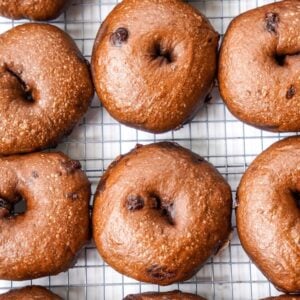
Double Chocolate Sourdough Bagels
INGREDIENTS
Feed Your Starter
- 15 g sourdough starter
- 75 g water
- 75 g bread flour
Bloom the Cocoa and Espresso
- 80 g steaming hot water
- 28 g Dutch-processed cocoa powder
- 1 tsp espresso powder optional
Main Dough
- 370 g water
- 150 g active starter that you made, from above
- 130 g brown sugar
- 10 g vanilla extract or vanilla paste
- 825 g bread flour 12.7–13.5% protein is ideal, See Notes
- 25 g non-diastatic malt powder optional
- 16 g sea salt
- 200 g mini semi-sweet chocolate chips or regular-sized
For the Boiling Water
- 2 tbsp brown sugar or honey or molasses
Equipment
- Stand mixer fitted with the dough hook; you can also knead by hand
- Half sheet pan or two quarter sheet pans
- Bread bag use code THATSOURDOUGHGAL for 15% off
Instructions
Day 1: Feed Your Starter & Mix Your Dough
- In the morning, feed your starter using a 1:5:5 ratio: 15 g sourdough starter, 75 g water, and 75 g bread flour. This recipe uses 150 g, so this leaves you with 15 g left to maintain your starter.
- Bloom the cocoa and espresso: About 30 minutes before you want to mix your dough in the evening, whisk together 80 g steaming hot water, 28 g Dutch-processed cocoa powder, and 1 tsp espresso powder (optional) in a small bowl. Once it has cooled to below 90°F (32°C), proceed to the next step.
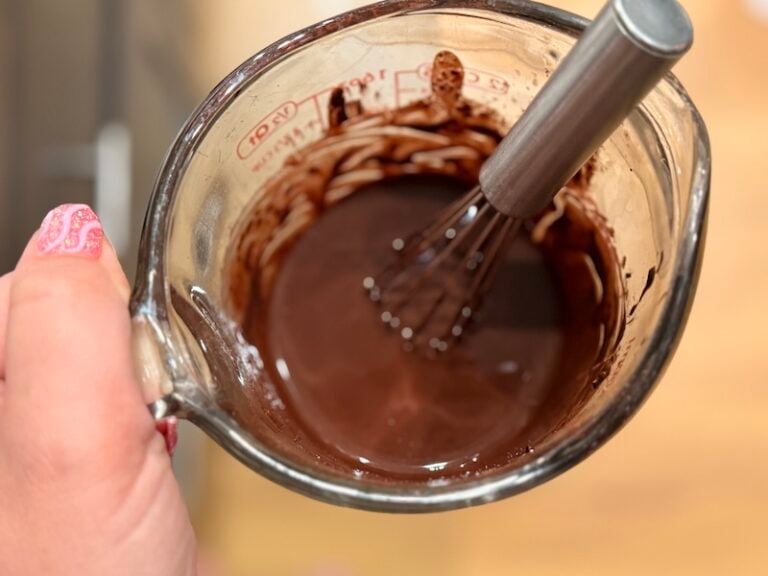
- To a stand mixer fitted with the dough hook, add all of the cooled cocoa and espresso mixture, 370 g water, 150 g active starter, 130 g brown sugar, 10 g vanilla extract, 825 g bread flour, 25 g non-diastatic malt powder (optional), 16 g sea salt, and 200 g mini semi-sweet chocolate chips.
- Stand mixer method: Mix on low speed for 7–10 minutes, or until the dough is smooth and has a stiff Play-Doh texture. If your mixer struggles, stop and let it rest for 10–20 minutes, then resume mixing.Hand mixing method: Combine all main dough ingredients in a large bowl and stir until it comes together. Turn out onto a clean counter and knead for 10–15 minutes until smooth and pliable. (It's a workout, but totally doable!)
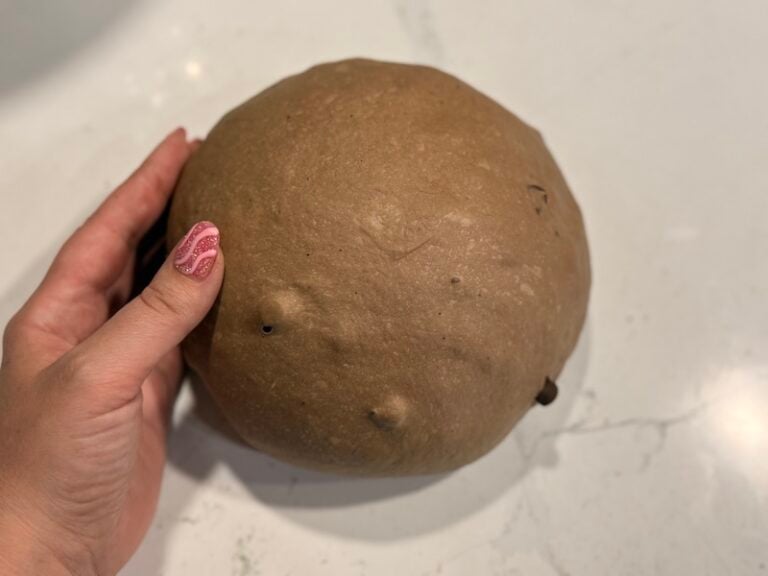
- Hydration adjustment: If your dough seems too dry, add 1 tbsp water at a time. If it's sticky, add 1 tbsp flour at a time.
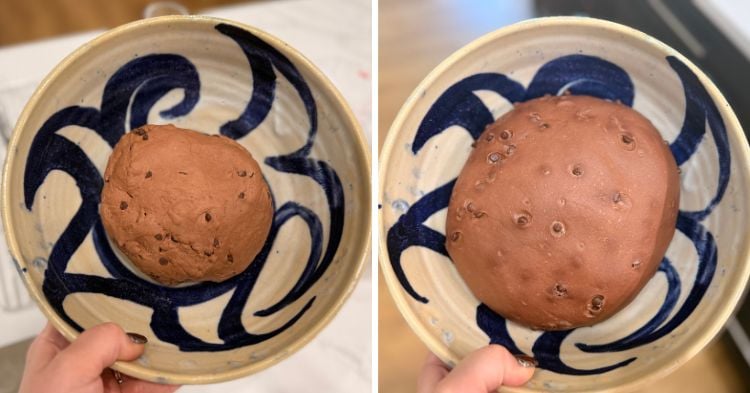
- Cover the dough and let it bulk ferment on the counter overnight, about 10–12 hours at 68–75°F (20–24°C). It should puff up nicely and roughly double in size.
Day 2: Shape, Boil, & Bake
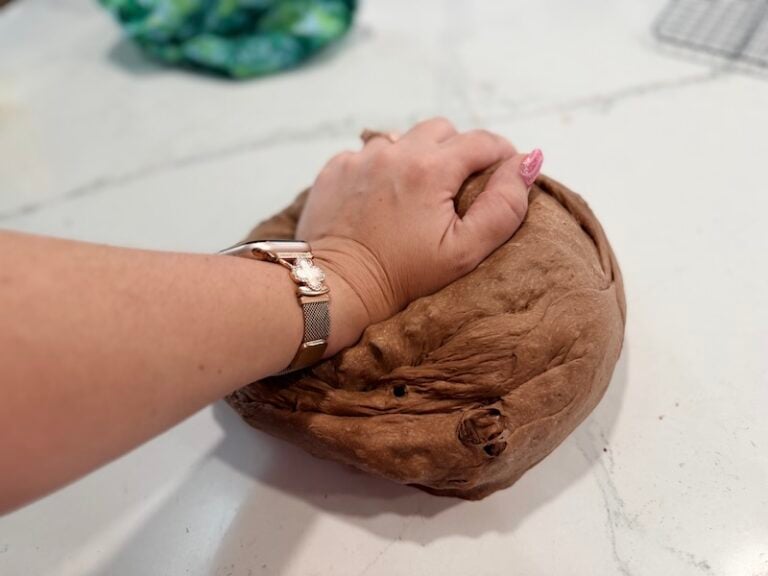
- The next morning, dump out your dough and give it a quick knead.
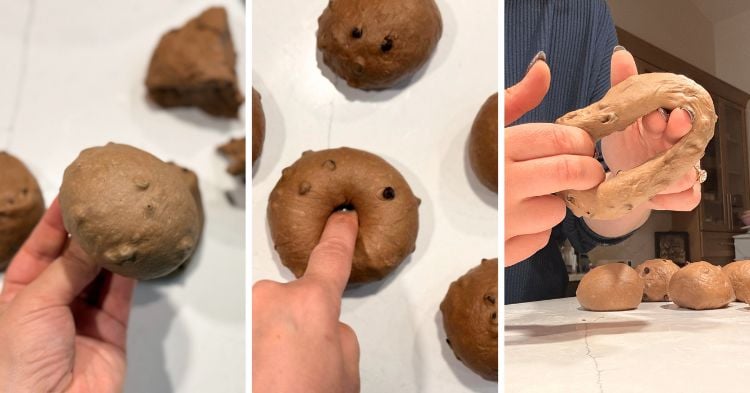
- Divide into 12 equal portions, about 150g each. Shape each portion into a smooth, taut ball. Then, poke a hole in the center of each ball and stretch it out using your fingers to form the bagel shape. Make the hole slightly larger than desired — it will fill in a bit during proofing. If any chocolate chips escape, just pinch them back in. Place on individual parchment squares.
- Optional pause point: You can refrigerate the shaped bagels here for a few hours up to 2–3 days. When ready to continue, remove from fridge and proceed with the second proof at room temperature or in a proofing box until puffy.
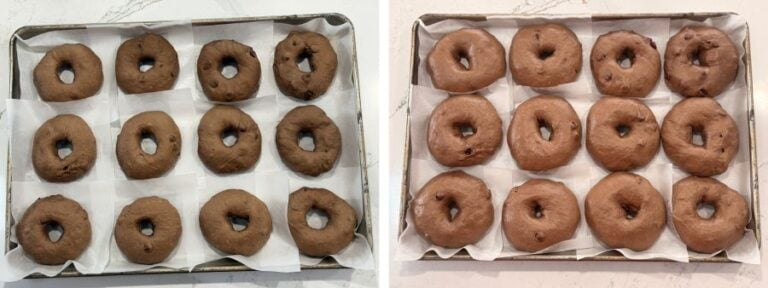
- Cover the bagels (so they don't dry out) and let them proof for 5–6 hours at room temperature, or use a proofing box at 80°F (26°C) to speed things up. They should puff up and feel very airy when gently touched. If you pick one up, it should feel very light in the hand.
- Preheat your oven to 425°F (220°C) convection, or 450°F (230°C) conventional. Bring a large pot of water (about 4 quarts) to a boil, then add 2 tbsp brown sugar.
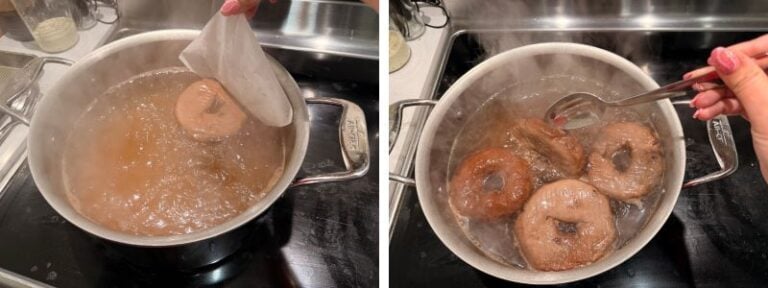
- Drop bagels into the boiling water still on their parchment squares — the parchment will release on its own, so just peel it off and set it aside to reuse. Boil 4 at a time for 20–30 seconds per side, flipping with a slotted spoon. (A smaller pot works fine, too — just boil 2 at a time.)
- Remove boiled bagels and place them back on your parchment-lined sheet tray. Optional: lightly spritz the parchment with cooking oil if concerned about sticking — I've never needed to, but some bakers prefer this.
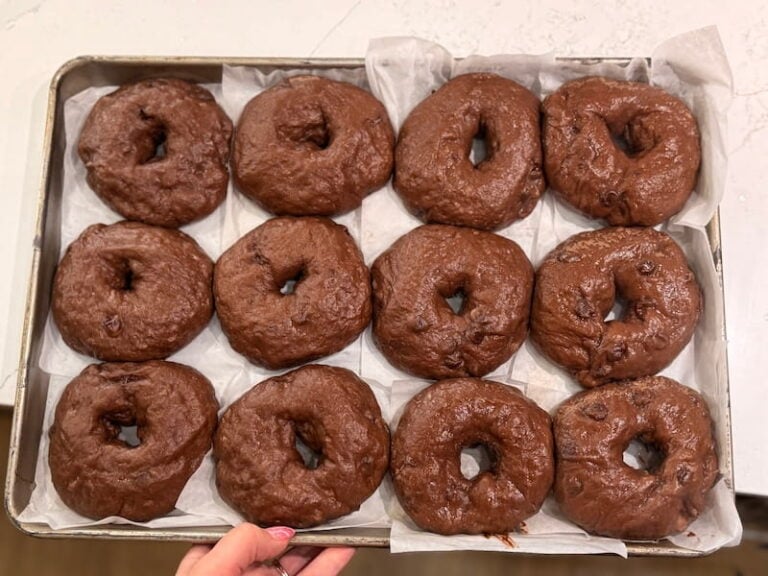
- Bake for 15–20 minutes until the internal temperature reaches 205°F (96°C) or higher.
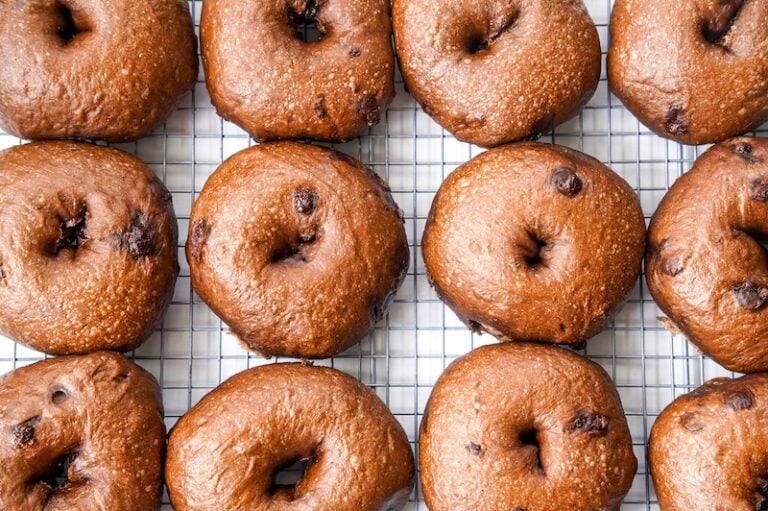
- Let cool on a wire rack for at least 30 minutes before enjoying (or 1–2 hours for best results).
Video
Notes
- Warm homes (above 75°F/24°C): If your kitchen is warmer than 75°F (24°C), skip the overnight fermentation and flip the timeline instead. Mix your dough in the morning, monitor the bulk fermentation throughout the day (watching for it to double), then shape and proof in the afternoon/evening. This prevents overproofing.
- Bread flour: Bread flour works best for bagels — its higher protein content gives them a nice chewiness. I've tested this recipe with King Arthur unbleached bread flour (12.7% protein) and Central Milling High Mountain bread flour (13.5% protein). If you use a lower-protein flour, such as Kirkland all-purpose flour from Costco (11.5% protein), add 1 tbsp of vital wheat gluten to help it perform like a higher-protein flour, or decrease the water in the dough slightly.
- Non-diastatic malt powder: This is optional but highly recommended — it keeps bagels soft for days and enhances flavor and browning. If you only have diastatic malt powder (or non-diastatic is out of stock, which is the case at the time of this writing), toast it at 325°F (160°C) for 5 minutes first to deactivate the enzymes. Those enzymes would speed up the fermentation, which is not ideal for an overnight fermentation recipe.
- Flexible timeline/long-ferment option: You can refrigerate shaped bagels for a few hours up to 2–3 days, then complete the second proof before boiling and baking.
Nutrition Facts
Double Chocolate Sourdough Bagels
Serving Size
1 bagel
Amount per Serving
Calories
427
% Daily Value*
Fat
8
g
12
%
Saturated Fat
4
g
25
%
Trans Fat
0.01
g
Polyunsaturated Fat
1
g
Monounsaturated Fat
2
g
Cholesterol
2
mg
1
%
Sodium
532
mg
23
%
Potassium
237
mg
7
%
Carbohydrates
78
g
26
%
Fiber
4
g
17
%
Sugar
19
g
21
%
Protein
11
g
22
%
Vitamin A
15
IU
0
%
Vitamin C
0.1
mg
0
%
Calcium
41
mg
4
%
Iron
2
mg
11
%
* Percent Daily Values are based on a 2000 calorie diet.
