Soft Sourdough Pretzels
INGREDIENTS
Feed Your Starter
- 10 g sourdough starter healthy; ideally, fed within the last 24 hours
- 50 g water
- 50 g bread flour
Pretzel Dough
- 245 g water
- 95 g active sourdough starter that you made, from above
- 10 g sugar
- 25 g unsalted butter softened or melted and cooled
- 510 g high-protein bread flour see Recipe Notes
- 15 g non-diastatic malt powder optional
- 11 g sea salt
For Boiling
- 6 cups water
- 1/2 cup baking soda
After Boiling, Before Baking
- 2 tbsp unsalted butter melted
- pretzel salt shake on pretzels to taste
Before You Begin

This recipe yields 6 large soft pretzels, but about 32% of recipe testers felt they were too big. If you prefer a smaller pretzel, divide your dough into 8 pieces at about 100–110g each instead.Note: This recipe was developed and is written in metric (grams). Volume measurements (cups & spoons) are automatically converted and untested — use at your own risk. For best results, use a kitchen scale.
Equipment
- Stand mixer with the dough hook (or you can knead by hand)
Instructions
- Feed your starter: In the morning, in a medium glass jar, stir together 10 g sourdough starter and 50 g water. Mix in 50 g bread flour until smooth. Loosely cover and let ferment all day, 10–12 hours at 68–75°F (20–24°C).
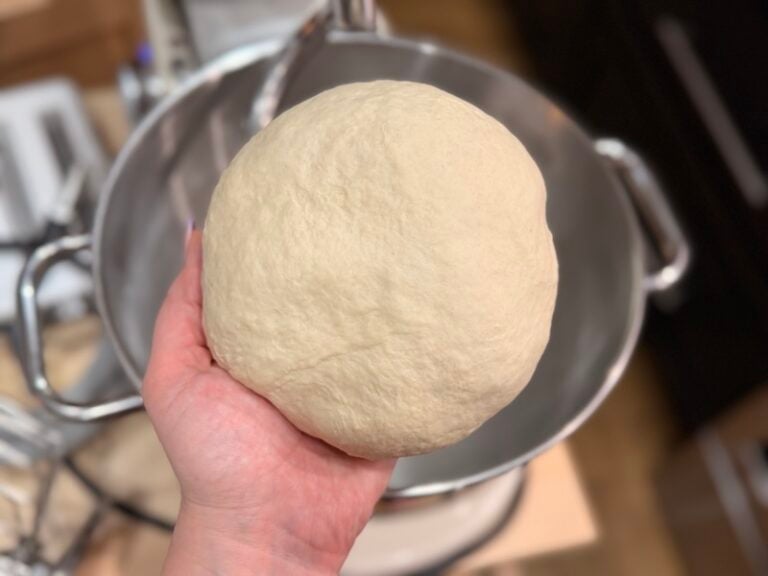
- Mix the dough (before bed): In the bowl of a stand mixer fitted with the dough hook, combine 245 g water, 95 g active sourdough starter (that you made earlier), 10 g sugar, and 25 g unsalted butter (softened or melted and cooled). Add 510 g high-protein bread flour, 15 g non-diastatic malt powder, and 11 g sea salt. Mix on low speed (usually Speed 1) until no dry flour remains, about 2 minutes. Increase the speed slightly (usually Speed 2) and knead 6–8 minutes, or until smooth. The texture of this dough is just like bagel dough, which is firm and smooth yet pliable — not sticky or tacky.To mix by hand: combine all of the pretzel dough ingredients in a large bowl. Once you have a rough dough ball, turn it out onto a clean, unfloured counter and knead 10–12 minutes, or until smooth.
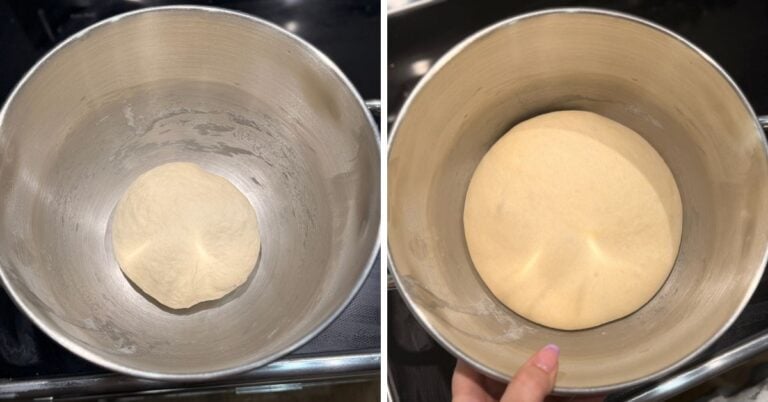
- Bulk ferment: Transfer dough to a large mixing bowl and cover. Let ferment on the counter overnight, 8–12 hours at 68–75°F (20–24°C). In the morning, the dough should be roughly doubled to tripled in size (there is flexibility here).
- Divide and shape: Turn dough out onto a clean, unfloured surface. Divide into 6 equal pieces, about 150 g each.
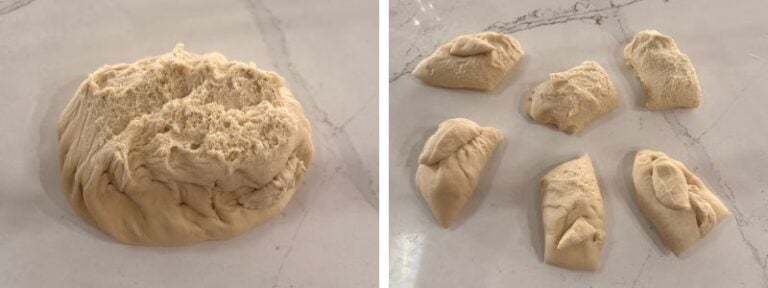
- Working one piece at a time, roll each piece into a cylinder about 6 inches long and pinch the seams on each end.
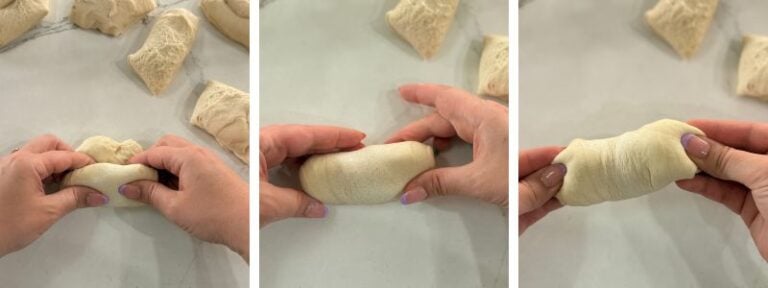
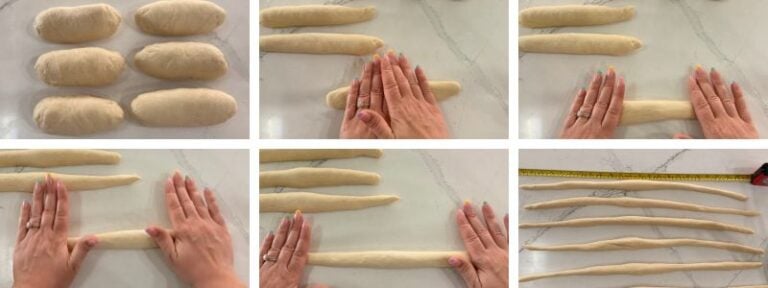
- Using your palms, roll each cylinder into a rope, keeping the center slightly thicker than the ends. The gluten will tighten quickly — roll each rope as far as it'll go, then move to the next one. Rotate through all the pieces, rolling a little further each time, until all ropes reach 24 inches long.
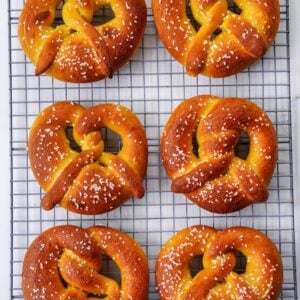
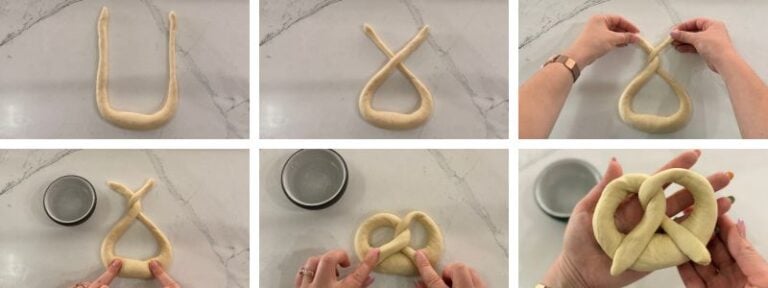
- Shape into a pretzel: form a U shape, cross the two ends over each other twice to create a twist, then fold the twisted ends down onto the bottom curve. Place a small drop of water where the dough meets the bottom curve, then press firmly to seal.
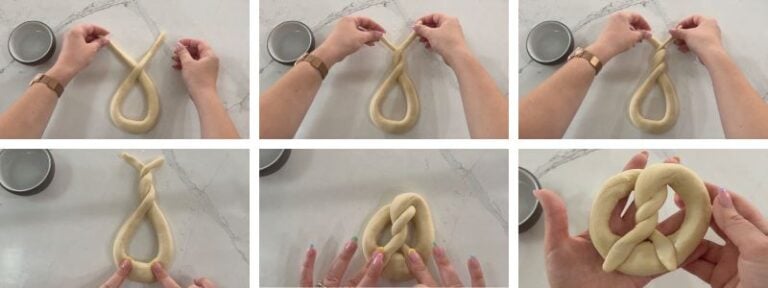
- Optional extra twist: Twist the ends an extra time before folding them down for a more traditional pretzel shape.
- Second proof: Place each shaped pretzel on its own small square of parchment paper. Set on a half sheet tray. Cover loosely and let rise on the counter until the pretzels are about 50% larger and feel puffed up, which takes about 3–6 hours.
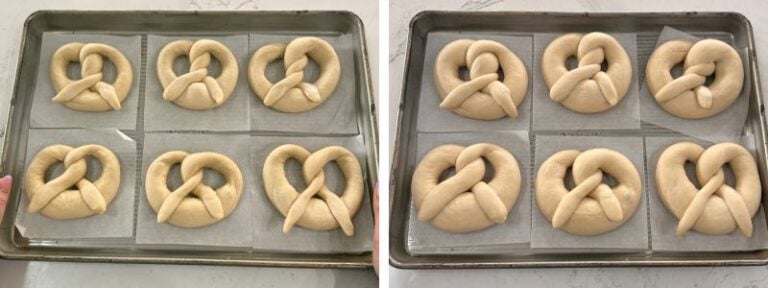
- Optional cold proof: For a deeper sourdough flavor, improved handling during boiling, and potentially better digestion, refrigerate the shaped pretzels for 12–36 hours. You can do this before or after the second proof — just make sure the pretzels are fully puffed up before you boil them.
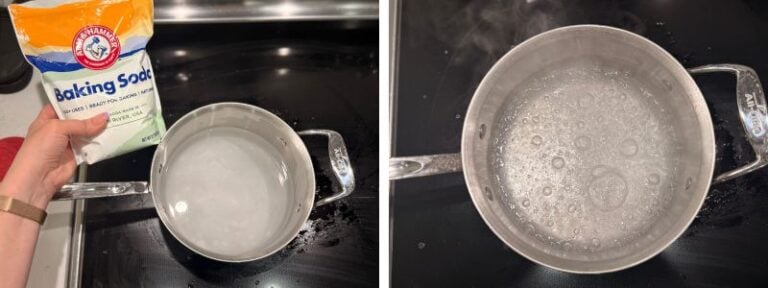
- Preheat and prep the boiling water: When ready to bake, position one oven rack in the center and one at the very top. Preheat oven to 450°F (230°C) convection or 475°F (245°C) conventional. In a 4-quart saucepan, combine 6 cups water and 1/2 cup baking soda before turning on the heat (adding baking soda to already-boiling water will cause it to foam up and overflow). Bring to a boil over medium-high heat.
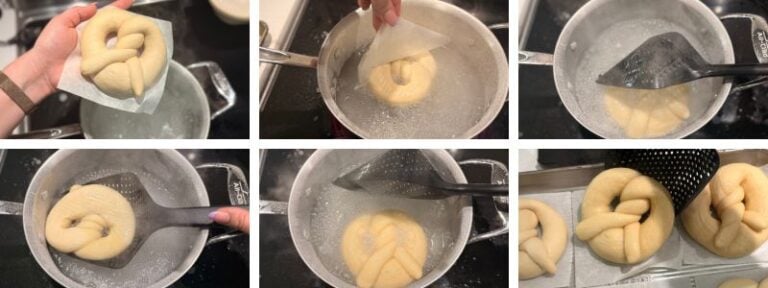
- Boil the pretzels: Working one at a time, lower each pretzel into the baking soda water using the parchment to help transfer it — peel away the parchment once the pretzel is in the water. Boil 30 seconds total, flipping once at 15 seconds. Remove with a slotted spoon and hold it over the pot for a few seconds to let the excess water drip off before placing on the parchment-lined sheet tray.
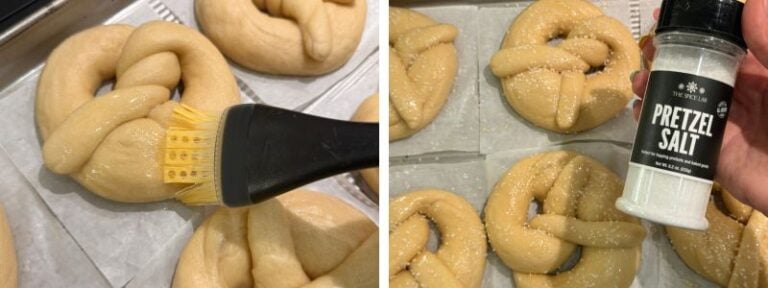
- Top the pretzels: Brush all of the boiled pretzels with 2 tbsp unsalted butter (melted). Sprinkle with pretzel salt to taste.
- Bake: Place the sheet tray on the center rack and bake 10–13 minutes. Move the pan to the top rack and bake an additional 1–2 minutes, or until pretzels are a deep mahogany brown — watch closely, as they can burn. Total bake time: 11–15 minutes.
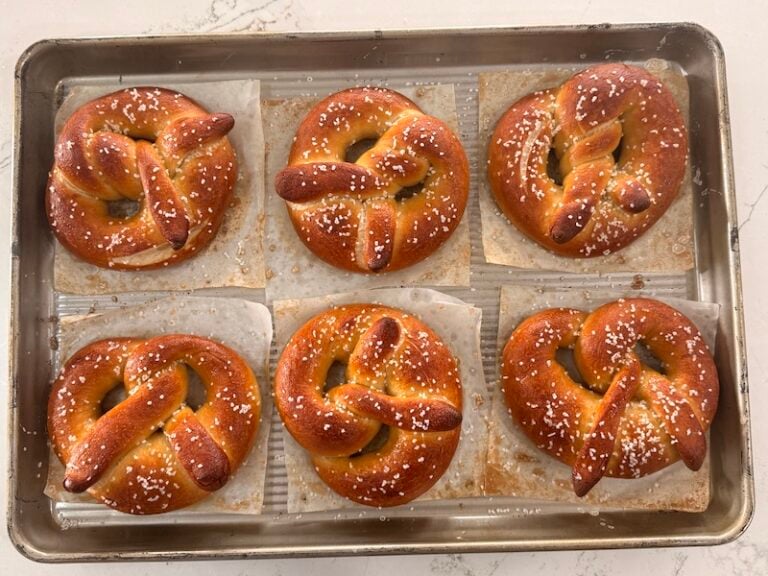
- Serve warm, ideally within the first hour of baking. Pairs well with mustard or a warm cheese dipping sauce.Pretzels are best the day they are baked. Store leftovers in an airtight container at room temperature for up to 5 days. To freeze, cool completely, then wrap individually and freeze for up to 3 months. Reheat in a 350°F (175°C) oven for 5–8 minutes.
Video
Notes
- Bread flour: Bread flour works best for pretzels — its higher protein content gives them a nice chewiness. I’ve tested this recipe with Central Milling High Mountain bread flour (13.5% protein). Another great option is King Arthur unbleached bread flour (12.7% protein). If you use a lower-protein flour, such as Kirkland all-purpose flour from Costco (11.5% protein), add 1 tbsp of vital wheat gluten to help it perform like a higher-protein flour, or decrease the water in the dough by about 10–15 g.
- Non-diastatic malt powder: This is optional but highly recommended — it keeps the pretzels soft for days and enhances flavor and browning. If you only have diastatic malt powder (or non-diastatic is out of stock), toast it at 325°F (160°C) for 5 minutes first to deactivate the enzymes. Those enzymes would speed up the fermentation, which is not ideal for an overnight fermentation recipe.
Nutrition Facts
Soft Sourdough Pretzels
Serving Size
1 pretzel
Amount per Serving
Calories
401
% Daily Value*
Fat
7
g
11
%
Saturated Fat
4
g
25
%
Trans Fat
0.2
g
Polyunsaturated Fat
1
g
Monounsaturated Fat
2
g
Cholesterol
15
mg
5
%
Sodium
723
mg
31
%
Potassium
114
mg
3
%
Carbohydrates
71
g
24
%
Fiber
2
g
8
%
Sugar
3
g
3
%
Protein
12
g
24
%
Vitamin A
171
IU
3
%
Vitamin C
0.1
mg
0
%
Calcium
23
mg
2
%
Iron
1
mg
6
%
* Percent Daily Values are based on a 2000 calorie diet.
