
50% Einkorn Sourdough Bread Recipe
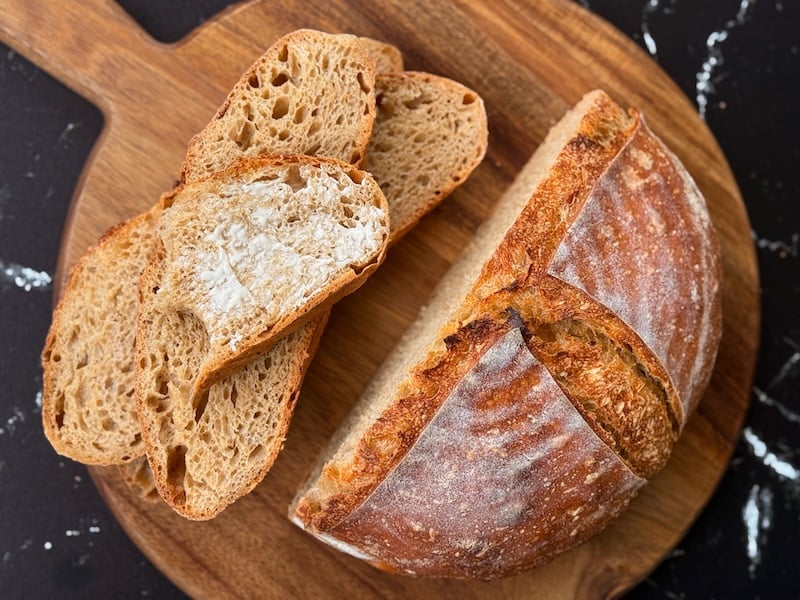
My inbox has been full of one request for months: Can you please develop a recipe using einkorn? Right behind it is another: I tried baking with einkorn, and my loaf came out completely flat and dense. Help.
Health-conscious bakers want to use ancient grains — einkorn in particular — and they keep ending up with a dense, flat result.
Einkorn is tricky. It has significantly less gluten than modern bread flour, which means it can’t hold as much gas during fermentation. Push too far — too much einkorn, too much fermentation, too much hydration — and the whole loaf can deflate.
I found the sweet spot in a half einkorn and half bread flour loaf — and 190 home bakers helped confirm it. You get all that ancient grain character and nutrition without sacrificing the soft, squishy interior that makes a loaf worth eating.
“Delicious bread with a soft interior, a tender crust, and a flavour that took me back to childhood, to a bread my grandmother used to make.” –Recipe tester from Ourique, Southern Portugal
Disclaimer: Some of the products I recommend in this post are affiliate links – if you choose to purchase after clicking one of my links, I may earn a small commission, which helps fund this website, recipe development, and monthly giveaways. I sincerely appreciate your support.
Why You’ll Love This Einkorn Sourdough Bread
- It finally makes einkorn approachable: With the right ratio, hydration, and technique, einkorn is absolutely workable. Dozens of testers who had struggled with it before or felt too intimidated to try ended up with a beautiful loaf on the first attempt.
“I had been afraid to try einkorn in my sourdough baking, but it turned out delicious and fluffy! My husband kept raving about it, too!” –Recipe tester from Columbia, SC
- Fast bulk fermentation: one of the most consistent pieces of tester feedback was how much faster this dough moves than a standard artisan loaf. At 71–73°F (22–23°C), most testers finished bulk fermentation in 5.5–6.5 hours, which means this can comfortably be made in a single day.
“Fast bread from start to finish with minimal effort.” –Recipe tester from Arizona
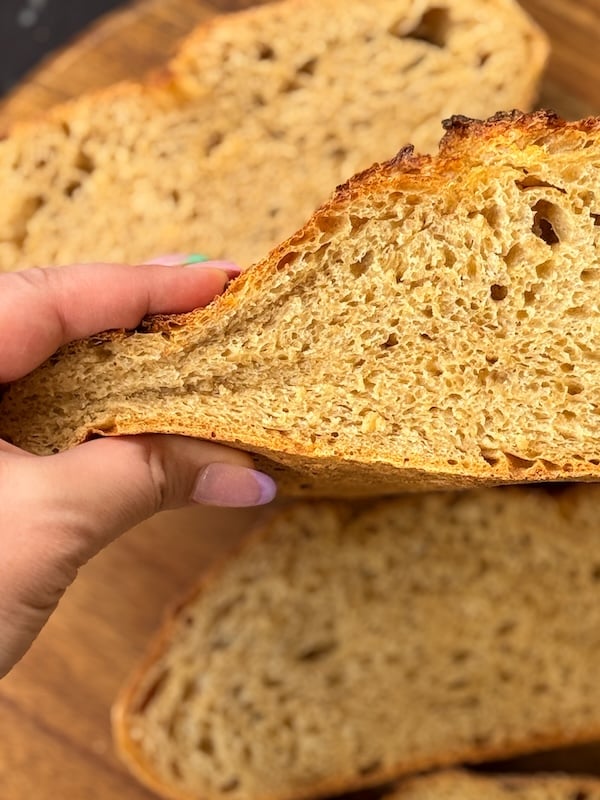
- A soft, pillowy crumb: einkorn produces a noticeably tender interior. Several testers described it as almost sandwich-bread soft, but with the crust and character of an artisan loaf. Perfect sliced thick with salted butter or used for sandwiches.
“Richer flavor and softer crust than normal sourdough loaf.” –Recipe tester from Delaware
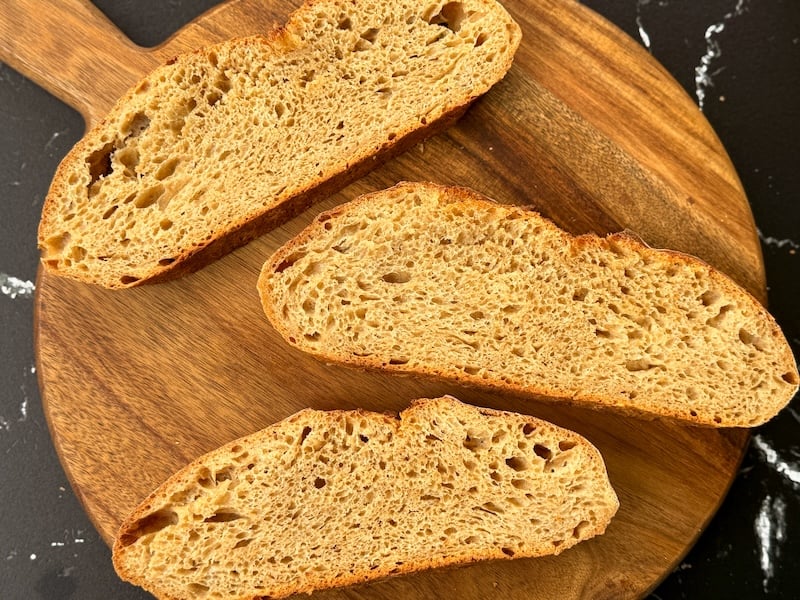
- A flavor all its own: einkorn brings a distinctive nuttiness and natural sweetness that modern wheat just doesn’t have. It also tends to amplify the tang of sourdough, so if you love a pronounced sour note, this loaf delivers.
“It is deliciously rich and nutty. My favorite recipe so far…” –Recipe tester from Annapolis, MD
“Einkorn flour adds an incredible depth of flavor to traditional sourdough without taking away from the texture.” –Recipe tester from Conneaut, OH
- Dead simple ingredients: No oil. No sugar. No add-ins. Just flour, water, salt, and your starter.
- Tested by 190 home bakers: from Connecticut to California, Canada to Puerto Rico. Among testers using whole wheat einkorn rather than AP einkorn, the average rating was 4.62 out of 5. More on the full breakdown below.
Another bread recipe you might like: Hint of Rye Artisan Sourdough Bread (Our Family’s Staple Recipe)
The Recipe Testing Journey
This recipe came together fast! My first test was at 40% einkorn. The loaf was lofty and tall with great oven spring — classic artisan structure. But I wanted to see if I could push it a little further.
For my second test, I went up to 50%. The loaf wasn’t quite as tall — the extra einkorn means less gluten structure and a slightly lower rise — but the flavor was nuttier and richer, and the added nutrition is a big bonus.
After these two rounds of personal testing, I sent it to testers. Their feedback confirmed the recipe was solid — and also surfaced the single most important variable I hadn’t anticipated.
The big discovery: AP einkorn vs. whole wheat einkorn matters enormously.
All-Purpose vs Whole Wheat Einkorn Flour
When I developed this recipe, I used whole wheat einkorn flour from Central Milling.
I then started getting messages from recipe testers: Wait, should I buy the bag that says whole wheat einkorn or AP einkorn? I was curious to see how both flour types would perform, and that turned out to be the most revealing part of the whole testing process.
Whole wheat einkorn absorbs significantly more water than AP einkorn. At 350g of water — the amount in this recipe — AP einkorn produces a very slack dough that’s difficult to shape.
Most AP einkorn testers who reduced their water by 25–50g ended up with a much more workable dough. The ones who didn’t know to reduce it — understandably — had a harder time.
This is now addressed clearly in the Substitutions section. If you’re using AP einkorn, please read that before you mix your dough.
God bless the recipe testers!!
Meet the Recipe Testers
190 home bakers tested this recipe, and I asked for feedback from testers using different types of einkorn flour — whole wheat, AP, and freshly milled — so I could see how each type performs.
Here’s how the ratings broke down by flour type:
- Overall average (all 190 testers): 4.55 out of 5
- Whole wheat einkorn users: 4.62 out of 5
- AP einkorn users: 4.24 out of 5
- Freshly milled einkorn users: 4.84 out of 5
The gap between whole wheat and AP testers isn’t a mystery — it’s almost entirely explained by the hydration difference covered in the Substitutions section. AP einkorn simply can’t absorb as much water, and testers who didn’t know to reduce the water struggled with a slack, sticky dough.
The freshly milled crowd, meanwhile, was the happiest group of all — likely because bakers who mill their own grain tend to have more experience working with whole-grain, higher-hydration doughs.
“If you want a rustic sourdough bread that is super soft and nutty, this recipe is for you — 10/10!” –Recipe tester from Lansing, MI
Here’s a compilation of photo submissions from a few of the recipe testers:
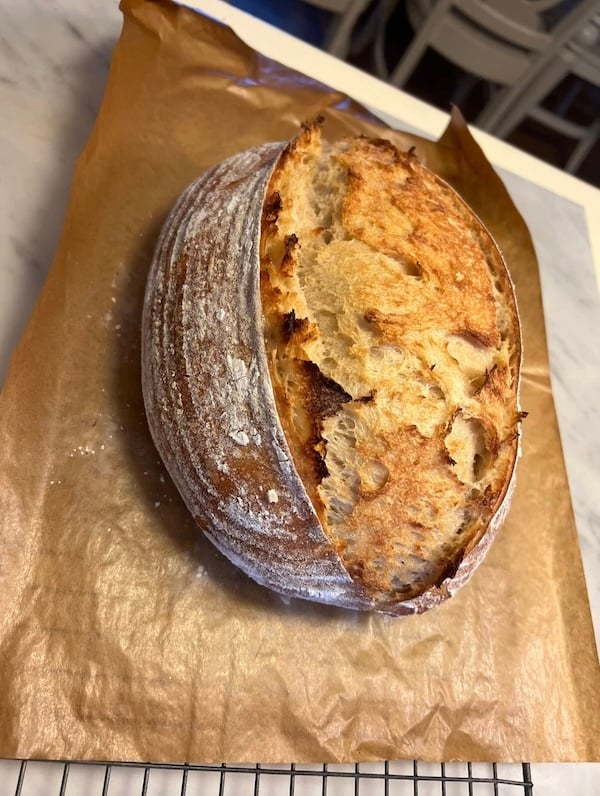
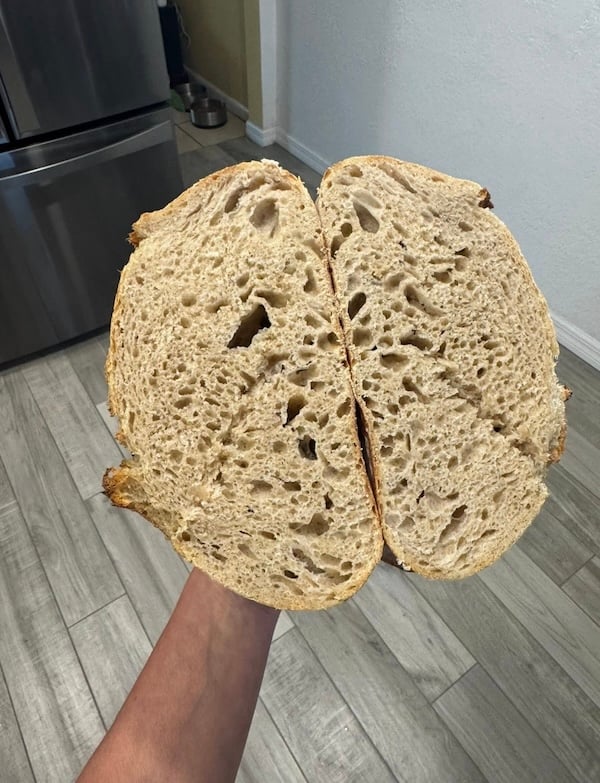
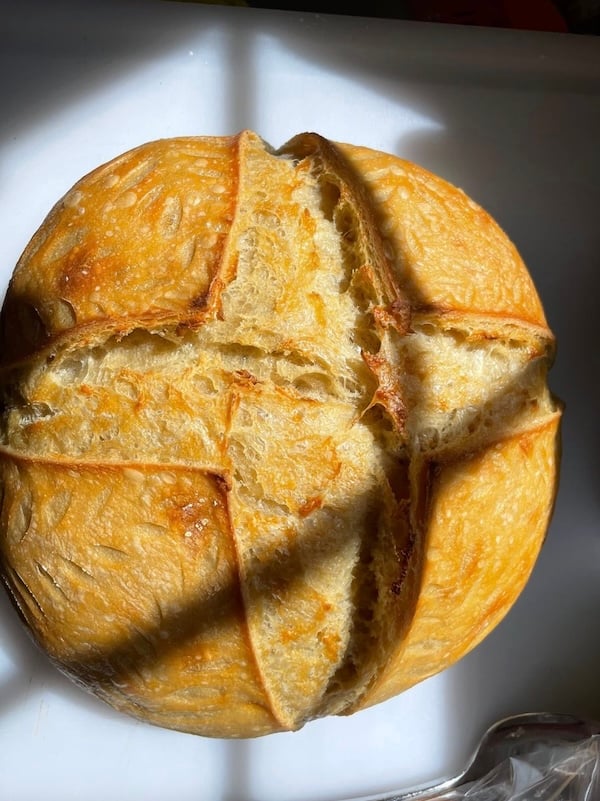
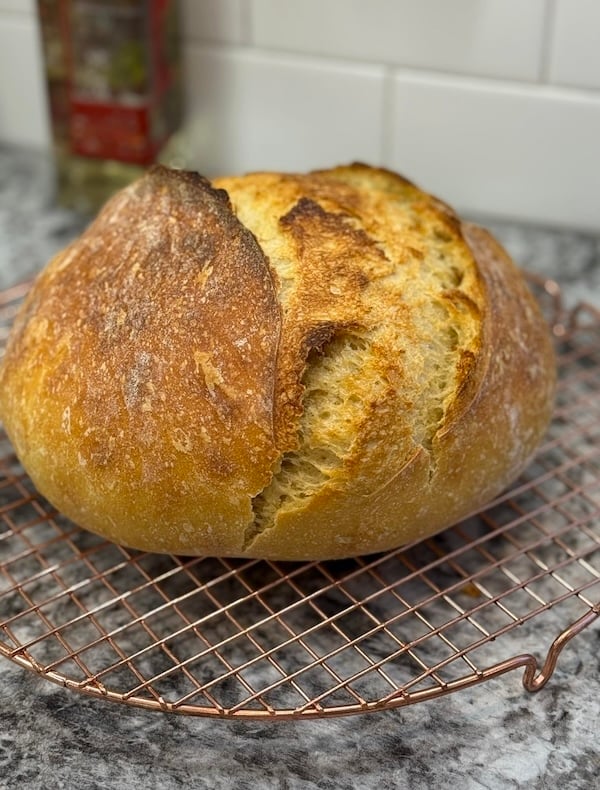
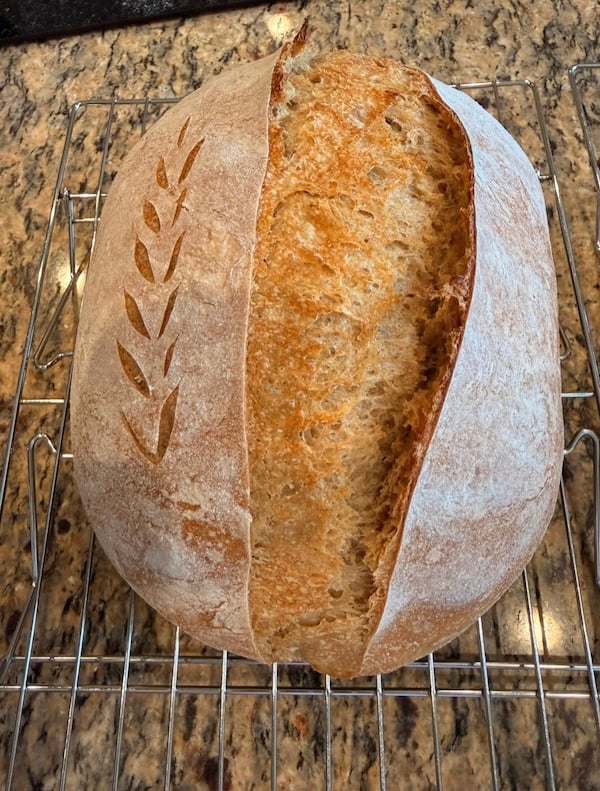
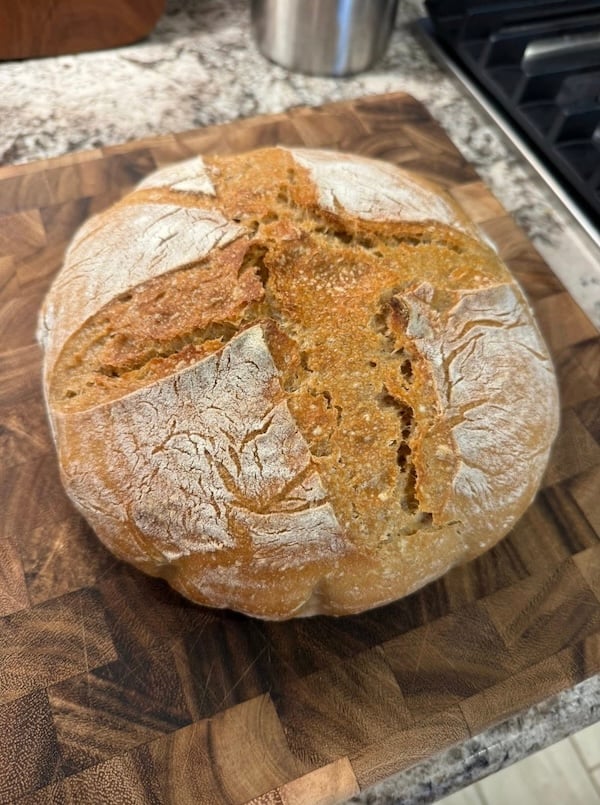
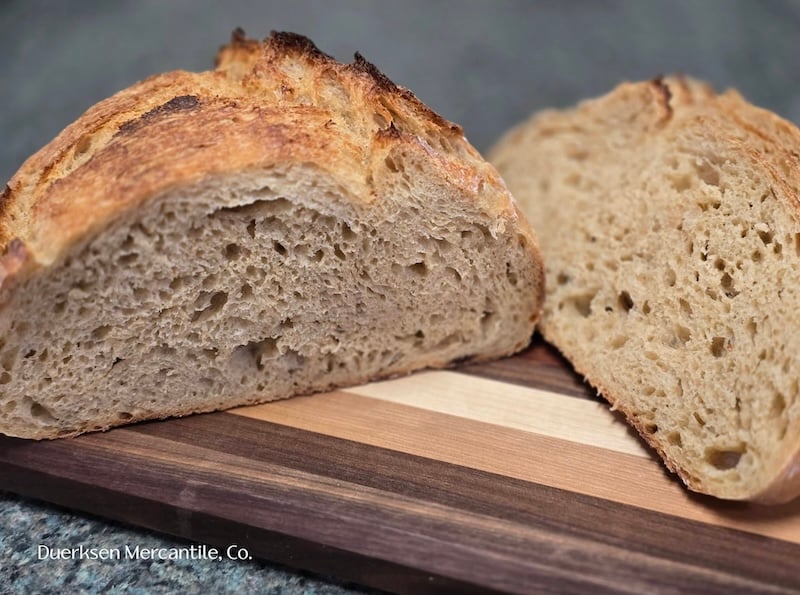
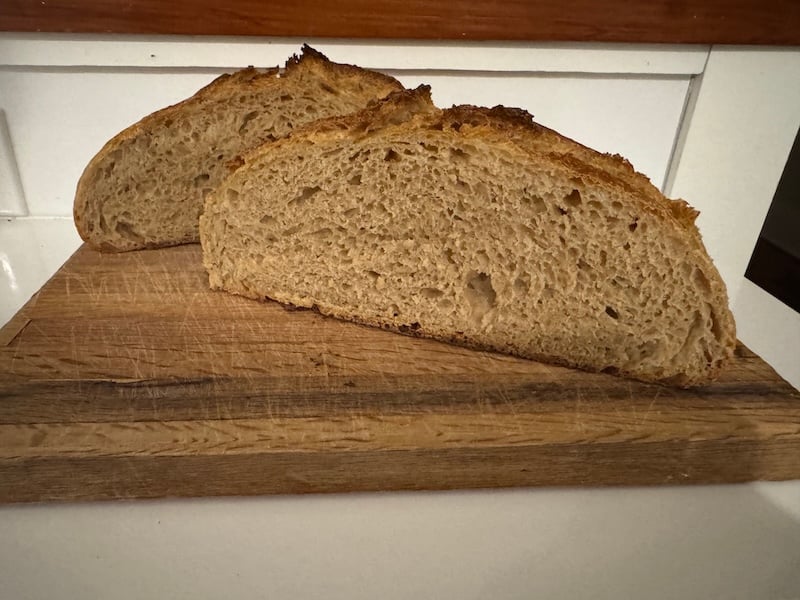
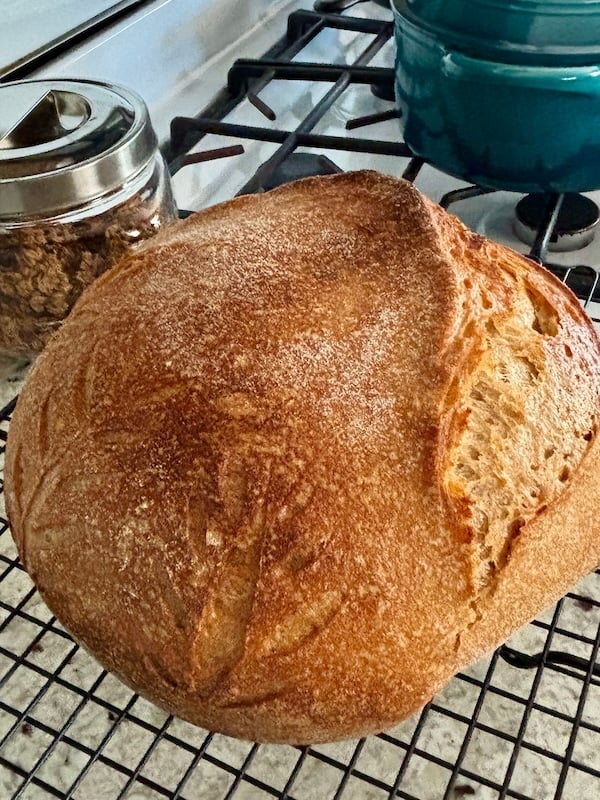
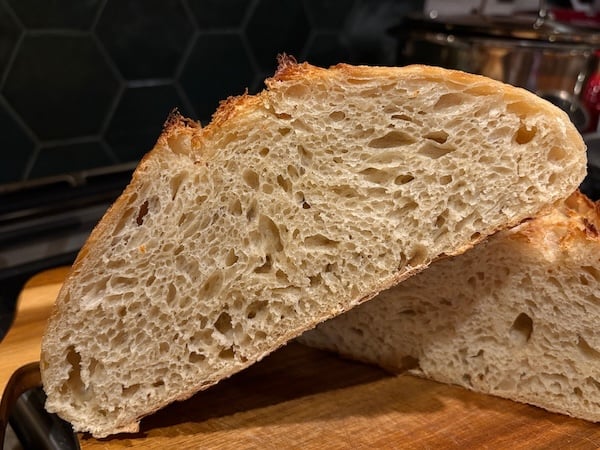
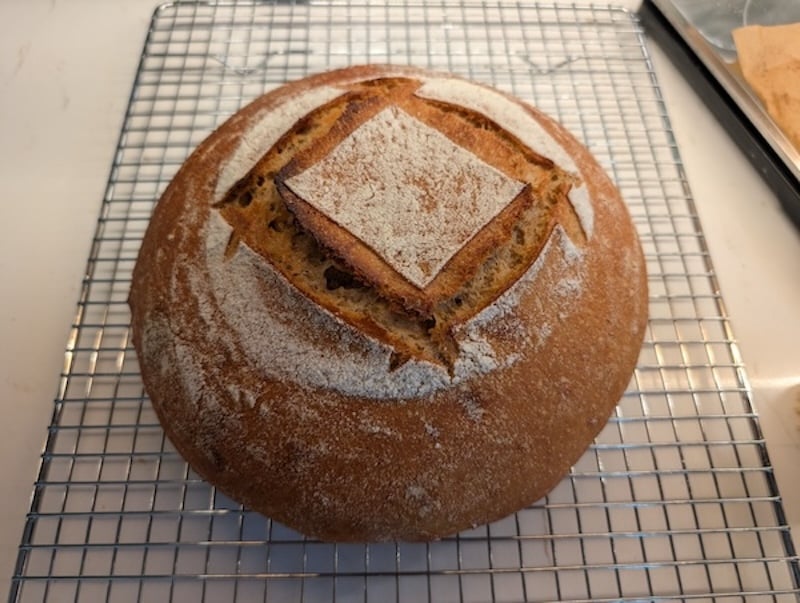
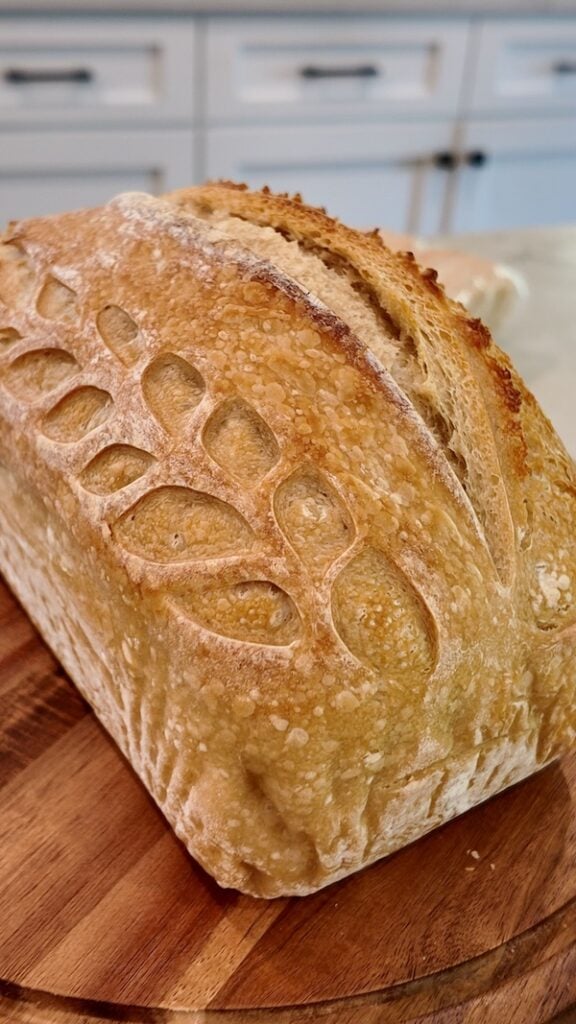
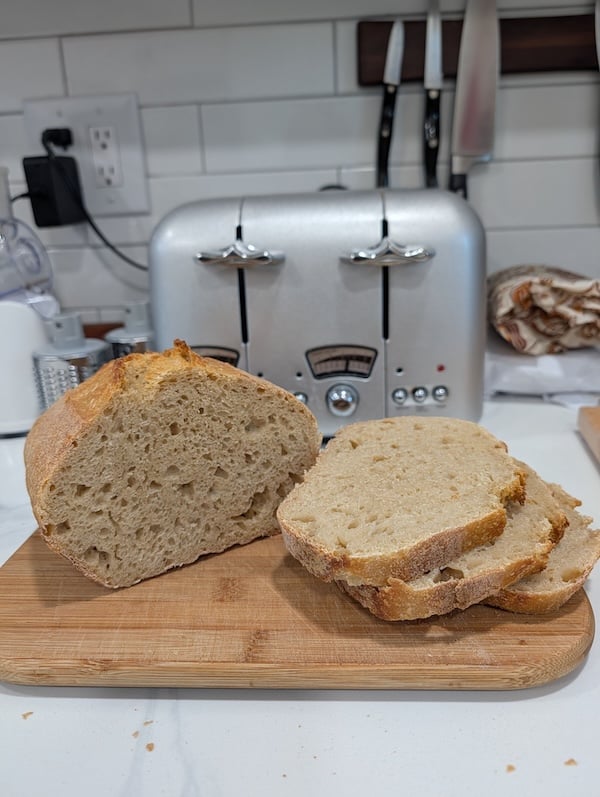
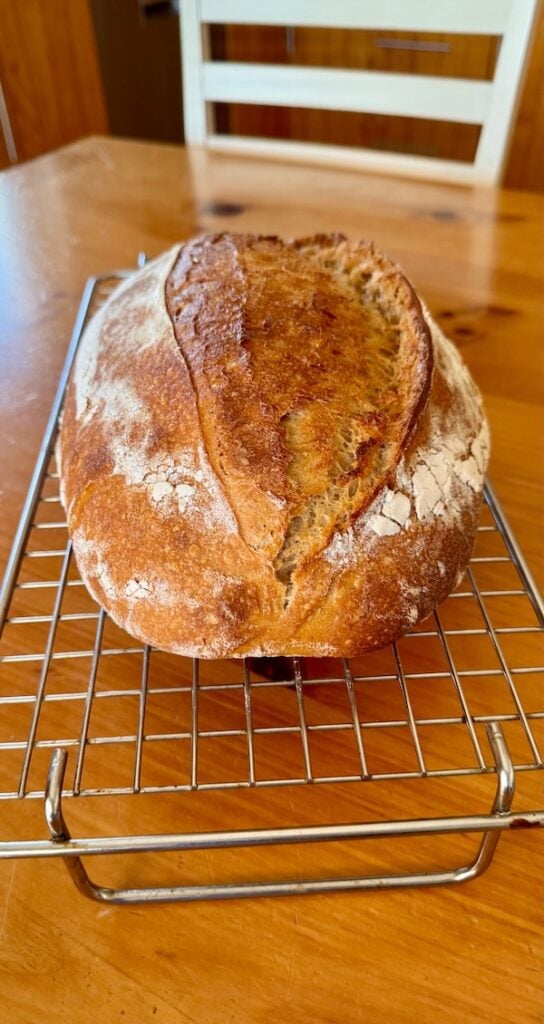
“I love einkorn and never thought to do 50% because 100% is just too dense for me. This was the best of both worlds — light and fluffy with the taste and benefits of einkorn.” –Recipe tester from Susanville, CA
Baker’s Timeline
These times are based on a dough temperature of around 73°F (23°C). Warmer kitchens will move faster; cooler kitchens will move slower.
Rely on visual cues more than the clock — this dough ferments quite a bit faster than a standard bread flour loaf.
| Day 1 | |
| Evening | Feed your starter. Cover and leave on the counter overnight (10–12 hours). |
| Day 2 | |
| 8 AM | Mix the dough. Rest 30–40 minutes. |
| 8:40 AM | Coil fold #1 |
| 9:10 AM | Coil fold #2 |
| 9:40 AM | Coil fold #3 |
| 10:10 AM | Coil fold #4 |
| 10:10 AM – around 2 PM | Finish bulk fermentation (~5.5 hours total from initial mix at 73°F/23°C). |
| Around 2 PM | Pre-shape, rest 10 minutes, final shape, into the banneton, refrigerate. |
| Day 3 | |
| Morning | Score and bake. |
Here is an alternative timeline if you want to feed your starter in the morning – you’ll want to adjust the feeding ratio to 1:1:1 (instead of 1:5:5), so it peaks faster!
| Day 1 | |
| 8 AM | Feed your starter, but use 57g starter, 57g water, and 57g bread flour. Cover and leave on the counter until peaked – about 4–6 hours. |
| 1 PM | Mix the dough. Rest 30–40 minutes. |
| 1:40 PM | Coil fold #1 |
| 2:10 PM | Coil fold #2 |
| 2:40 PM | Coil fold #3 |
| 3:10 PM | Coil fold #4 |
| 3:10 PM – around 6:30 PM | Finish bulk fermentation (~5.5 hours total from initial mix at 73°F/23°C). |
| Around 6:30 PM | Pre-shape, rest 10 minutes, final shape, into the banneton, refrigerate. |
| Day 2 | |
| Morning | Score and bake. |
Equipment You’ll Need
- Kitchen scale: Essential for sourdough baking — gram measurements give you consistent results every time.
- 3/4 L Weck jar: My favorite vessel for feeding my starter. The straight sides make it easy to see how much it has risen.
- The Tovolo spatula is my go-to for feeding my starter. I have three of them, and the large size is the best.
- Large mixing bowl: I love a large glass or ceramic bowl — the wide opening makes coil folds easy and if it’s glass, you can see the dough activity through the sides.
- Danish dough whisk: Makes the initial mix much easier than a spoon or spatula. The Brod & Taylor one is my favorite — it’s dishwasher safe with a grippy handle.
- Bowl scraper: Great for scraping down the sides of the bowl after mixing.
- Bowl cover: I’m a huge fan of the bowl covers from Doe a Deer — they keep the dough from drying out and wash up beautifully. Use code THATSOURDOUGHGAL for 15% off.
- Bench scraper: Used for pre-shaping and final shaping. A good bench scraper makes a real difference with a sticky dough like this one.
- Banneton: I’m partial to wood pulp or sugarcane & bamboo bannetons because they wick away just enough moisture to create a crisp crust. The medium round from Flourside works great for this recipe, and code TSG5 gets you 5% off. I also adore the bannetons from Brod & Taylor.
- Bread lame: For scoring the loaf before it goes into the oven.
- Parchment paper: Makes transferring the dough into a hot Dutch oven much less stressful.
- Dutch oven: My preferred setup for consistent oven spring and a great crust. Krustic’s Dutch ovens are fantastic — code REBEKAH15 saves you $15.
- Thermometer: Pull the loaf from the oven when the internal temperature hits 205–210°F (96–99°C). Don’t skip this one — it takes the guesswork out of knowing when it’s done.
- Bread knife: A sharp serrated knife is essential for clean slices. The Mercer budget knife is still my top pick.
50% Einkorn Sourdough Ingredients
For the sourdough starter:
- Sourdough starter (15g): It should be healthy and fed within the last 24 hours. A weak or acidic starter from the back of the fridge will slow things down significantly.
- Water (75g): Room temperature is fine.
- Bread flour (75g): Whatever you typically use for your starter.
“It’s got such a unique flavor, it’s worth trying it out in my opinion!” –Recipe tester from Casper, WY
For the main dough:
- Water (350g): Room temperature. This amount is calibrated for whole wheat einkorn flour. If you’re using AP einkorn, reduce this amount — see the Substitutions section.
- Starter (160g): Yes, this is more than most recipes call for. The FAQs have the story behind it, but the short version: I loved what the extra starter did for this loaf and never looked back.
- Bread flour (250g): The structural backbone. I used Central Milling High Mountain flour in testing, but any quality bread flour works — King Arthur is widely available and reliable.
- Einkorn flour (250g): The star of the show. I tested this recipe with whole grain einkorn flour from Central Milling, but most testers used Jovial brand whole wheat einkorn. See the Substitutions section for more info and the all-important AP vs. whole wheat guidance.
- Salt (10g): I use Redmond’s Real Salt (15% off with code TSG15), but any salt will work.
Ingredient Substitutions
This dough is just water, flour, and salt, so the substitutions are really all about the flour.
I developed this recipe with whole wheat einkorn flour.
Whole wheat einkorn absorbs significantly more water than AP einkorn. At 350g water, AP einkorn produces a very slack, difficult-to-shape dough. If you’re using AP einkorn, reduce the water to about 300–325g and adjust from there.
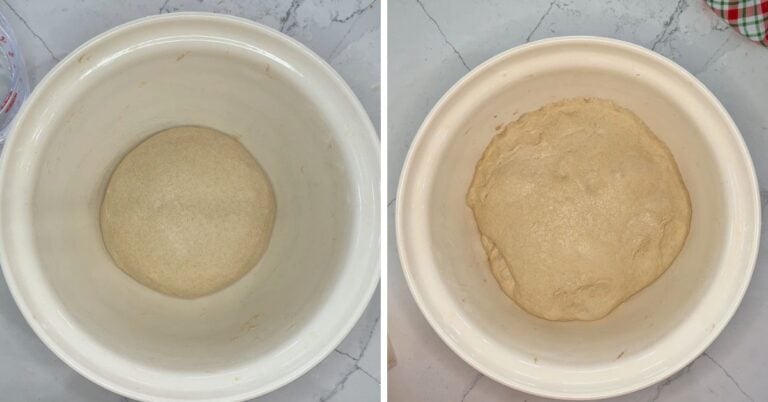
How do I know how much water to add? I provide photos of the dough at every stage so you can compare your dough’s texture to mine. After the initial dough mix, if yours clearly looks wetter and slack, add more flour, about 1 tablespoon at a time. If it looks like a stiff ball compared to mine, add more water. Don’t be afraid to make these adjustments on the fly!
“The flavor of the whole wheat einkorn is much better than the AP einkorn.” -Recipe tester from Columbus, OH, who tested both versions and submitted two separate responses
- Einkorn flour brands: Jovial Foods was far and away the most-used brand among testers (129 out of 190) and produced great results in the whole wheat version. Central Milling, Azure Standard, Barton Springs Mill, and Bluebird Grain Farms were also used successfully.
- Freshly milled einkorn: 25 testers used freshly milled einkorn with great results — they were actually the highest-rating group of all at 4.84 out of 5. If you’re milling your own, consider a 45–60 minute autolyse before adding your starter and salt. Freshly milled flour benefits from extra hydration time.
It also ferments faster, so watch bulk fermentation closely, and err on the side of shaping slightly early. It can continue fermenting in the fridge more than you’d expect. - Bread flour options: Central Milling High Mountain is what I tested with, but King Arthur Bread Flour and Kirkland (Costco) bread flour both work well.
How to Make 50% Einkorn Sourdough Bread (Step-by-Step)
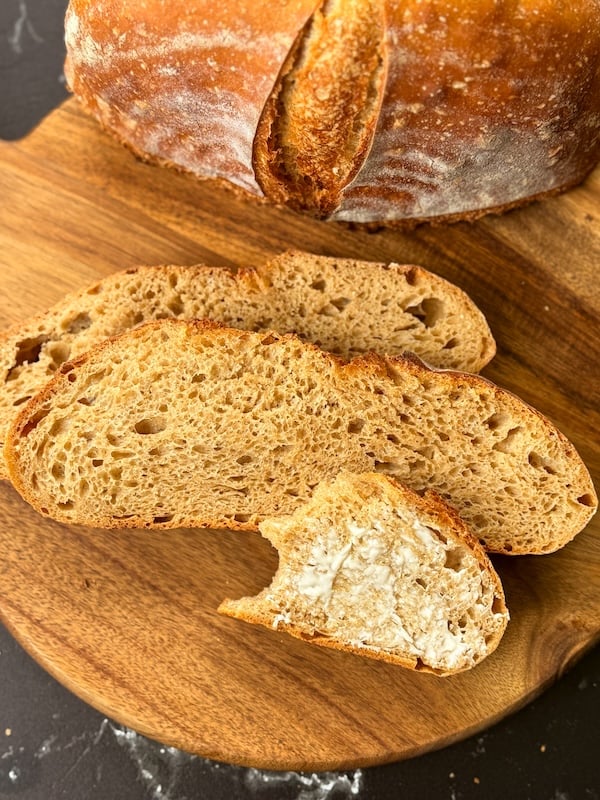
Step 1: Feed Your Starter
Before bed, in a 3/4 L Weck jar, mix together 15g sourdough starter and 75g water. Add 75g bread flour and stir until smooth.
Loosely cover and let ferment on the counter overnight (10–12 hours at 68–75°F / 20–24°C).
By morning it should look noticeably puffed (ideally about tripled in size), be full of bubbles, and smell yeasty and active.
Step 2: Mix the Dough
The next morning, in a large mixing bowl, combine 350g water and 160g of your peaked sourdough starter.
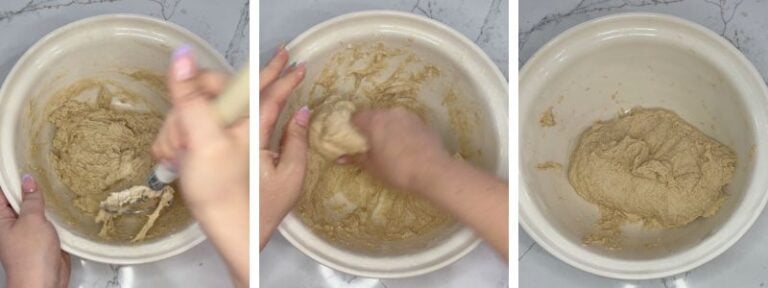
Add 250g bread flour, 250g einkorn flour, and 10g salt. Using a Danish dough whisk or your hands, mix until no dry flour remains.
Bulk fermentation has begun. Cover and rest for 30–40 minutes.
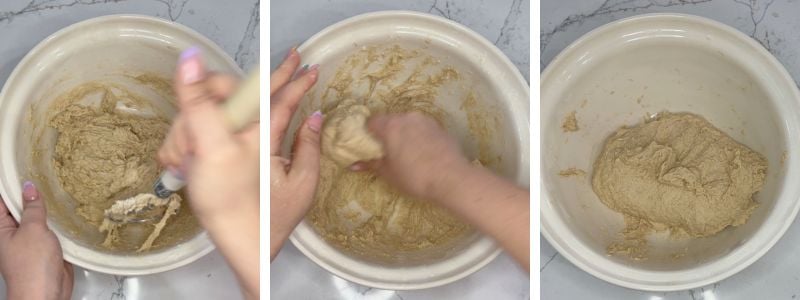
The dough will look rough and feel tacky — that’s right where it should be.
Don’t be thrown off by the color, either. Einkorn flour has a naturally warmer, slightly golden hue compared to white bread flour. Several testers mentioned being caught off guard by it. Completely normal.
Step 3: Coil Folds (4 Rounds, 30 Minutes Apart)
Beginning 30–40 minutes after your initial mix, do 4 rounds of coil folds spaced 30 minutes apart.
Why coil folds and not stretch and folds? Einkorn dough is more delicate than a typical bread flour dough. Its weaker gluten structure — and the bran in whole wheat einkorn — means it benefits from gentler handling, so coil folds are a better fit here. Save those slap and folds for your 100% bread flour loaves!
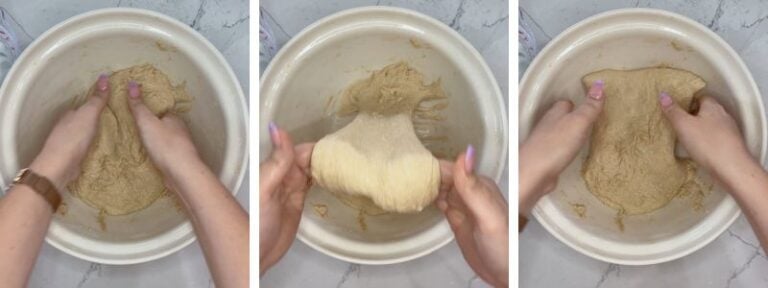
To coil fold, wet your hands and slide them under the center of the dough. Lift it up and let the ends fold underneath themselves. Rotate the bowl 90° and repeat, keeping your hands wet, until the dough tightens and resists stretching.
Cover and let the dough rest.
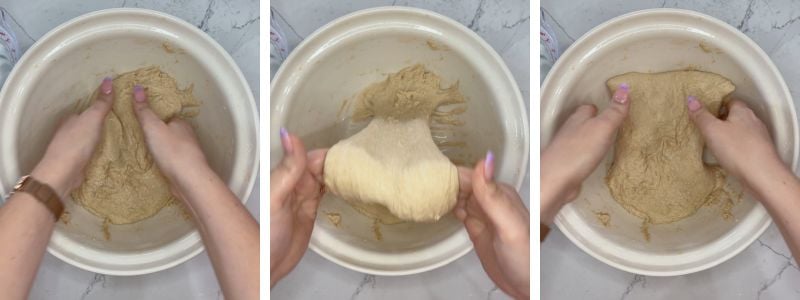
The dough transforms noticeably with each round — from rough and shaggy to smooth and strong. Testers consistently loved this part of the process.
“I loved the texture of the dough during the coil folds. [It] was a dream.” –Recipe tester from Lansing, MI
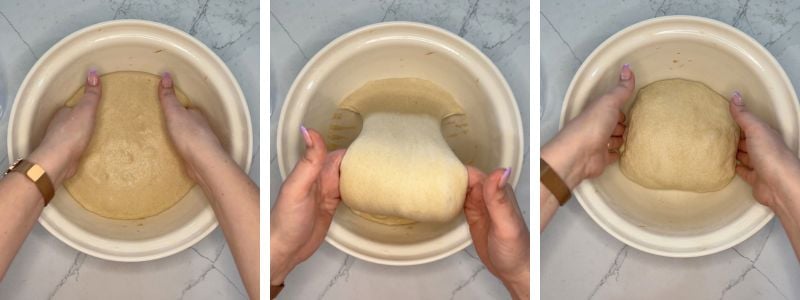
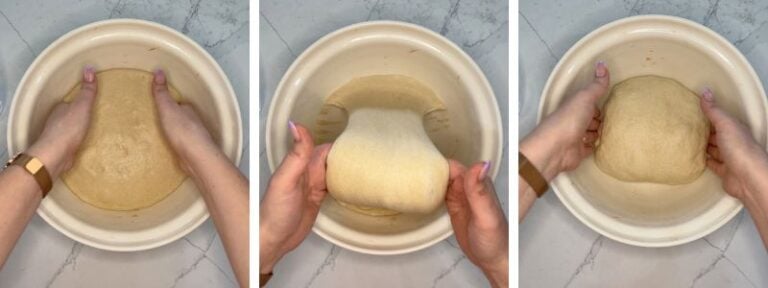
Be gentle during the last round or two. By the fourth coil fold, the dough may be close to ready for pre-shaping. Avoid degassing it.
Step 4: Finish Bulk Fermentation
After your coil folds, let the dough continue to ferment undisturbed. You’re looking for:
- Visible increase in volume (the percentage rise can vary, so look for all of these features, not just a certain amount of rise)
- Bubbles throughout and on the surface
- Minor webbing when you gently pull on the dough — this one is key
- A light, aerated feel when you tap the surface
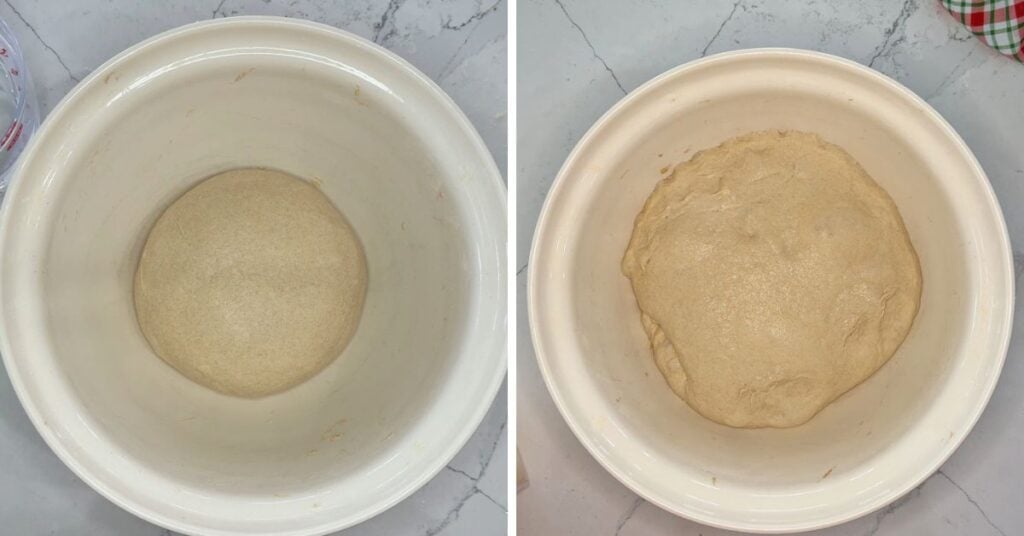
“I LOVED that you wrote ‘ready to shape when it has increased in volume, is filled with bubbles, and has minor webbing when you pull on the dough.’ The minor webbing was key for me.” –Recipe tester from Lewiston, MI
At a temp of 73°F (23°C), expect about 5.5 hours total from the initial mix. Warmer kitchens will finish faster; cooler kitchens will take longer.
Stay close. This dough ferments noticeably faster than a standard bread flour loaf. The whole wheat einkorn and higher starter amount both keep things moving.
Step 5: Pre-Shape
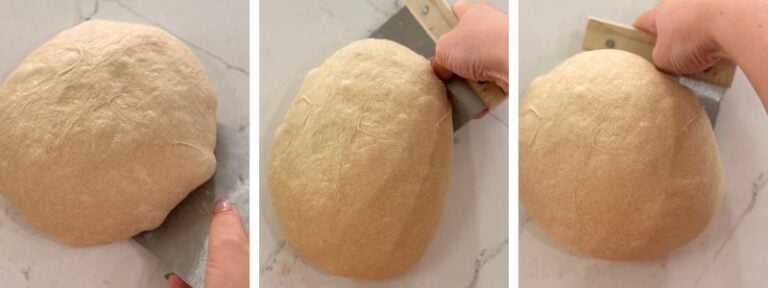
Lightly dust your work surface with flour (I used einkorn to stay on theme) and turn the dough out. Use your bench scraper to flip it so the smooth side faces up.
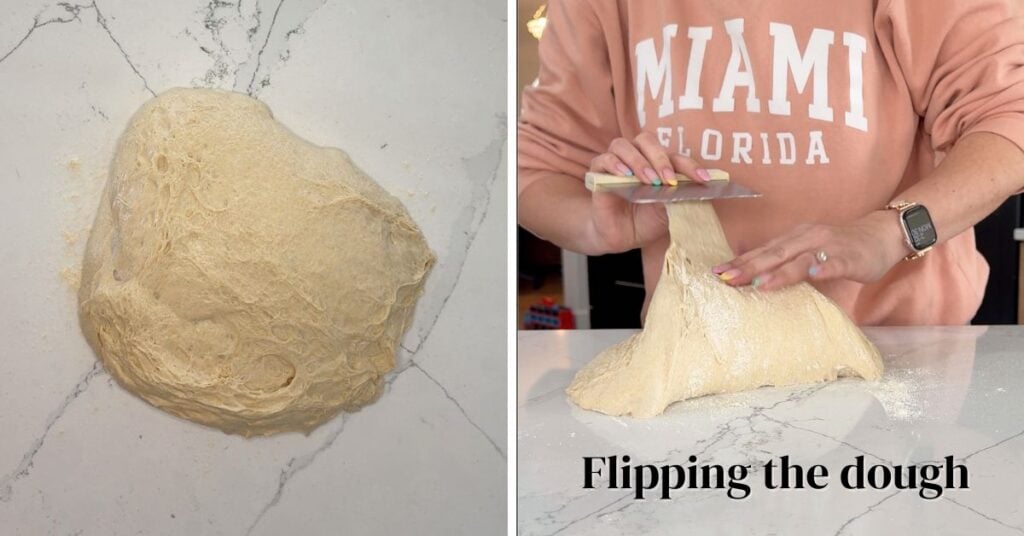
Using your bench scraper or hands, do a push-and-pull motion to coax the dough into a taut round. Let it rest uncovered for about 10 minutes.
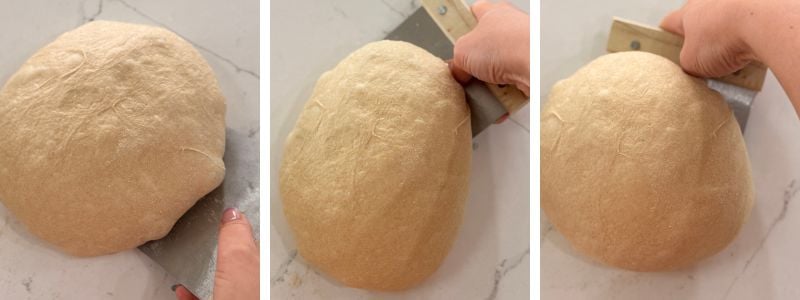
Step 6: Final Shape and Cold Proof
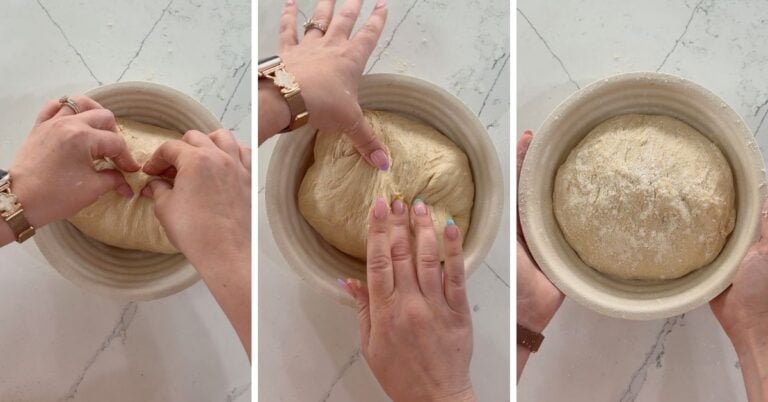
Use the caddy clasp technique (shown below) to shape your dough.
For a batard, fold the dough like a book and place it seam-side up in your floured banneton. For a boule, do a double clasp, turning the dough 90º and folding again, then flip into the banneton.
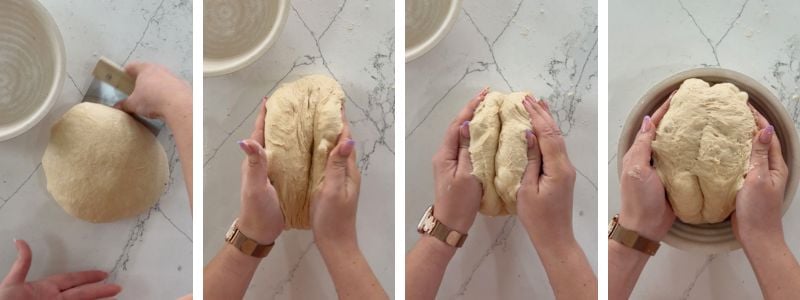
Pinch the seam closed, dust lightly with rice flour, cover, and refrigerate overnight. Ideal cold retard: 12–36 hours. (I like 12–18 hours best.) Do not exceed 96 hours.
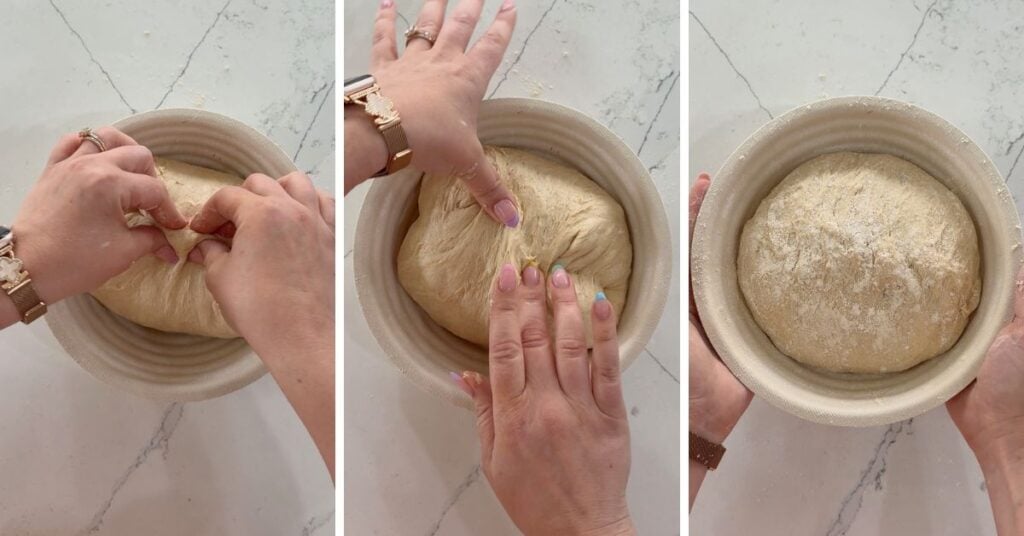
Shaping note: This dough can feel sticky at the shaping stage — especially if you used AP einkorn at full hydration. A light dusting of flour on your surface helps, and your bench scraper is your best friend.
Step 7: Score and Bake
When you’re ready to bake, preheat your oven to 450°F (230°C) convection — or 475°F (250°C) conventional — with your Dutch oven inside. After it preheats, give it 10 more minutes to make sure your Dutch oven is truly hot.
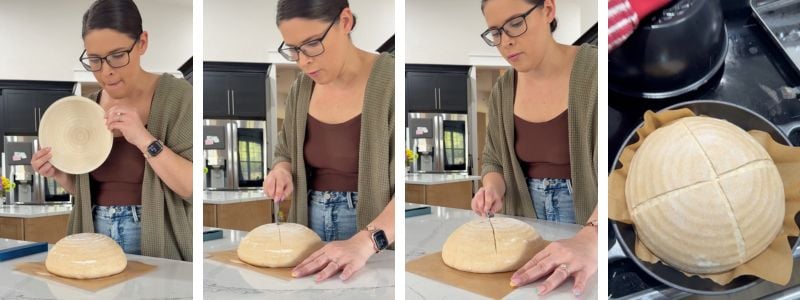
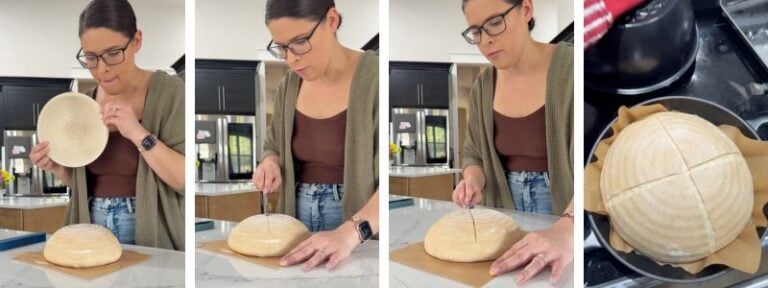
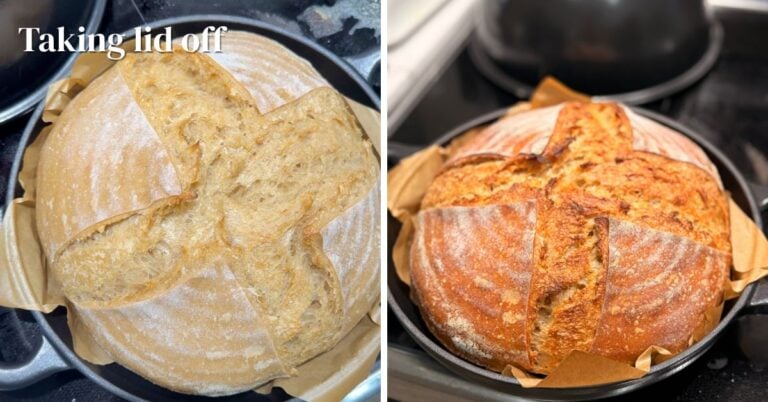
Turn the dough out of your banneton onto parchment paper or a bread sling. Score — a single slash for a batard or a large X for a boule — and lower it into the hot Dutch oven. For a blistered crust, add 1–2 ice cubes to the bottom before putting the lid on.
Bake covered for 25 minutes. Remove the lid and bake 10–15 more minutes, until golden brown and the internal temperature reaches 205–210°F (96–99°C).
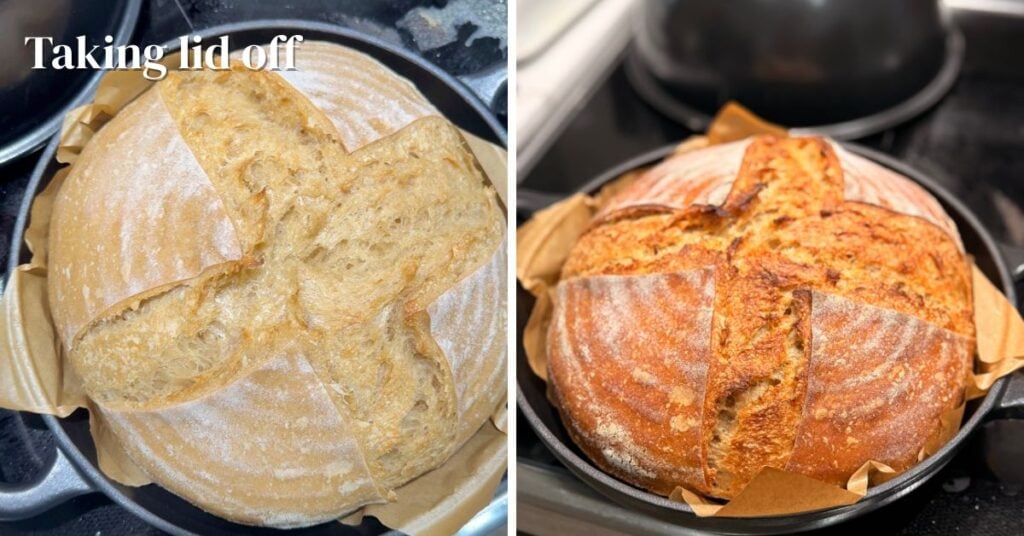
Cool on a wire rack for at least 90 minutes before slicing. I know. It’s hard. I won’t tell anyone if you cut into it early. 😂
Be forewarned, though — your loaf can turn gummy if you cut into it before it has cooled off!
Storage & Reheating
Room temperature: Store in a bread bag (these are my favorite – use code THATSOURDOUGHGAL for 15% off) or on a glass cake stand for 2–3 days.
Freezer: Slice the loaf and freeze in a sealed bag for up to 3 months. Toast slices straight from frozen.
Revive a dry loaf: Mist lightly with water and warm at 325°F (165°C) for about 8–10 minutes.
Troubleshooting Tips
FAQs
I admit: 160g of starter is a lot for a single loaf of bread. So why does this recipe use that much? It’s a silly story. That’s simply how much starter came out of my jar during my first recipe test.
I stared at the large blob and thought, “Should I take some out?” But I left it, and I ended up absolutely loving the loaf. I loved how it continued fermenting and rising in the fridge — I think the extra starter helped keep things moving. The final loaf was so large and puffed up that I hated to change a thing.
You absolutely can adjust the starter amount – all sourdough recipes are just a starting point. For example, you can lower the starter to 100g and simply add 30g more water and 30g more flour to the main dough. The hydration is the same, but the dough will ferment a little slower!
Whole wheat einkorn is what this recipe was developed with, and it’s what I recommend. The biggest difference comes down to water absorption — whole wheat einkorn soaks up significantly more water than AP einkorn. At the full 350g of water in this recipe, AP einkorn produces a very slack, sticky dough that’s hard to shape. If you’re using AP einkorn, reduce the water to 300–325g and adjust from there.
Beyond the handling difference, several testers who tried both versions said the whole wheat einkorn had noticeably better flavor — so if you have the choice, it’s worth seeking out.
Jovial Foods was the most popular brand among testers by a wide margin — 129 out of 190 testers used it — and it performed beautifully in the whole wheat version. Central Milling, Azure Standard, Barton Springs Mill, and Bluebird Grain Farms were also used successfully. If you have a grain mill, freshly milled einkorn is absolutely worth trying — testers using freshly milled einkorn were actually the happiest group of all, rating the recipe 4.84 out of 5.
Yes, and testers who did loved it — they rated the recipe 4.84 out of 5, the highest of any group. A couple of tips if you’re going that route: consider a 45–60 minute autolyse before adding your starter and salt, since freshly milled flour benefits from extra time to hydrate. it ferments faster than store-bought flour, so watch your bulk fermentation closely and err on the side of shaping early — it can continue fermenting in the fridge more than you might expect.
This was the most common question from testers, and understandably so — einkorn dough doesn’t always give you the same obvious visual cues as a 100% bread flour loaf.
Look for all of these together rather than any single sign: the dough has visibly increased in volume, there are bubbles throughout and on the surface, it feels light and aerated when you tap it, and — this is the big one — there’s minor webbing when you gently pull on the dough.
At 73°F (23°C), expect about 5.5 hours total from the initial mix, but rely on those visual cues more than the clock. This dough moves faster than you might be used to, so stay close.
Einkorn flour is more delicate than modern bread flour — it has less gluten structure to work with. Coil folds are gentler, which helps build strength without overworking the dough. Stretch and folds aren’t going to ruin your loaf, but coil folds are simply kinder to this particular dough.
Yes, absolutely! Instead of putting your shaped loaf in the fridge overnight, simply let it continue fermenting on your counter until it passes the poke test. When you poke the dough with a floured finger, it should remain indented and spring back ever so slightly aand slowly. If it springs back quickly and fully, it needs more time.
This is completely normal and not a sign that something went wrong. Einkorn has significantly less gluten than modern bread flour, which means it simply can’t trap as much gas during fermentation.
A 50% einkorn loaf will never be as tall as a 100% bread flour loaf — the tradeoff is that nutty, rich flavor and tender crumb that you just can’t get from modern wheat. If your loaf is significantly flat (like a pancake), that’s more likely overproofing or the AP einkorn hydration issue — both covered in the Troubleshooting section.
Nutty, slightly sweet, and a little earthy — with the sourdough tang coming through more prominently than in a standard white loaf. A lot of testers described it as tasting “healthy” in the best possible way. It’s not a sharp or acquired flavor — most people who try it love it on the first bite, especially sliced thick with salted butter.
Jovial Foods whole wheat einkorn is the most widely available option and what most testers used. You can find it at Whole Foods, some grocery stores, and online. I personally used Central Milling’s Einkorn flour. If you have a grain mill, sourcing einkorn berries and milling your own is absolutely worth it — our testers using freshly milled einkorn were the happiest group of all.
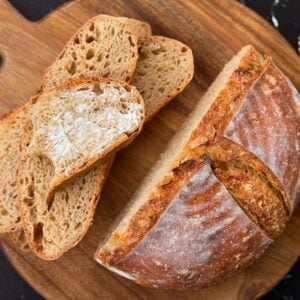
50% Einkorn Sourdough Bread Recipe
Equipment
- 3/4 L Weck jar for your starter
- Tovolo spatula for mixing your starter
- Large mixing bowl or rectangular tub
- Bowl cover 15% off with code THATSOURDOUGHGAL
- Dutch oven $15 off with code REBEKAH15
Ingredients
Feed Your Starter
- 15 g sourdough starter healthy, ideally fed within the last 24 hours
- 75 g water
- 75 g bread flour
Main Dough
- 350 g water
- 160 g active sourdough starter that you made, from above
- 250 g bread flour
- 250 g whole wheat einkorn flour
- 10 g sea salt
Before You Begin

Instructions
- Feed your starter: Before bed, in a 3/4 L Weck jar (or similar-sized glass jar), mix together 15 g sourdough starter and 75 g water. Then, mix in 75 g bread flour until smooth. Loosely cover and let ferment on the counter overnight [10–12 hours at 68–75°F (20–24°C)].
- Mix the dough: In the morning, in a large mixing bowl, combine 350 g water and 160 g active sourdough starter. Add 250 g bread flour, 250 g whole wheat einkorn flour, and 10 g sea salt. Using a Danish dough whisk or your hands, mix until no dry flour remains. Bulk fermentation has begun. Cover the bowl and let rest for 30–40 minutes.

- Coil folds (beginning 30–40 minutes after the initial dough mix and repeating every 30 minutes for a total of 4 rounds): Wet your hands and slide them under the center of the dough, lift it up, and let the ends fold underneath themselves. Rotate the bowl 90° and repeat, wetting your hands often. Cover and rest between rounds.
- Note: This dough ferments quickly. Be gentle during the last round or two of coil folds — by the time you finish the fourth, it may nearly be time to pre-shape, so avoid degassing the dough. Photo note: this was my fourth and final round of coil folds.
- Finish bulk fermentation: Bulk fermentation began when we first mixed our dough — we're ready to shape when it has increased in volume, is filled with bubbles, and has minor webbing when you pull on the dough. Stay close — fermentation happens quickly with this dough. Expect about 5.5 hours total at 73°F (23°C), but timing can vary, so pay more attention to visual cues.

- Pre-shape: Lightly dust your work surface with flour and dump out the dough. Use your bench scraper to flip it so the smoothest side is facing up.
- Push the mass of dough up, around, and back toward you, like a candy cane motion. Continue doing this gently, until you've coaxed the mass of dough into a taut round shape. Let rest, uncovered, for about 10 minutes.
- Final shape: Use the caddy clasp technique to easily and quickly shape your dough. For a batard, fold your dough like a book and place it into your floured banneton. For a boule, do a double clasp (folding like a book in both directions), and flip into a floured banneton.
- Cold proof: Pinch the seam closed and dust lightly with flour before covering and refrigerating overnight. Ideal cold retard: 12–36 hours. Do not exceed 96 hours.
- Score and bake: Preheat oven to 450°F (230°C) convection — or 475°F (250°C) conventional — with a Dutch oven inside.
- Transfer the dough to parchment paper or a bread sling, score it, and place it in the Dutch oven. For a blistered crust, add 1–2 ice cubes to the bottom of the Dutch oven.
- Bake with the lid on for 25 minutes. Remove lid and bake for 10–15 minutes more, or until golden brown and the internal temperature is 205–210°F (96–99°C).
- Cool on a wire rack for at least 90 minutes before slicing.


Conclusion
If you want to know what all the Einkorn fuss is about, give this recipe a try!
The dough is approachable, the process is pretty fast, and the result tastes like nothing you’d get from straight bread flour. That nutty, ancient-grain depth is really lovely!!!
“Everyone raved about it. They said it was the best loaf I’ve made, and my husband made me put it in regular rotation.” –Recipe tester from Baltimore, Maryland
If you make it, I’d love to see it — drop a photo in the comments or tag me on Instagram @thatsourdoughgal!
Similar recipes:


This recipe turned out so well. The dough was sticky and I had my doubts…I thought I ruined it but stuck the course and it made delicious bread. I used AP einkorn because that’s what my store had and reduced to 300 g of water.
So glad it turned out well!!
This is THE recipe!!! I have made the boule and the bread turned out SOOO great. The dough was definitely easier to work with than with other Einkorn recipes I’ve tried in the past. Thank for posting.. I do have one question though… Would the outcome be different if baked in a loaf pan?
Yay so glad! No, you can totally bake in a loaf pan. Just check the internal temp before pulling it as sometimes it can take a little longer.
This came out great! Awesome spring and great, soft crumb. The loaf was big! Tastes great. I forgot to preshape, and placed it right into the baneton, but then decided let it rest on the counter, uncovered, for 30 min before placing in the fridge. A keeper for sure!
WOOHOO! Glad you’re loving this one!
I’ve baked this loaf several times now and thought I’d experiment a little bit by adding some blueberry jam to it for a flavor boost. We were out of blueberries so I pulled out the delicious organic jam we had in the fridge and slathered it on at the final shaping (old style- stretched it out like you do your cinnamon brown sugar loaf) then rolled it up and dumped into the banneton. I say ‘dumped’ because for some reason it was wetter than usual and the jam was spilling out everywhere, so fancy techniques were a definite no go. I’m pretty sure I stuck to the water amount but should probably have added a bit more flour at the beginning – it was rather slack and never tightened up like I expected. It continued to expand quite a bit in the fridge, way more than usual (the sugar in the jam maybe?) and I had to coax it into my favorite enameled cast iron sandwich dutch oven. I didn’t score it until after 7 minutes in the oven because it had grown so much and I didn’t want to deflate it. The end result? It turned out very well and is quite a nice loaf, very soft with uneven blueberry streaks throughout (the shaping was quite messy). I’ve attached a photo (taken after slicing off a large piece, of course!)
I love this recipe. It’s easy and the dough is easy to work with. I’ve made it several times–perfection. I like to add mixed fresh dried herbs and super seeds to the dough at shaping.
Looks amazing! Thank you so much for sharing, Terry!