
Easy Loaf Pan Sourdough Bread Recipe (No Dutch Oven Needed!)

It’s totally possible to make amazing sourdough bread in a loaf pan. The biggest benefit, besides having a sandwich-shaped loaf, is that you don’t need a banneton or a Dutch oven.
If you’re just starting out with sourdough and don’t want to invest in specialty equipment, this is a surefire way to start making incredible, simple bread straight away.
Affiliate disclosure: To cover the cost of running my platforms, I do sometimes link to products. Please assume these links are affiliate links. If you choose to buy through my links then THANK YOU – it will make it possible for me to keep doing this.
Why You’ll Love This Loaf Pan Artisan Sourdough Bread
- No fancy equipment needed: You don’t need a Dutch oven or fancy banneton. Just a couple of loaf pans and your everyday kitchen tools, like a bowl and a scale.
- That classic loaf shape: This isn’t a sandwich bread recipe per se (the dough isn’t enriched), but it bakes up in a neat rectangle that stores easily, slices evenly, and looks like it came off the grocery store shelf.
- Delightfully soft crust: The crust stays softer than a traditional artisan boule, making it perfect for sandwiches.
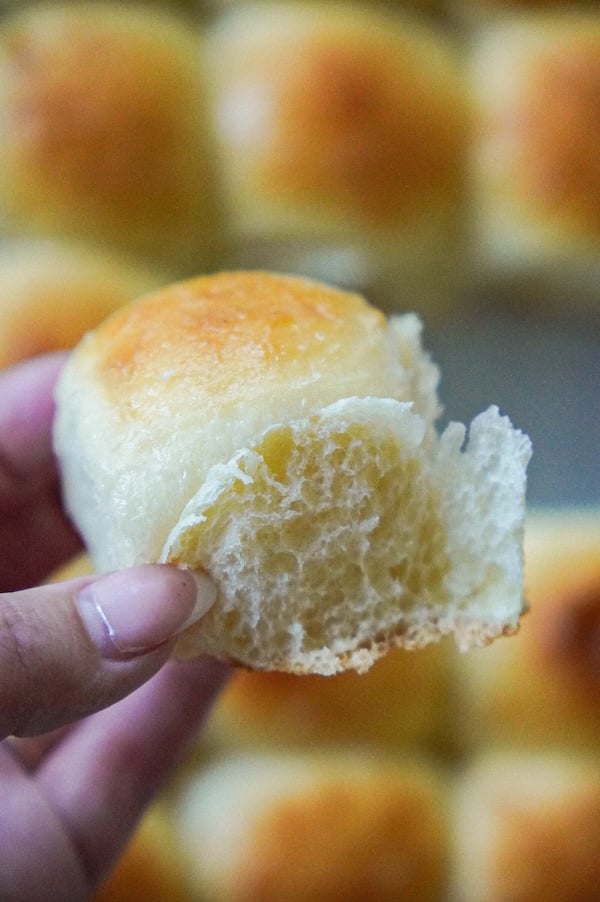
Want an even softer crust and a squishy interior? Check out Sourdough Wonderbread Copycat Recipe – So Soft!
- Foolproof and forgiving: If your starter’s a little sleepy or you forget a stretch and fold, this recipe is flexible and beginner-friendly. The loaf pan essentially forces the dough to take on that shape, so if it’s overproofed, it’s really no problem.
- Customizable: Toss in whatever you’re craving—cheese, herbs, dried fruit—during the second set of stretch and folds to make it your own.

Baker’s Timeline
Here’s a sample schedule to show you how it all comes together. You can adjust as needed to fit your routine.
| Day 1 | |
| 8:00 PM (or before bed) | Feed your starter |
| Day 2 | |
| 8:00 AM | Mix dough |
| 8:30 AM | Stretch & fold #1 |
| 9:00 AM | Stretch & fold #2 (Add any inclusions) |
| 9:30 AM | Stretch & fold #3 |
| 10:00 AM | Coil fold |
| 10:00 AM – 2:00 PM | Bulk fermentation (timing can vary) |
| 2:00 PM | Shape dough and transfer to loaf pan |
| 2:15 PM | Cover and put in fridge for cold retard |
| Day 3 | |
| 9:00 AM | Preheat oven to 450°F and bake |
| 9:40 AM | Cool on a rack for at least 1 hour before slicing |
| 11:00 AM | Enjoy! |
Ingredients
- Active Starter: Should be bubbly and at its peak—ideally, tripled in size with a flattened surface and tons of bubbles. This will give your bread the best rise.
- Bread Flour: I’ve been using Caputo Americana 00 flour as well as the Ballerina Farms bread flour lately. I love and recommend both, but any bread flour works.
- Water: Use warm water if your kitchen is cold, and cooler water if it’s hot. Room temperature tap water is perfect for kitchens around 70-74°F.
- Salt: I like Redmond’s sea salt (affiliate code TSG15 for a discount), but any fine sea salt that doesn’t have anti-caking agents will work.
Step-By-Step Instructions For Loaf Pan Artisan Sourdough Bread
Step 1: Feed Your Starter (Night Before)
Before going to bed, feed your starter using a 1:5:5 ratio:
- 10g starter
- 50g bread flour
- 50g water
Stir well, cover loosely, and leave it on the counter overnight.
This will give you just enough for the recipe, plus about 10g left over to keep your starter going for your next bake.
If you’re new to starter ratios or want to bake on a different schedule, use my Sourdough Starter Ratio Calculators to make it easy.
Step 2: Mix the Dough (Next Morning)
In the morning, check that your starter has peaked. It should triple in size, smell sweet and yeasty, and look flat on top (not domed, which means it’s still rising). A little past peak, or when the starter just begins to fall and drag down the jar, is also fine.
In a large bowl, mix 100g of active starter with 300-350g of water until fully dissolved.
Tip: The amount of water you need in your dough depends on the bread flour you’re using as well as your environment. Do not be afraid to adjust on the fly. Here is what I do for a few different flour brands I love:
- Ballerina Farms bread flour: 350g water
- King Arthur bread flour: 320-325g water
- Caputo Americana 00 flour: 300-320g water
Then, add 10g sea salt and 500g bread flour.
Mix until all the flour is wet and you’ve got a shaggy dough (about 3-4 minutes). I like starting with a Danish dough whisk (Brod & Taylor’s is my favorite) and then switching to my hands.


You’re building dough strength here, so don’t be afraid to really work it.
Cover the bowl and let it rest for 30 minutes.
Step 3: Stretch & Folds
With damp hands, gently stretch one side of the dough up and fold it over itself. Rotate the bowl a quarter turn and repeat this on all 4 sides, or until the dough starts resisting when you pull it up. That’s one round.

You’ll do 4 rounds total, spaced 30-60 minutes apart. Keep the dough covered between rounds with a reusable bowl cover or plastic wrap.
Note: These are my favorite reusable bowl covers at the moment. Use affiliate code THATSOURDOUGHGAL for 10% off.
If you want to add any inclusions, I’d advise doing it during the second round of stretch and folds. If the inclusion is something sugary that will liquify, don’t add it until the final shaping.
For the final round, I like switching to coil folds. Lift the dough from the middle with both hands, let the ends drape down, then tuck them underneath. It’s a bit gentler on the dough.


By now, your dough should feel stronger and puffier.
Step 4: Bulk Fermentation
Let the dough sit on the counter for the remainder of the bulk fermentation (which started at the time you mixed your dough).
Bulk fermentation timing varies depending on a lot of factors, the most important one being your dough temperature. If your dough is quite warm (78°F/25.5°C or so), you might be ready to shape it as soon as the stretch and folds are done. If your dough is cooler (68°F/20°C or so), it may not be ready for 12+ hours.
For the dough you see photographed and filmed for this post, it was 73°F (23°C) and took 7.5 hours.
Don’t rely on the clock—watch your dough. It’s ready when:
- It jiggles like Jell-O
- The top is domed
- Bubbles are visible on the surface and sides
- The dough feels soft, bouncy, and pillowy when you touch it
- If you tug at the edge of the dough where it meets the bowl, you don’t see a ton of webbing (that can be an indicator of overfermentation)

This video can help you visualize what I’m describing here:

Step 5: Shape for the Loaf Pan
Prep your loaf pan to get it ready for the dough.
I use these USA Loaf Pans that are amazingly nonstick and Teflon-free. If yours isn’t nonstick, spray it, butter and flour it well, or line it with parchment (pre-cut bread pan squares make it easy).
Then, lightly flour your counter (if needed) and turn the dough out.

Gently stretch it into a loose rectangle about as wide as your loaf pan. Starting at the bottom, roll it up, tucking in the sides as you go. Be super light with your hands so you don’t pop too many of the bubbles.

When you get to the end, use a bench scraper to pull it toward you to build a little surface tension.

Scoop the dough up and transfer it seam-side down into your prepared loaf pan.

Step 6: Cold Retard
Cover your loaf and pop it in the fridge overnight for a cold retard.
Tip: An overnight cold proof adds more complex flavor, helps with scheduling purposes, and many with gluten sensitivities report better digestion. But, if you want to bake the same day, let it proof on the counter for 2-4 more hours instead. Just wait until the dough reaches the top of the loaf pan (or maybe even a little higher).

Step 7: Bake
The next day, you have two options for baking:
- Baking with one loaf pan (demonstrated here by my good friend Joselyn from A Friend In Knead)
- Propping a second loaf pan on top (called the “two-pan method,” made popular by Maria at Leaf & Loaf Co)
I suggest trying both options to see which works best for your particular oven.
Joselyn’s recommended bake temperature and times for a single loaf pan:
- Allow the dough to proof in the loaf pan until it’s at the edge or just over the edge.
- Bake at 400°F (205°C) for 10 minutes
- Score the top of the loaf
- Bake for an additional 20 minutes
- Rotate the pan and bake 20 minutes more
Her oven is gas (not electric), so she doesn’t need to add steam. However, if you have an electric oven, add a cast iron skillet with a boiling water-soaked kitchen towel in it. Ensure the towel is completely soaked (a dry one is a fire hazard).
And for the two-pan method, here’s what I usually do:
- Preheat oven to 450°F or 230°C (not convection)
- Bake for 25 minutes with the second loaf pan on top
- Optional: At the 8-minute mark, remove the top loaf pan, quickly score the top of the dough, and put the top pan back on to finish the rest of the 25 minutes. You can also just score the loaf before you put it in the oven – try both ways to see what works best for you.
- After the full 25 minutes, remove the top pan and bake for an additional 10-15 minutes, or until the loaf is golden brown and reads 205-210°F (96-99°C) internally


If the crust is getting too dark, lower the temperature to 425°F (220°C) for the last stretch. Every oven is different, so keep an eye on it!
Step 8: Cool & Enjoy!
Once it’s out of the oven, let the bread sit in the pan for 5-10 minutes, then turn it out onto a wire rack.

Let it cool completely before slicing (I know—it’s hard). The steam’s still working its magic inside.
Not sure what to do with stale or leftover slices? Try this recipe: Italian-Style Sourdough Breadcrumbs

Loaf Pan Sourdough Bread Recipe
Equipment
- USA loaf pan 1 lb or 8.5 x 4.5
Ingredients
Feed Your Starter
- 10 g sourdough starter (active or discard)
- 50 g water
- 50 g flour
Main Dough
- 100 g active starter (from above)
- 300-350 g water (See Notes)
- 500 g bread flour
- 10 g salt
Instructions
Day 1 (Evening)
- Feed Starter: Mix 10 g sourdough starter, 50 g water, and 50 g flour. Cover loosely, leave on counter 10-12 hours until bubbly.
Day 2
- Mix Dough: In the morning, dissolve your 100 g active starter in 300-350 g water (See Notes for tips). Add 500 g bread flour and 10 g salt. Mix 3-4 minutes. Cover, rest 30 minutes.
- Stretch & Folds: 4 rounds, 30 minutes apart. Final round: gentle coil folds. If desired, add inclusions during round 2.
- Bulk Fermentation: Ferment at room temp until jiggly, domed, and bubbly. For me, this takes about 7.5 hours at 73°F (23°C).
- Shape: Turn onto lightly floured counter. Stretch to loaf pan width. Roll up tightly, tucking sides. Place seam-down in greased pan.
- Cold proof: Cover, refrigerate overnight. Same-day option: proof 2-4 more hours at room temp before baking.
Day 3
- Bake: Choose one method:Single Pan Method: Preheat oven to 400°F (205°C). Bake 10 min → score → 20 min → rotate → 20 min more. Electric ovens: add steam with wet towels in cast iron skillet. See Notes for more information.Two-Pan Method: Preheat oven to 450°F (230°C). Cover loaf pan with a second inverted pan, bake 25 min. Optional: score at 8-min mark. Remove cover, bake 10-15 min more. Lower to 425°F (220°C) if browning too quickly.When done, the bread's internal temperature should be 205-210°F or 96-99°C.
- Cool: Rest in pan 5-10 minutes, then cool completely on rack before slicing.
Video

Notes
- Ballerina Farms bread flour: 350g water
- King Arthur bread flour: 320-325g water
- Caputo Americana 00 flour: 300-320g water
Conclusion
And that’s it! Simple, delicious, and no fancy gear needed.

The crust is softer than a boule, but the flavor is just as amazing. Once you try this loaf pan artisan sourdough bread, you might never go back. I know my mom hasn’t!



I really appreciate your videos. I’m an old but new baker. I had an epic fail that was oddly depressing but thanks to you I am getting better and excited to see the outcome of this recipe!
We’ve had a few less than successful loaves of sourdough for various reasons. We decided to give this a go because the recipe was easy to follow AND we prefer a loaf pan shaped loaf anyway. We decided to add Italian seasoning, basil, parmesan, and colby jack cheese. I got nervous because the dough just didn’t seem to rise overnight and wasn’t at the level of the bread pan, but my mantra has been “bake it anyway.” It turned out so beautifully!! Just a delicious loaf. We’ll be making more with this recipe! Thanks so much!!
My goodness, those flavors sound so yummy!! So glad you loved it!
Yummmmm! Def an easy recipe to follow! Thank you!
So glad you enjoyed the recipe!!
Can this be left in the fridge longer than overnight for a “long fermented” loaf? Like 24-48 hours?
Yes
Hi! Do you know what the pre baked weight is for each loaf? I’m doing 5 loaves and trying to figure out how to divide it! 🙂
Should be around 940g or so! Just depends on how much water you needed in the dough but somewhere around there
I love sourdough sandwich bread, and your recipe was awesome. I also watched your YouTube video on bulk fermentation and that was very helpful and plan to watch more. I bought the small 9×5 pullman pan without the top for your soft wonder bread which was delicious. The pullman gives it more of a sandwich shape. How could I adapt this recipe to be able to use my pullman?
I have never used the pullman lid with success so I’m kind of useless here!
Thank you for sharing this!
Have made about half a dozen lovely loaves.
So happy to hear this Erica!
Why bake for 10 minutes and then score? Why not score the bread earlier, before it goes into the oven at all?
You can if you prefer
Rebekah,
Recently diagnosed as a type 2 diabetic so decided to try sourdough bread due to its lower glycemic index Saw your video online. Initially used our glass bread pans which didn’t brown the areas inside the pans. Decided to order the USA loaf pans which work beautifully. Now am trying your cinnamon roll recipe with a couple of minor changes to it. I used allulose for half of the sugar quantities and Trivia brown sugar substitute for half of the brown sugar in the recipe. The final rise was good and the rolls are baking. I will send a photo and let you know how they turned out. What size USA pan did you use for your rolls? Thank you. What are your thoughts on using powdered licithen and powdered gluten in bread recipes?
9×13 for the cinnamon rolls. I haven’t worked with lecithin before. Vital wheat gluten can be helpful if you want extra chew or are using a weaker flour and need a boost!
I can’t get over how good this bread is! I’ve had a starter for over a year and my bread has gone from ok to not great. Thanks to all your tutorials and tips, I received my acidic starter and made the best loaf of sourdough yet! This was so much easier than I expected and the timeline was super helpful. Thank you!
Yay!!! I’m so happy to hear that!
We prefer sandwich bread for its practicality and my pics reflect the two pan method in this recipe.
Your bulk fermentation videos helped me crack the code for getting the desired rise…I was already right on the cusp but I changed two things that I learned from you; letting my starter rise past the doubling stage (almost collapsing) and pushing the bulk ferment a little longer. WHAT A GAME CHANGER!!
Those changes increased the rise and reduced that slight gummy texture
I have NEVER posted on a forum like…but I MUST let you know your work to make sour dough baking accessible to everyone is appreciated. My wife loves my bakes and that brings me such joy.
Now I just need to work on improving my folding technique!!
Thank you so so much for taking the time to share!! Lovely loaves!!
I tired this recipe recently and have never had such great success compared to other recipes I have used. The dough was perfect.
I appreciated the notes on adjusting the water content based on flour used!
Thank you for your extensive testing and thorough directions and notes!
So glad to hear that!!
How do I prevent my dough from being sticky even though I am adding the correct ingredients?
That’s a loaded question – sticky dough is normal to a point but the context surrounding it can lead to lots of other potential problems. Acidic starter, over hydrated flour, not enough dough handling… it’s hard for me to answer without tons of info!
Do I need to put a cookie sheet below the bread to keep the bottom from burning?
If you notice the bottom of your loaf getting too dark, you can certainly try placing a sheet pan on the rack directly below your loaf pan to deflect some heat. I also just made a post with 10 ways to prevent burnt bottoms! https://thatsourdoughgal.com/how-to-prevent-burnt-bottoms-on-sourdough-bread/
This is the recipe I used for my fifth sourdough loaf and it’s the first one that I think was a true success. I followed the baking instructions for the gas oven with no lid or steam. I expect I will use a loaf pan for many more loaves.
Woo-hoo! Happy to hear this recipe was a winnder for you!
Rebekah I love your recipes and they are so easy to follow. I made this yesterday and the bf time was long…10 hrs (kitchen was cold 69-70, finally put it in oven with light on, got up to 76-78). Took long time. I wonder if it overproofed. Loaf was slightly gummy when I cut it even though it had completely cooled. Had a good ear and belly, good oven spring. I much prefer doing my loaves in loaf pans rather than DO. I’ll keep at it. I love your honey wheat soft sandwich loaf with the tangzhong.
Thank you for pouring your heart and soul into your recipes !
Hey!! So I actually suspect this loaf is underfermented based on the exterior coloring. Pale exteriors that resist browning are underfermented and dark exteriors that seem to burn prematurely are often overfermented.
What makes the crust soft since the recipe is similar to others? My attempts have been fails. Very hard crust and dense loaves, but taste is great. I think that issue is from the starter so have given her a refresh. And, my pans don’t cover tight enough. Otherwise, just wondering how the crust is soft. I will conquer this yet! Thanks for all you do.
The dough touching the side of the loaf pan during baking leads to a softer crust in my experience. Hard and dense sounds underfermented and/or a weak starter. Feel free to email me photos or more information and I can help troubleshoot more.
Do you let the dough rise after taking out if the refrigerator before putting in the oven?
I do not. You could if you felt your dough was underfermented! But you don’t need to.
Looked a little flat after the cold proof but jumped when baked. Used the butter trick to soften the crust. Excellent recipe!
I’ve been making sourdough for a while and I’ve always had problems with Boules keeping their shape so I was glad to see this one done in a bread pan. (Rebekah fixed that problem with bulk ferment video. I’ve always been under proofing, thanks). I used 50g wheat but other than that I followed the recipe as printed, other than the 1# difference. I made 2 loaves, one with 90g starter and the other with 128g starter. Both proofed and rose about the same, other than less time for the 128g, but it was much less sour as well. Now I can change that just by the amount of starter. I scored them both and it shows, but no “belly” poking out, but it was easier to cut without the ear. It squished and bounced back, was soft and I found it easier to cut after the initial for pictures, the next day. Especially with the knife Rebekah suggests, the Mercer knife. I can cut them as thin as I like without squishing the bread. Thanks so much for this option.