
The Ultimate Guide to Sourdough Starter Feeding Ratios
Sourdough starter feeding ratios can feel mathematical and confusing at first glance, but I promise you: they’re very simple and easy!
Here’s what feeding ratios have to offer:
- Total control over your own sourdough routine
- More precision so you can have repeatable, predictable results every time you feed your starter
- Less waste and sourdough discard
- Better sourdough starter health
What’s not to love?!
I promise if my English major brain can wrap my head around this, you can, too. Plus, I made a calculator so we all have a shortcut at the end of the day.

Feeding Ratios at a Glance
I’m a very visual learner, so seeing how feeding ratios actually work feels like the best place to begin.
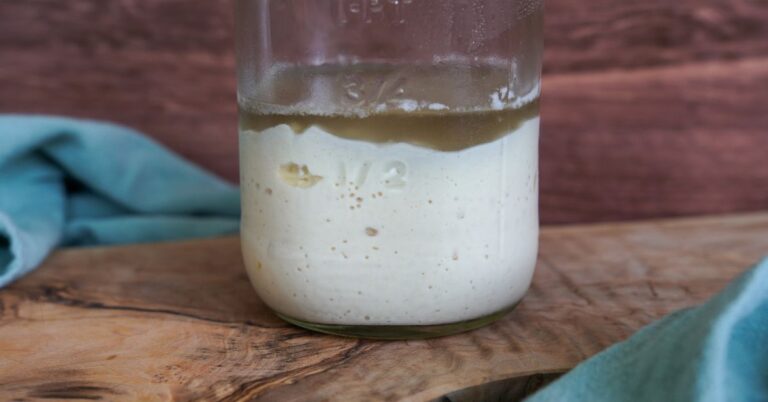
In the following video, you can see how different feeding ratios cause the starter to peak at different times. The more starter you have in the jar to begin with, the faster it will peak.
With this visual in mind, let’s take a look at what all those numbers mean.
The Numbers In Sourdough Starter Feeding Ratios
A sourdough starter feeding ratio has three numbers, in a format like this: 1:1:1.
The first number represents the starter. The second number represents the flour, and the third is the water.

In the simplest example of a 1:1:1 (voiced as “one to one to one”) feeding ratio, we have 1 part starter, 1 part flour, and 1 part water.
If you want 200g of starter for a recipe, as an example, you’d divide 200 into three parts, which gives us:
- 67g starter
- 67g flour
- 67g water (all rounded to the nearest whole number)
Pretty simple, right?
Understanding Larger Feeding Ratios
A 1:1:1 feeding ratio is pretty simple because it’s equal parts, and most people can understand that fairly quickly.
I start to see confusion when we use larger feeding ratios, like 1:5:5.
As a reminder, this means 1 part starter, 5 parts flour, and 5 parts water.
If you add all of these “parts” together, we have 11 parts to work with. If we want 200g of starter for a recipe, we’d divide 200 by 11, which gives us:
- 18g starter (1 part)
- 91g flour (5 parts)
- 91g water (5 parts)
Note: Again, I rounded these numbers to the nearest whole number, so please don’t get confused. It’s technically 18.18g in one part, which is why 5 parts comes out to 91g and not 90g.
Feel free to plug in different numbers in my feeding ratio calculator to better understand how this works!
Understanding Yeast and Lactic Acid Bacteria (LAB) in Your Starter
The following section was kindly written and provided by Tom Cucuzza of The Sourdough Journey.
When sourdough bakers struggle with a “weak” starter, it is more likely that your starter has become acidic.
Your starter contains two primary microbes:
- Yeast
- Lactic acid bacteria (LAB)
When the lactic acid bacteria begin to outrun the yeast, it builds up a high acid load that chokes off the yeast production. A healthy starter keeps the acidity level low, which favors yeast production.
Many starters naturally become acidic over time, and learning to “de-acidify” your starter is just like doing routine maintenance on your vehicle.
Revitalizing a Weak Starter with Feeding Ratios
If your starter becomes sluggish and is not raising your dough quickly, or rising quickly after feeding, it is likely becoming acidic.


Your starter can become acidic due to two primary reasons:
- Low feeding ratios (e.g., 1:1:1), and/or
- Letting your starter fall completely flat before discarding and feeding.
Both of these routines can cause your starter to become acidic but also know that sometimes, it just naturally happens over time with a well-maintained starter.
If your starter becomes acidic, you can correct it in two ways:
- A few high ratio feedings like 1:5:5 or 1:10:10, and/or
- A few “peak-to-peak” feedings.
High feeding ratios keep a very small amount of carryover starter, and by giving it a large feeding of flour and water, you dilute the acidity and give the yeast a chance to strengthen.
Peak-to-peak feedings can achieve the same result. By discarding and refeeding as soon as your starter peaks, you favor the yeast instead of the lactic acid bacteria. A few back-to-back peak-to-peak feedings can deacidify your starter, too.
To learn more about starter acidity and these techniques check out the video “How to Strengthen a Weak Starter,” on YouTube at The Sourdough Journey, or on the website thesourdoughjourney.com.
That concludes the section so generously provided by Tom Cucuzza of The Sourdough Journey. Thank you, Tom, for sharing this insight and advice!
Scaling Up or Down: Why Ratios Matter More Than Exact Grams
Some people watch my feeding ratio videos and say: “I get that your ratio is 1:5:5, but what are the exact grams in the jar?”
The answer is it doesn’t matter – how many grams of starter, flour, and water are in my jar will vary based on how much starter I need.
Ratios simplify scaling up or down, giving flexibility to make any amount of starter you require for a recipe.
When feeding a starter, the ratio (like 1:5:5) is what determines the timing of its peak, not the exact grams used. For instance, whether you’re using 50g or 1000g, a 1:5:5 ratio will peak consistently around the same time.
As Hannah from Crusty Cravings by Hannah notes, “The peak time stays the same no matter the amount. While more starter might retain heat and speed things up, I haven’t found that to be the case. My 1:10:10 ratio takes about 12 hours to peak.”
Ratios focus on the proportions of starter, flour, and water, so you can make as little or as much as your recipe requires.
Why Do Different Ratios Look the Same?
A lot of people saw my timelapse video and got confused about how they all started out at the same level if they were different ratios.


Remember we’re talking about parts of a whole here – all of those 5 jars had a total of 100g inside – it’s just the amounts of starter, flour, and water that are different!
Using Feeding Ratios In Your Sourdough Routine
The beauty of feeding ratios is you can choose one that fits with your schedule.
Decide when you plan to use your starter and work backward!
If you want to put some dough together in 4-6 hours, use a 1:1:1 feeding ratio. If you want to feed your starter before bed to make bread in the morning, consider something around a 1:5:5 ratio.
The temperature of your home will impact these times. A warmer home will cause the starter to rise faster whereas a cooler home will slow things down.
Adjusting Your Routine With the Seasons
As your kitchen temperature changes with the seasons, you may want to adjust your feeding ratio.
Remember: cooler temperatures slow down the yeast and bacteria in your starter, so it will take longer for it to rise.
In the wintertime, you may prefer a 1:2:2 or 1:3:3 feeding ratio, wheras in the summer, you may prefer a 1:5:5 or 1:10:10 feeding ratio.
Feel free to play around with different ratios to find the one that works best with your schedule and kitchen temperature.
My Feeding Routine
For my own typical feeding schedule, I aim to feed my starter a 1:5:5 ratio in the morning and at night.
I do this for two main reasons:
- It ensures I always have a peaked starter at the main times I’m ready to start baking: first thing in the morning or before bed (for an overnight recipe). It’s frustrating when you’re ready to bake but your starter isn’t – this schedule has really solved this problem for me.
- It has transformed the health of my starter by ensuring it’s never starving. I’m essentially feeding my starter peak-to-peak, which is a tactic to strengthen a sluggish starter. I have not dealt with a sluggish, overly acidic, or weak starter since implementing this schedule.
Do I always remember to feed my starter twice per day? No. If I feed it once in a day, it’s perfectly fine. But I’ve personally found that twice a day produces even better results.
Feeding Ratio Timing
So, how long does it take for different feeding ratios to peak?
The answer to that is: it depends. I’ve done several time lapses and experiments in my own kitchen and have a good idea of how long different ratios take to peak.
That said, the timing in your kitchen may be slightly different. The temperature of your kitchen is likely the biggest factor as the yeast and bacteria in a starter are highly influenced by temperature.
In my home, which is typically about 75°F/24°C, here’s what my peak times look like (verified many times and very consistent):
| Feeding Ratio | Approximate Peak Time at 75°F/24°C |
|---|---|
| 1:1:1 | 4.5-5 hours |
| 1:2:2 | 5-5.5 hours |
| 1:3:3 | 6.5-9 hours |
| 1:5:5 | 10 hours |
| 1:10:10 | 17 hours |
If your kitchen is warmer, your peak times will be faster, and if your home is colder, they will be slower.
Eyeballing Your Feeds vs Using Feeding Ratios
I personally believe there is nothing wrong with eyeballing your feeds. I did that for a long time, and I even have an entire blog post about how I did it.
That said, using feeding ratios is certainly more precise, and I’ve found it also reduces waste and excess discard.
I didn’t realize until I started measuring my feeds that you don’t need hardly any starter to carry over. If you’re doing a 1:5:5 feeding ratio and want 100g of starter, you literally need 9g of starter. That’s it.
When I was eyeballing my feeds, I was definitely carrying over a lot more starter than this. If you find you’re wasting a lot of starter or can’t go through all of your discard, consider using a scale and using feeding ratios instead of eyeballing your feeds.

FAQs
What is the best feeding ratio for sourdough starter?
I wouldn’t call any particular feeding ratio the “best” for every situation. I use many different feeding ratios depending on my situation. While my maintenance is usually a 1:5:5 ratio, I’ll often choose other options depending on when I need my starter to peak.
What’s the best feeding ratio if I only bake once a week?
If you only bake once per week and typically keep your starter in the fridge, I’d advise a 1:5:5 feeding ratio. You may need to feed your starter twice before baking to ensure it’s fully perked up and ready to raise your bread.
What is the best feeding ratio for creating a new starter?
I have never created a sourdough starter from scratch. The information in this article is for an established starter. If you’re creating a starter from scratch, I’d suggest this recipe and guide from Maurizio at The Perfect Loaf.
What does feeding peak-to-peak mean?
Feeding peak-to-peak simply means you are feeding your starter when it has peaked versus waiting for it to deflate before feeding again. This is a great tactic to strengthen your starter.
How do I keep my starter at a steady temperature for more predictable peak times?
Companies like Sourhouse and Brod & Taylor (affiliate links) have created contraptions to keep your sourdough starter at a steady, ideal temperature.
You essentially put your jar of starter in these temperature-controlled environments. If you have a cold kitchen, it will help speed things up, and if you have a hot kitchen, it’ll prevent your starter from getting too warm (which favors the bacteria in the starter and can lead to undesirable effects).



Thank you for this
Info.
Very intetesting indeef
I will be trying this method.
Glad it is helpful!
I’m very confused about maintaining a starter. I have been baking about a loaf per week and feeding daily by discarding about half of what I have each day (leaving about 3/4 of a cup) and then adding 50-60g each of flour and water. Ot doesn’t go in fridge at all. My recipe calls for 50g of starter, 500g flour, 350g water and 9g salt. I found you and your site intriguing! Do you feed your starter daily?
Hey Jody! I do feed my starter daily. I would suggest you simply feed a lot less. Instead of leaving so much starter in the jar, use a scale so you can get precise with how many grams of starter you have. You can maintain a starter on your counter with very little waste. As an example, you could do 3g starter, 12g flour, and 12g water. This is such a tiny amount but it keeps your starter active and healthy, and you won’t have so much excess discard.
Hi, happy new year. I am looking at your website which is super interesting but I could not find the recipe for the sourdough starter, would you be able to help? Thanks so much
I don’t have one! Check out Maurizio Leo for one
I feed my starter once or twice a day usually a 1:5:5 or 1:3:3. I check my starter to see if it floats in water to see if it’s ready to bake. Sometimes this takes several days for it to show signs of being ready. Am I supposed to do the float test when it is at peak? Is it ok when I want to bake without passing the float test make the stiff sweet starter the night before?
Does changing your starter ration change the recipe you are using? For instance, I had been doing 1:1:1 and decided to try the 1:5:5. But I want to make your easy sandwich bread which says 100% hydration. Do I need to change anything in the recipe?
No, both of these are 100% hydration, because they both use equal parts water and flour.
When should I put my starter in the fridge until I’m ready to use it? Right after I make the starter, or should I wait until it gets to peak? I am using a 1:5:5 ratio before putting into the fridge.
I have personally found that putting my starter in the fridge when it’s still rising and not yet at peak gives me the most flexibility. I have also put it in at peak, but it usually has deflated quite a bit by the time I get around to using it (within a day or two). I say experiment!
So i dont need to get my 1:5:5 up to 1:10:10 before baking
No you can bake with any feeding ratio. Just ensure it’s at peak for the best results.
Hi I already have an active starter been doing 1.1.1 100grams starter 100grams flour 100 grams water would like to do 1.2.2 ratio how much starter flour water would I need and what time have I got to prepare? I have been doing my SF at night just before bed and leave to BF over night ready to shape into basket to put in fridge thank you
For a 1:2:2 ratio you can do 5g starter, 10g flour, 10g water. Or 50g starter, 100g flour, 100g water. Or anything in between – the ratio is scalable up or down so it just depends on how much you want to make. Feel free to use the feeding ratio calculator on my website here to help more. The second calculator on this page has peak time estimates to help you plan your bakes. https://thatsourdoughgal.com/sourdough-starter-ratio-calculator/
Help Rebekah- I think I broke my starter. 🫤 I had a perfectly happy, healthy starter for the longest time. And then (I’m not sure why), I experimented with different feeding ratios to see if I could achieve a better bulk fermentation. Now my starter has become stiff, elastic and doughy (see attached photo)…which would be great if it was actually dough and not starter! Is there any way to fix it?
I wonder if you’re overfeeding, or feeding the starter before it fully peaks, which will dilute the yeast population over time leading to a weak starter.
I bake sourdough for a Farmer’s Market. I unknowingly overfed my starter once and thought I had killed it. It just slowed it down, it took a few extra hours to peak, but she is alive!!!
This was incredibly helpful—so clear, practical, and easy to follow. Thank you for breaking it down so well!
So glad to hear that!
So I keep my starter in the fridge and have had it for nearly a year. My confusion on maintaining it is: if I don’t use it but still need to feed it the starter grows and I end up with more starter. Do I need to discard all but a small amount each week (if not used) and feed it, or feed what’s in the jar without discarding? I see a lot a people saying they keep only a small amount of starter so I’m guessing they discard when it’s not being used? I hope this makes sense.
I’d discard all but a small amount. Then, feed that small amount to keep it going. The bit you’ve discarded, I personally add to a “discard jar” in my fridge. I do not feed this discard. I simply use it in sourdough discard recipes. It’s essentially pre-fermented flour, so why waste it!
Thanks so much for your quick reply! This helps me so much!
Hola,
How do i determine when the starter has peaked?
This article talks about that in depth: https://thatsourdoughgal.com/is-my-sourdough-starter-ready/
Wow! Now I get it! Thank you for the explanation with visuals about feeding ratios.
You’re so welcome!
What are some recipes for sourdough discards?
You can find some discard recipes here! https://thatsourdoughgal.com/?s=discard
Hello, I think this information is going to help me with my acidic starter. I use freshly milled flour but it should be the same, I assume. Do you, (or would you) have this information in a document that I can print? I’d love to have it handy for reference! Thank you!
I don’t have it in a document but I will write that down as something to work on soon!
I have been using 1:1:1, but I take the discard I have in my fridge, weight it and use the same amount of each- which could be 200g. I feed it on the day I’m baking (since it is so warm) and then store the rest in the fridge. The discard adds up, so I’ll make waffles (love your recipe). But should I take a small amount from my refrigerated starter and feed it to get what I need for that day?
I got confused by your question! Any chance you can reword it or clarify what you mean?
How many days to have peak performance when changing from a 1:2:2 to 1:5:5? Thank you.
When my starter goes acidic, I can usually get it back to normal in just 1-2 feedings!
I am a very uneducated beginner. I bought a starter from a popular bakery. I have been too intimidated and overwhelmed to begin (a little OCD procrastination) I want to try your copycat Wonderbread recipe. I am only planning on baking once per week as it is just my husband and I. My starter has been fed 1.1.1 once and kept in the fridge for 3 months. This morning I fed it 60g starter, 60g water and 60g flour. Kitchen is typically 70 degrees. Where do I begin to bring the starter back to life more quickly?
I suggest doing 10g starter, 50g flour, 50g water once per day for 2-5 days. How many days it takes for your starter to get healthy and happy again just varies!
Your techniques and recipes are utterly outstanding! I am commenting to let you know that I believe that I have mastered making a Tangzhong, having made the copycat Wonder Bread sourdough loaf and the honey whole wheat twice: once with whole wheat and also whole white wheat. I use a Nutrimill Artiste mixer, a budget friendly version of the Bosch. I will admit that, on the second try with whole wheat flour I allowed a 30-minute rest (sort of autolyze) before proceeding with about 10 minutes of kneading at speed 2. This meant that no additional flour was required for the dough to pull away from the sides of the bowl for continued kneading. I had a perfect window pane after 10 minutes!
Thank you for your expertly detailed instructions! It is evident from your descriptions that you have researched and refined these recipes. On a side note: your all-starter sourdough waffles are excellent! I even built a separate 100% whole wheat starter just to try the recipe with all whole wheat. The were truly delicious! I have an entire batch of them in the freezer.
Thanks again!
Suzanne
Wow, thank you so much Suzanne!! Thanks for sharing your tips and trick with us!
I have a question about building my starter more accurately without having a lot of discard left over. Ex: I need 375 gms starter and I want to feed it twice to build its strength. (It’s been in the fridge 2 weeks and looks flat-very few bubbles) What ratios do I use with the 1st feed, then when it is peaked, feed again to make the total of 375 gms needed for the recipe? Thank you in advance for your answer!
Here’s the math for two 1:5:5 feeds to get 375g:
First Feed: 3g starter + 15g flour + 15g water = 33g total. Let it peak.
Second Feed: Take all 33g + 170g flour + 170g water = 373g total
You’ll have your ~375g ready to use with only 3g pulled from the fridge—basically zero discard. Since your starter has been cold for 2 weeks, just be patient with that first feed. It might be a little slow to wake up, but once it peaks, the second feed should move faster. You also may need more than two feeds to perk it up, just as a heads up.
Thanks for the “ratio” info. This might sound still but after you feed it in the evening before bed, where do you put it until morning? Leave it on the counter, in the fridge?
Thanks!
On the counter!