
The Best Wild Blueberry Sourdough Bagels (Overnight Recipe)
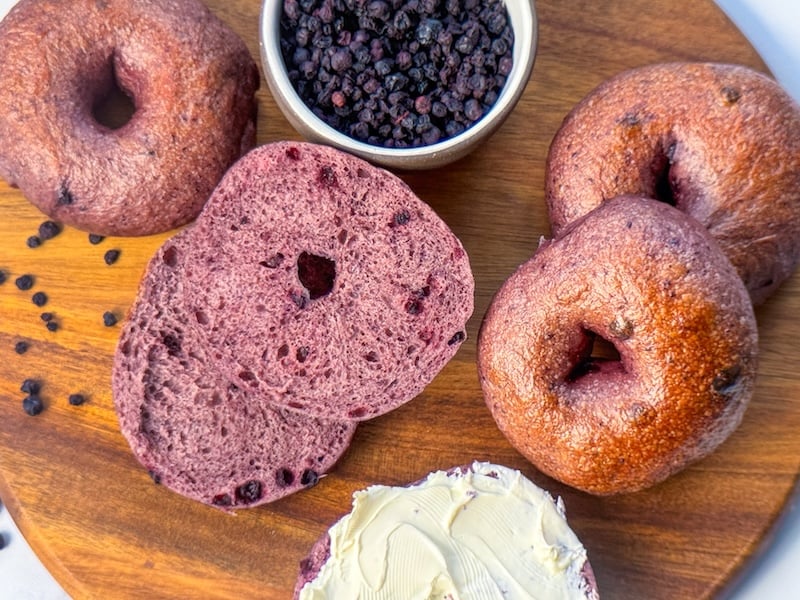
Developing a blueberry sourdough bagel recipe was way harder than I thought it’d be. The biggest challenge? Tasting the dang blueberries!
The key ended up being two forms of wild blueberries in the dough – and yes, wild truly is key here! Their flavor is considerably stronger than that of regular blueberries, though you can technically use either.
In this guide, I’ll show you exactly how to make wild blueberry sourdough bagels at home, using real fruit and a naturally fermented dough.
This recipe required six rounds of my own testing and two rounds of community testing – with 482 home bakers – before we perfected it. But perfect it, we did!
“These are, without a doubt, the most blueberry-forward bagels I have ever had! The hint of sweetness from the maple syrup is perfect, and the lemon zest really kicks the flavor up a notch to enhance the blueberries.” –Recipe tester from River Falls, WI
Disclaimer: Some of the products I recommend in this post are affiliate links – if you choose to purchase after clicking one of my links, I may earn a small commission, which helps fund this website, recipe development, and monthly giveaways. I sincerely appreciate your support.
Why You’ll Love These Wild Blueberry Sourdough Bagels
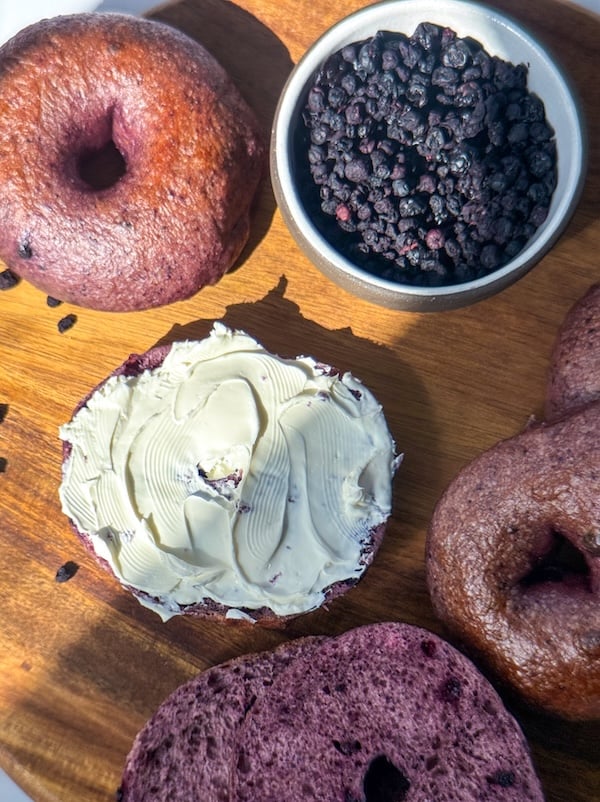
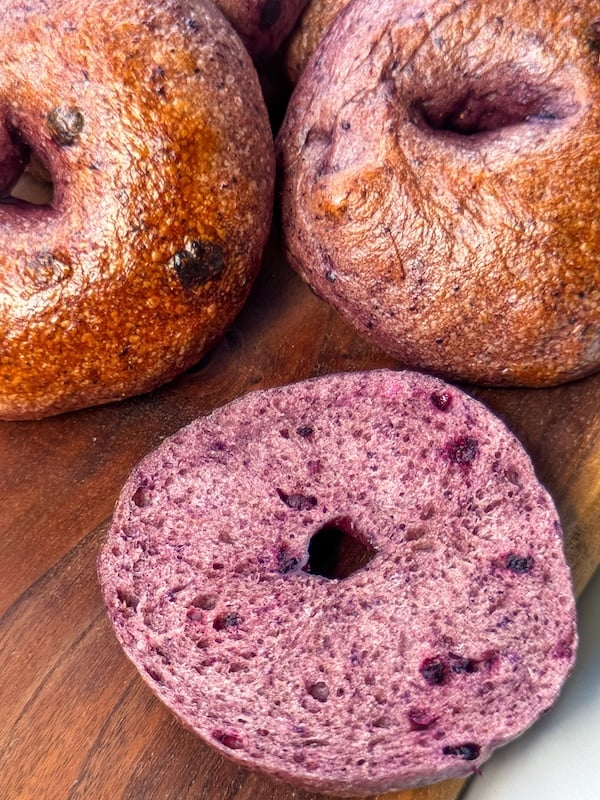
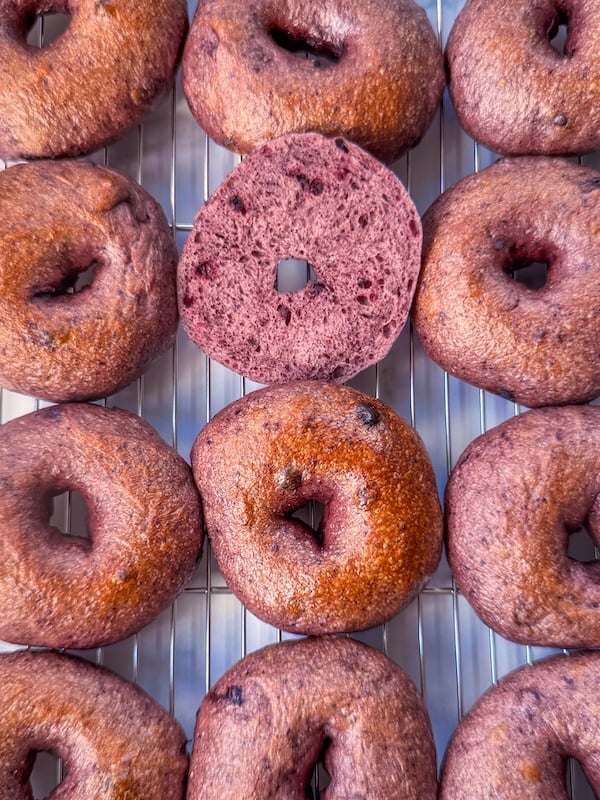
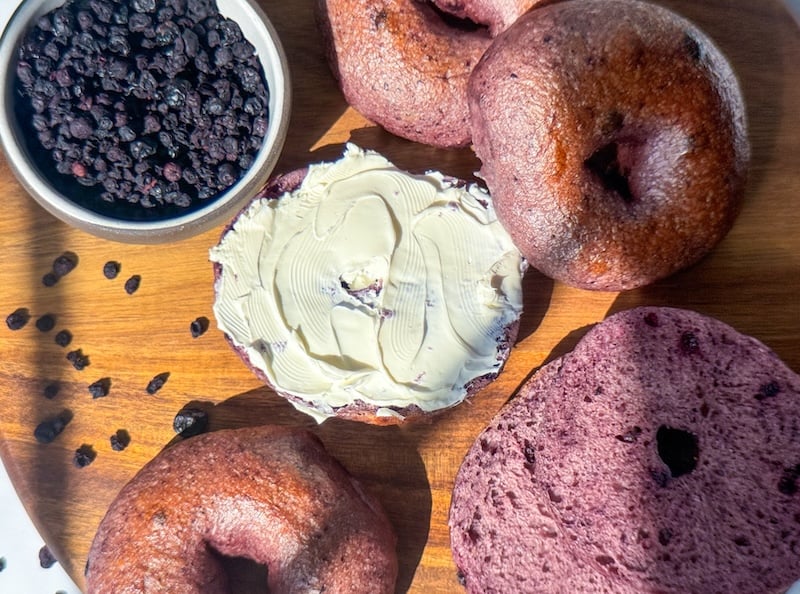
- Stunning, all-natural color: That deep purple hue? It comes entirely from 310g of wild blueberries blended right into the dough. No food coloring, just real fruit. Testers across both rounds consistently described the color as one of their favorite things about this recipe. It really is beautiful!
- Layered, genuine blueberry flavor: Between the blended blueberries in the dough and the chewy dried wild blueberries folded in, every bite is packed with real berry flavor. 86% of Version 2 testers said the sweetness and blueberry flavor were exactly right.
“Blueberry bagels were never my thing, but I know now it’s because they are usually very artificial tasting! This recipe is easy to follow, uses simple ingredients, and has a natural, delicious blueberry flavor.” –Recipe tester from CT
- Classic New York-style chewy bagel texture: A strong bread flour gives these bagels that satisfying chew you expect from a deli bagel. The boiling step with maple syrup in the water creates that signature shiny exterior. 97% of testers rated the chewiness “Good” or “Excellent.”
“I lived in the city of bagels, NYC, and this recipe is at the level of the famous bagel joints in the city.” –Recipe tester from San Juan, Puerto Rico
- Overnight fermentation = hands-off and flavorful: The bulk fermentation happens while you sleep. You wake up to a dough that’s ready to shape, and you’re boiling and baking a few hours later. If you have a really warm home, you can flip the timeline to shorten the fermentation.
- Easy enough for first-timers: Many recipe testers were first-time bagel makers, and they specifically commented on how much easier this process is than they expected. Every step is laid out in detail with tons of photos so you can nail it on your first try.
“I have never made bagels before and this was so easy. The time commitment also worked so well with my full-time job.” –Recipe tester from Denver, CO
“Since it was my first time making bagels, I was a bit nervous about a few of the steps. But as usual, the recipe and directions were spot on! I even found myself enjoying the entire process.” –Recipe tester from Bloomington, IN
- Freezer-friendly: Pre-slice, stack with parchment, and freeze for up to 3 months. Toast directly from frozen.
- Recipe tested by 482 unique home bakers: This recipe went through two full rounds of testing – 139 bakers in the first round and 383 in the second – before it was ready to publish. Version 2 earned an average rating of 4.66 out of 5, and of the 40 bakers who tested both versions, the feedback on Version 2 was overwhelmingly positive.
The Recipe Testing Journey
Six rounds of personal testing. That’s what it took before this recipe was ready to send to a single tester.
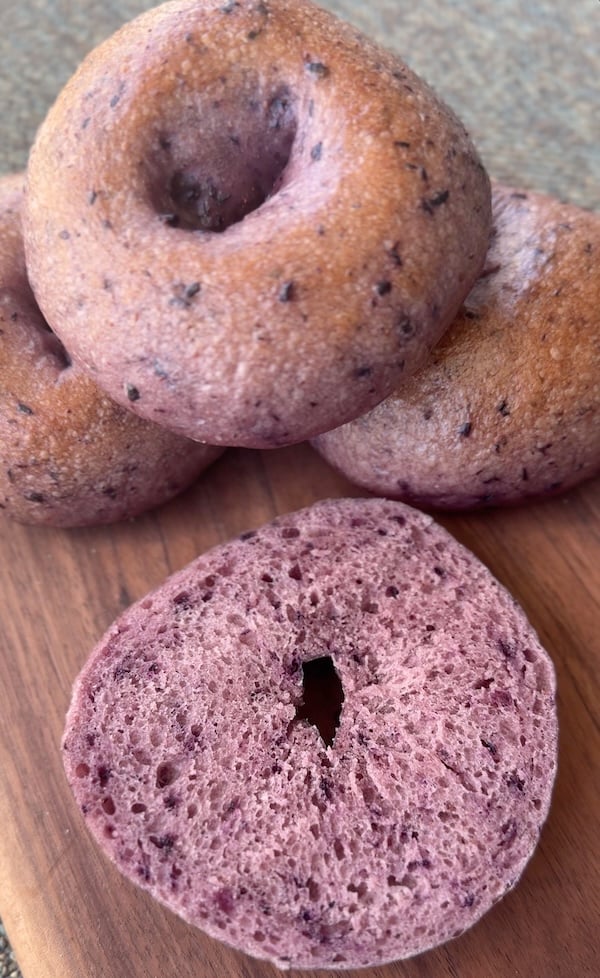
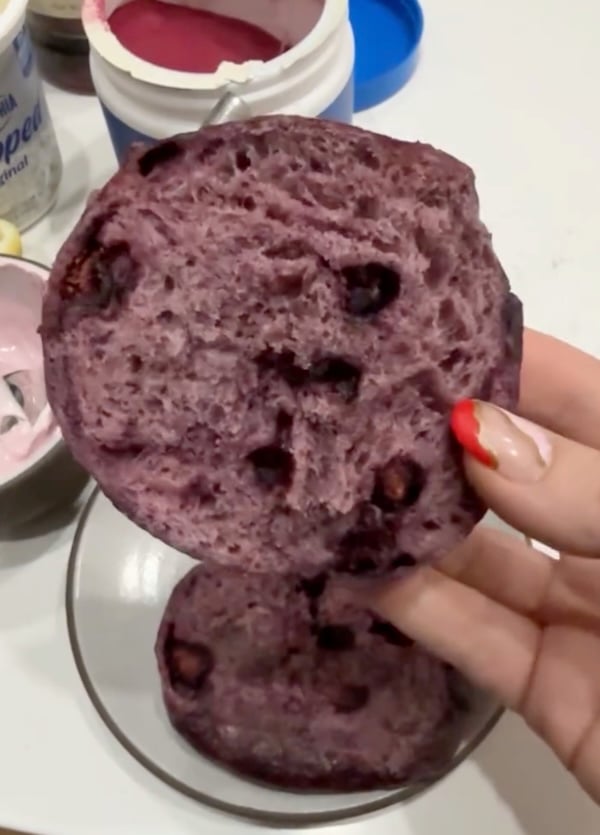
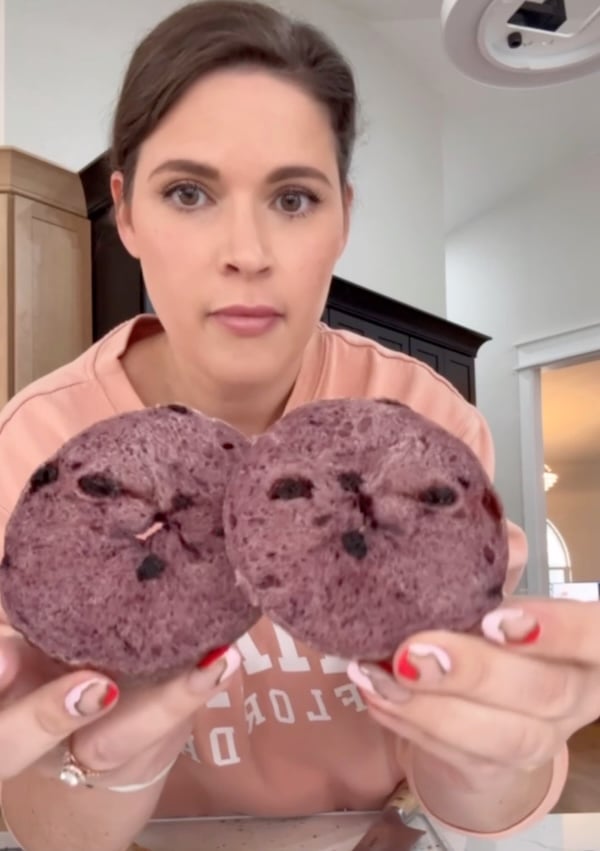
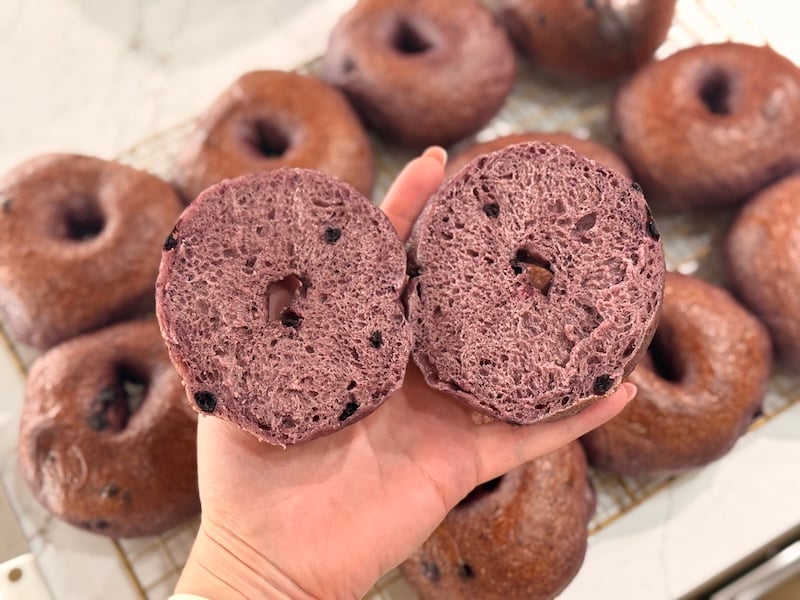
My starting point was straightforward: take my existing sourdough bagel recipe and incorporate blueberries. What wasn’t straightforward was figuring out how.
Choosing the Blueberry Format
Early tests used thawed frozen blueberries macerated with sugar and added to the dough. The flavor was there, but the dough hydration was hard to control. It felt too unpredictable for a repeatable recipe.
I tried:
- Extracting the juice separately and using it as part of the liquid (too fussy)
- Folding in freeze-dried blueberries (they got smushed)
- Store-bought blueberry juice (feedback poured in from followers saying they did not like this)
I also got lots of other suggestions – blueberry extract, freeze-dried blueberries ground into a powder, a stovetop blueberry reduction, blueberry jam…
The turning point was blending the thawed frozen blueberries completely and using that puree as part of the wet ingredients.
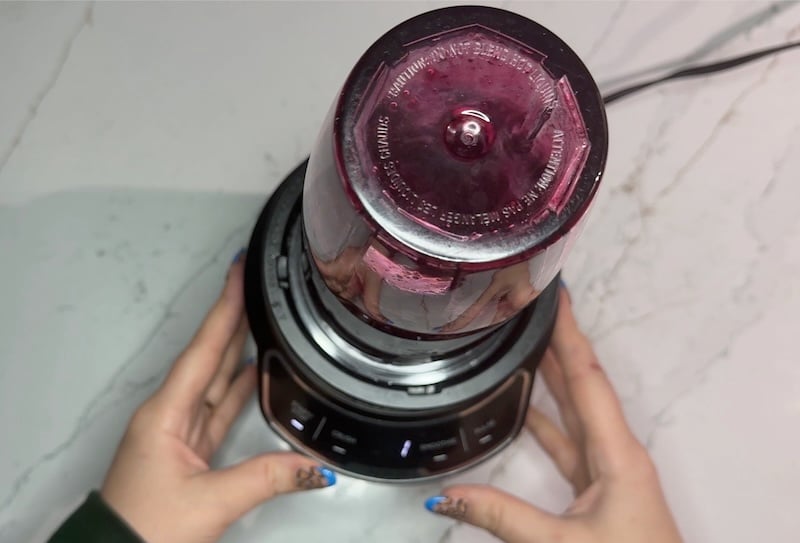
This gave a consistent, deep blueberry flavor throughout the dough – and the dramatic purple color that comes with it.
Wild vs. Regular Blueberries
Switching from regular frozen blueberries to wild made a significant difference in flavor intensity.
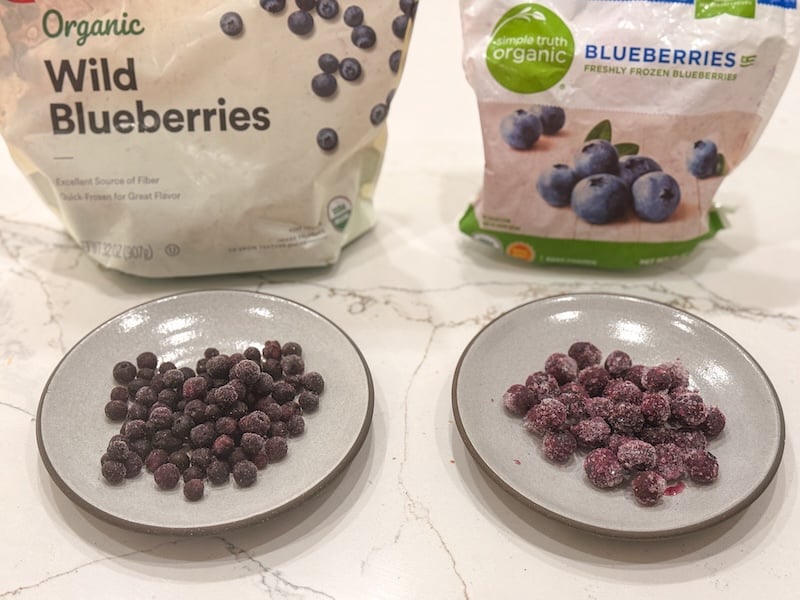
Wild blueberries are smaller, and the blueberry flavor is so much stronger – the improvement is very noticeable, and it showed up in the tester data, too.
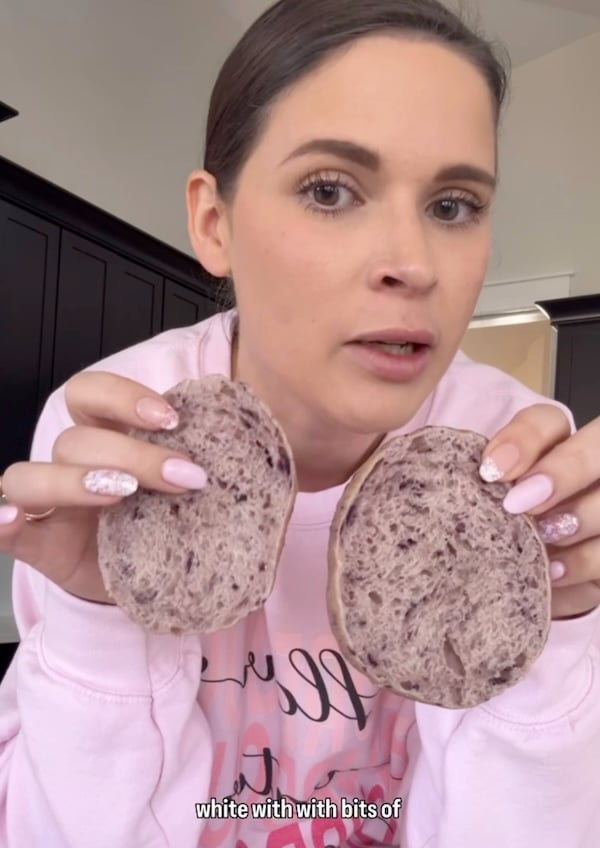
Wild blueberries also have a higher concentration of anthocyanins, the natural pigments found in deeply colored fruits and vegetables. That’s why testers who used regular (non-wild) frozen blueberries consistently reported less intense flavor and a lighter color.
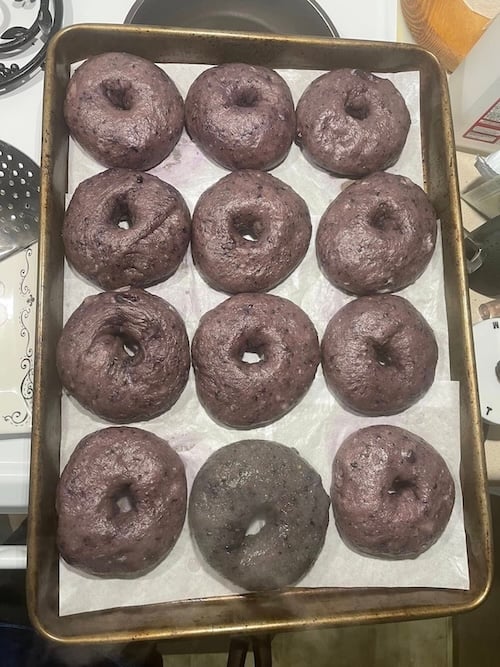
Interesting note: Anthocyanins are pH-sensitive, meaning they can change color depending on how acidic or alkaline the environment is. Adding baking soda to the boiling water makes it alkaline – and these lovely deep-purple bagels turn a surprising blue-green or grayish-green color!
Building Layers of Blueberry Flavor
Blended berries gave great color and base flavor, but we all wanted more.
Adding dried blueberries to the dough gives you an extra pop of blueberry in the finished bagel – a concentrated bit of blueberry flavor that the blended berries alone can’t provide.
Freeze-dried blueberries didn’t work well here – they got crushed during kneading and were hard to incorporate.
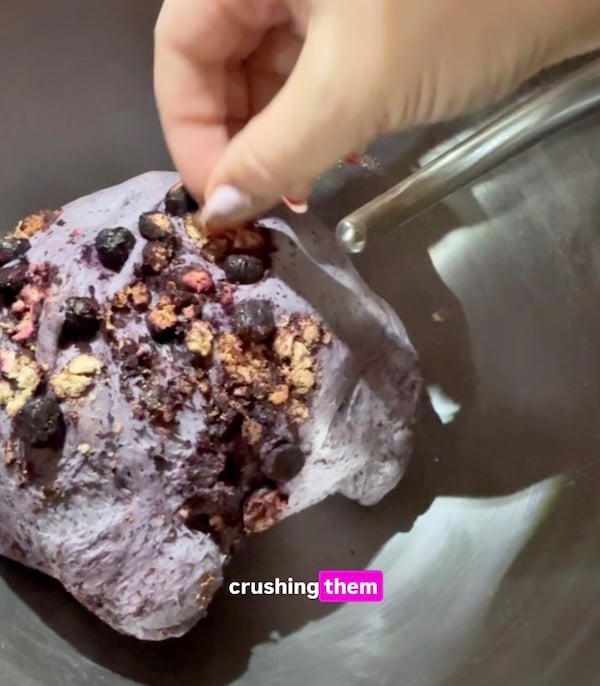
You can make it work, but you have to be gentle and perhaps lower your expectations for whole berries in the final result.
Regular dried blueberries kept their shape and were much simpler to work with.
Other Improvements
Over the course of six tests, several other changes accumulated:
- Maple syrup instead of sugar (better flavor pairing with blueberry)
- Lemon zest (brings out the blueberry flavor without making the bagels taste lemony – more on this later on)
- A touch of vanilla extract
The Recipe Testers: What 482 Bakers Thought
This recipe went through two full rounds of community testing – 139 bakers in the first round and 383 in the second – before it was ready to publish. That’s 522 total submissions, but 40 bakers tested both versions, bringing the number of unique testers to 482 across the United States, Canada, the UK, Europe, Australia, and beyond.
Version 2 earned an average rating of 4.66 out of 5, with 91% of testers saying they would absolutely or probably make it again.
Of the 40 testers who made both versions, the feedback on Version 2 was overwhelmingly positive.
The biggest win was blueberry flavor and sweetness: in Version 2, 86% said the sweetness and blueberry flavor were perfect.
“I am mostly a savory bagel girl – everything, garlic, asiago – but these blueberry bagels had me cross the street to the sweet side. You hit it out of the ballpark with this one!” –Recipe tester from Arizona
“My husband and I both thought this was the blueberry-est bagel we had ever tasted – and we are not blueberry bagel people. I think we may be converted!” –Recipe tester from Knoxville, TN
“My husband, who in 38 years of marriage has never liked a bagel he met, absolutely loved these! He said that all other bagels he’d ever had seemed dry and hard to chew, but these were more moist and enjoyable.” –Recipe tester from Fresno, CA
Here’s a collection of photos from a few of the recipe testers:

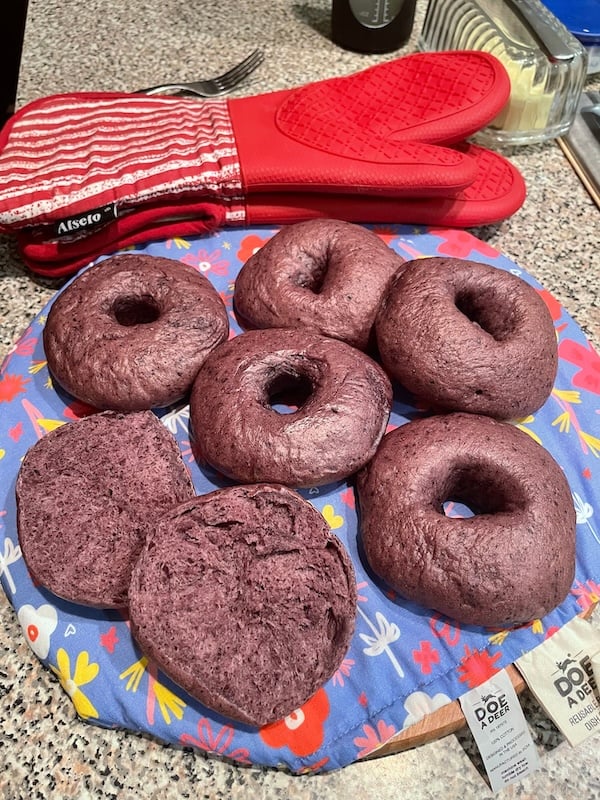
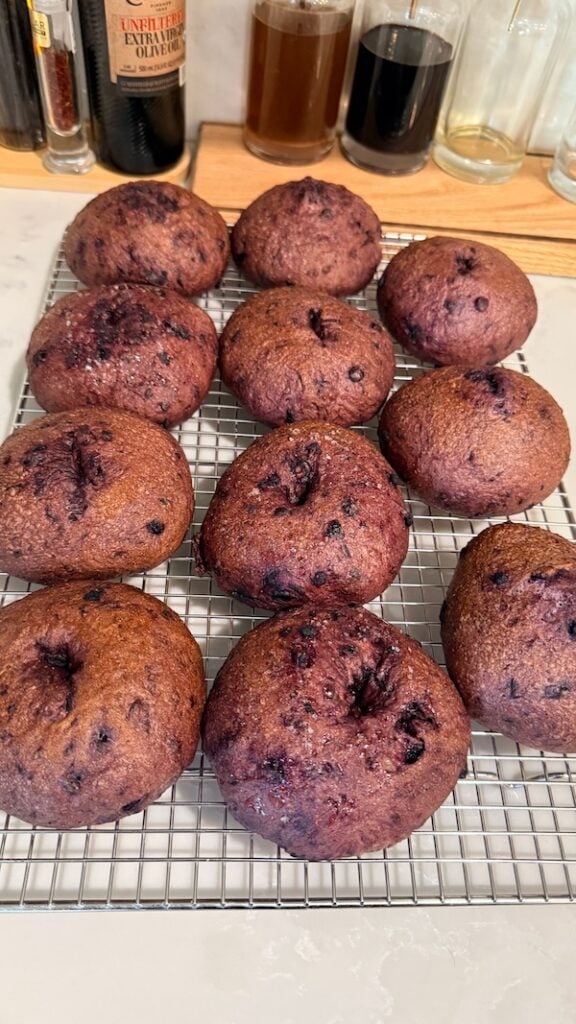
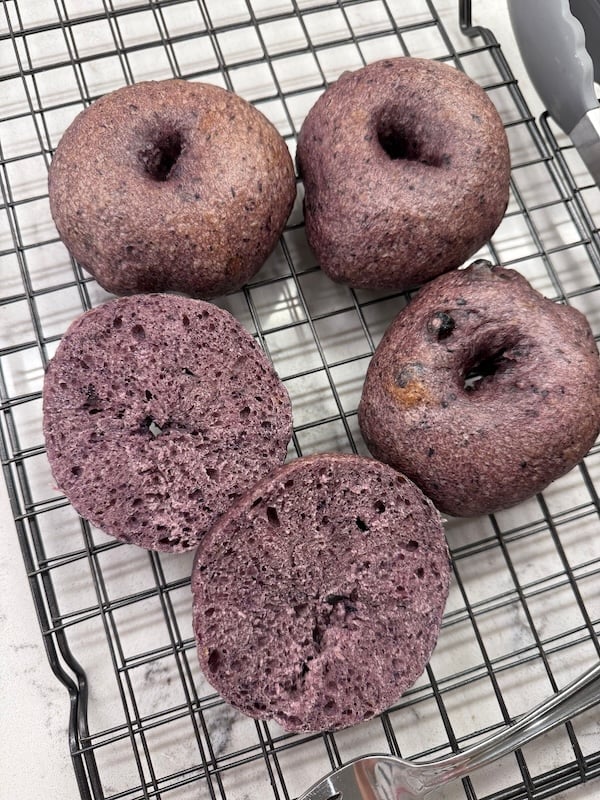
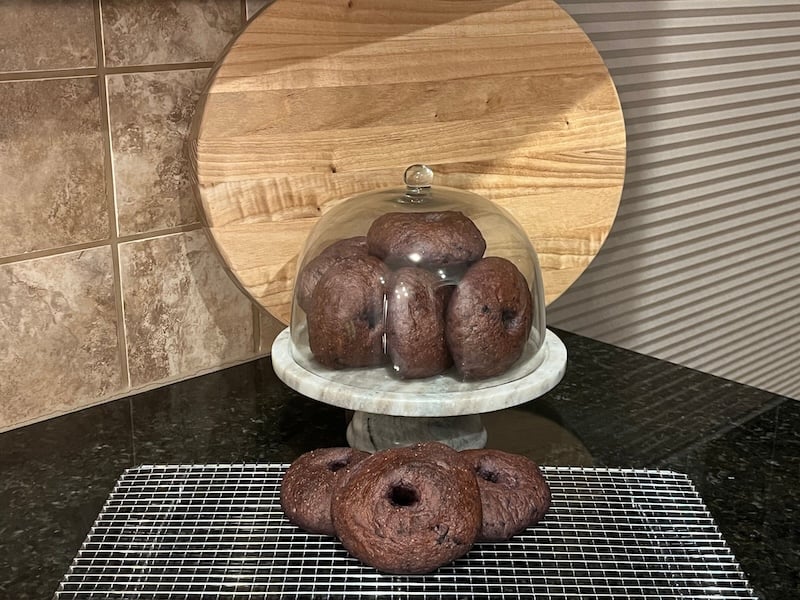

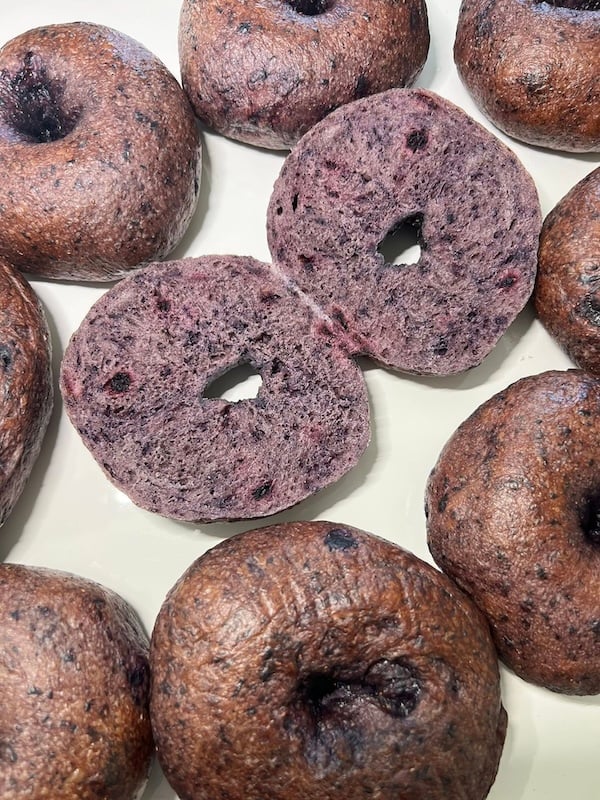
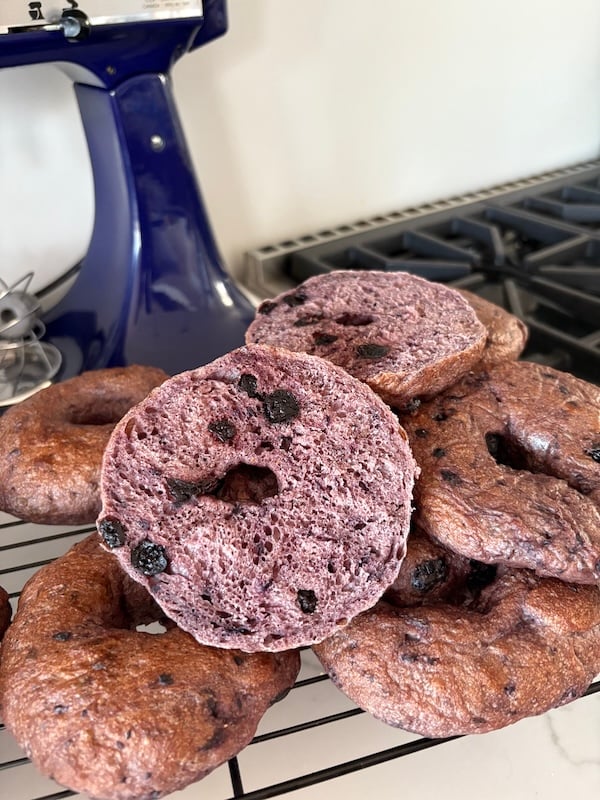
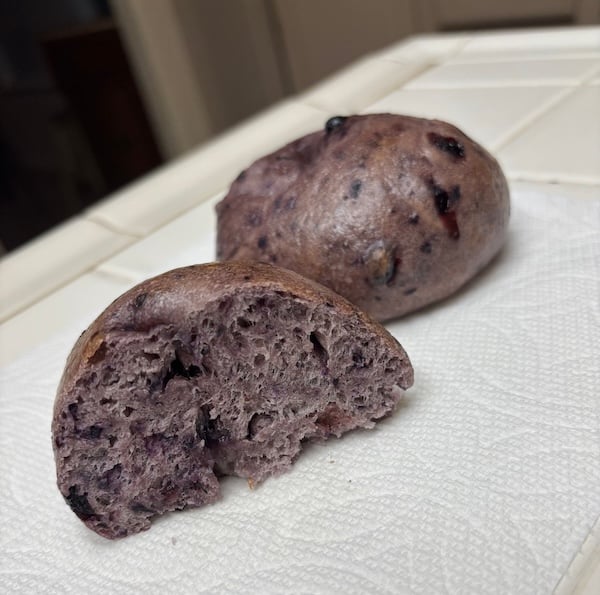
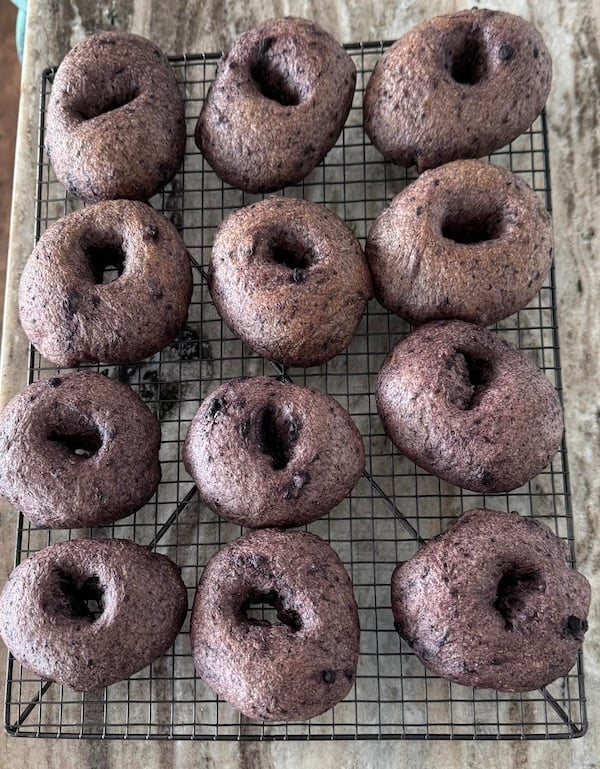
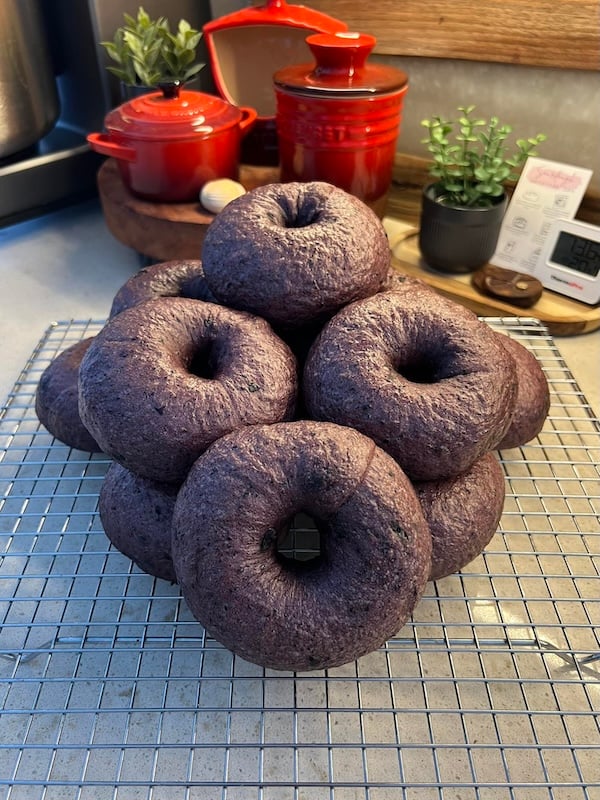
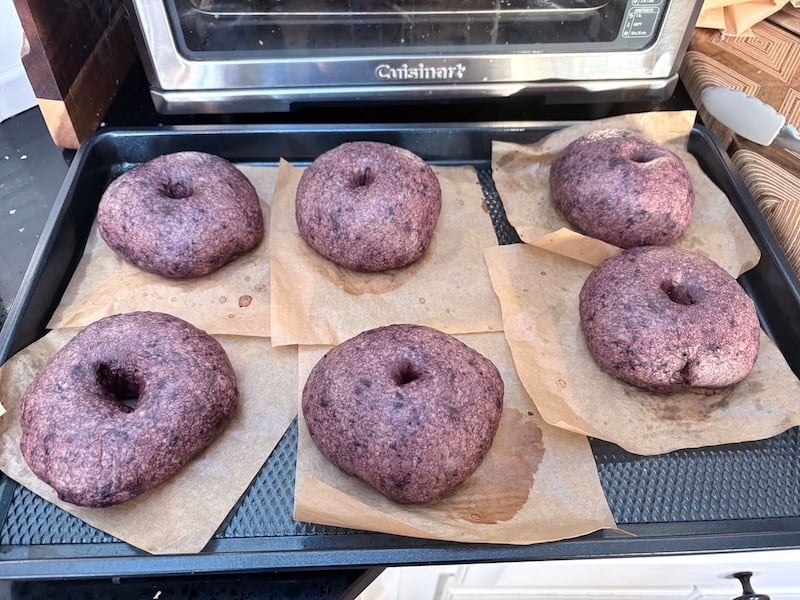
“Loved them – only problem is that I won’t be able to buy blueberry bagels from the store again.” –Recipe tester from California
“My youngest son is 22 and still lives at home. He loves this recipe so much that he offers to shop and buy the ingredients.” –Recipe tester from Sanford, NC
Baker’s Timelines (Overnight or Same-Day)
| Standard Overnight Timeline — for kitchens at 68–75°F (20–24°C) | |
|---|---|
| Stage | Step |
| Day 1 Morning | Feed your starter |
| Day 1 Evening (before bed) | Blend blueberries, mix dough |
| Day 2 Morning | Shape into bagels |
| Day 2 Mid-Morning to Midday | Second proof (4–6 hours) |
| Day 2 Midday | Boil and bake |
| Flipped, Same-Day Timeline — for warmer kitchens above 75°F (24°C) (or if using untoasted diastatic malt powder) | |
|---|---|
| Stage | Step |
| Day 1 Evening | Feed your starter |
| Day 2 Morning | Blend blueberries, mix dough; monitor bulk fermentation throughout the day |
| Day 2 Midday | Shape into bagels |
| Day 2 Afternoon/Evening | Second proof |
| Day 2 Evening | Boil and bake |
The flipped timeline prevents overproofing in warm kitchens.
It’s also the better option if you’re using untoasted diastatic malt powder, since the active enzymes will speed up fermentation and require closer monitoring.
Equipment You’ll Need
- Kitchen scale: This recipe is written in grams and was developed using metric measurements. Volume conversions are untested – use a scale for best results.
- Personal blender: For blending the thawed wild blueberries. I love using my Ninja personal blender for tasks like this!
- Microplane: To zest your lemon (if using).
- Stand mixer with dough hook: Bagel dough is stiff and dense. Mixing by hand is possible but tiring. A bread machine on the dough setting also works.
KitchenAid users: multiple testers reported their standard KitchenAid struggled with this full batch. If you have a standard KitchenAid model, consider making a half-batch or using the mixer for a few minutes, then knead the rest of the way by hand.
- Half sheet tray or two quarter sheet trays: For proofing and baking.
- Parchment squares: Each bagel proofs on its own small square of parchment, making it easy to slide them into the boiling water without deflating them. Dollar Tree carries inexpensive parchment squares that work well.

- Large pot for boiling: Wide enough to boil 4 bagels at a time comfortably.
- Slotted spoon or spider strainer: For transferring bagels in and out of the boiling water.
Ingredients for Wild Blueberry Sourdough Bagels
- Active sourdough starter: The first step of this recipe explains how to feed your starter so it’s active and ready to use. If you use discard, your bagels might turn out OK, but the results are too unpredictable for me to recommend it. For recipes like this, where the starter is responsible for raising the dough, an active, healthy starter is essential.
- Frozen wild blueberries: Measure while still frozen, then thaw and blend. Wild is strongly recommended; regular frozen blueberries work but produce less intense flavor and lighter color. My favorite wild blueberries are 365 by Whole Foods, and Wyman’s was another popular brand among testers.
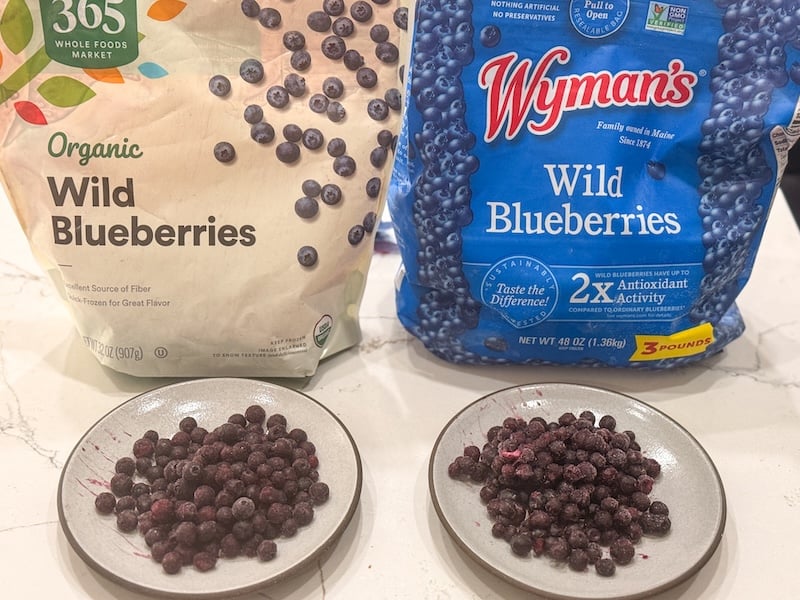
Other wild blueberry sources: a 12-oz bag of Trader Joe’s frozen wild blueberries weighed exactly 310g (what the recipe calls for), so no measuring needed! Costco also sells a 5 lb bag of frozen wild blueberries, which testers found to be a better value.
- Maple syrup: Maple syrup really brought out the blueberry flavor, compared to earlier tests with just sugar.
- Bread flour: King Arthur unbleached bread flour (12.7% protein) was used by the majority of testers and produced consistently excellent results. I personally tested the recipe with Central Milling High Mountain bread flour (13.5% protein).
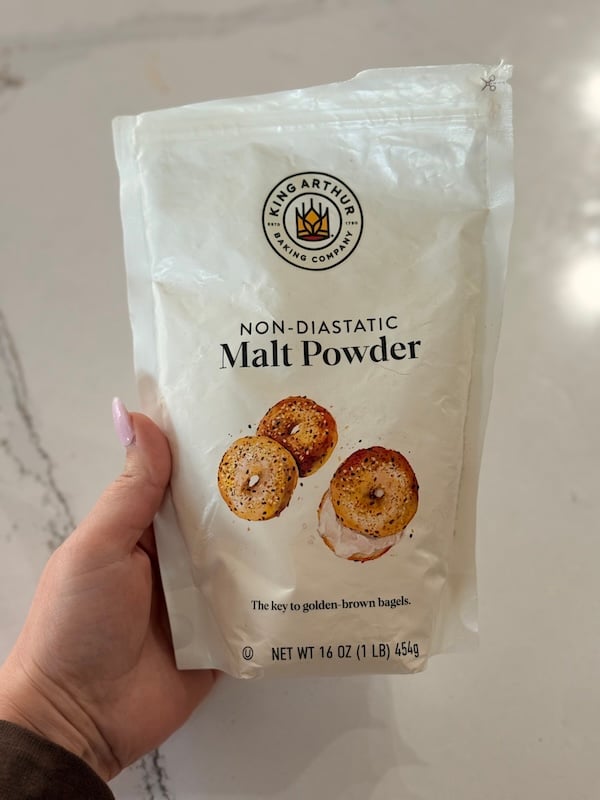
- Non-diastatic malt powder: Optional, but 92% of testers who used it said it made a clear improvement, keeping bagels squishy for up to 5 days. I used King Arthur brand (available on Amazon or from King Arthur), and Modernist Pantry is another popular option. See Substitutions if you can’t find it.
- Sea salt: Can’t forget the salt! I love Redmond’s Real Salt (15% off with code TSG15).
- Vanilla extract or paste: Not super noticeable in the final bagels, but it adds to the flavor profile and really rounds out that blueberry flavor.
- Lemon zest: Optional; see the note below on lemon zest before deciding how much to use.
- Dried wild blueberries: Chewy, like raisins. Do not use freeze-dried blueberries – the mixer will crush them during kneading. If using regular (not wild) dried blueberries, I recommend increasing the quantity by about 3x.
For the Boiling Water
- Maple syrup, brown sugar, or honey: I like using maple syrup in the boiling water to mirror the maple flavor in the dough. It adds a little sweetness and helps with browning. But brown sugar or honey also works great. Do NOT add baking soda to the boiling water – it creates an alkaline environment that reacts with the blueberry pigment, turning your bagels a murky blue-green or gray-green color.
A Note on the Lemon Zest
The lemon zest was the most discussed ingredient in the Version 2 survey, and the feedback was genuinely split – so I want to be upfront about it.
Many testers described it as a flavor amplifier that made the blueberry taste brighter without tasting overtly lemony. A meaningful minority felt it was too forward and said they’d reduce or omit it next time.
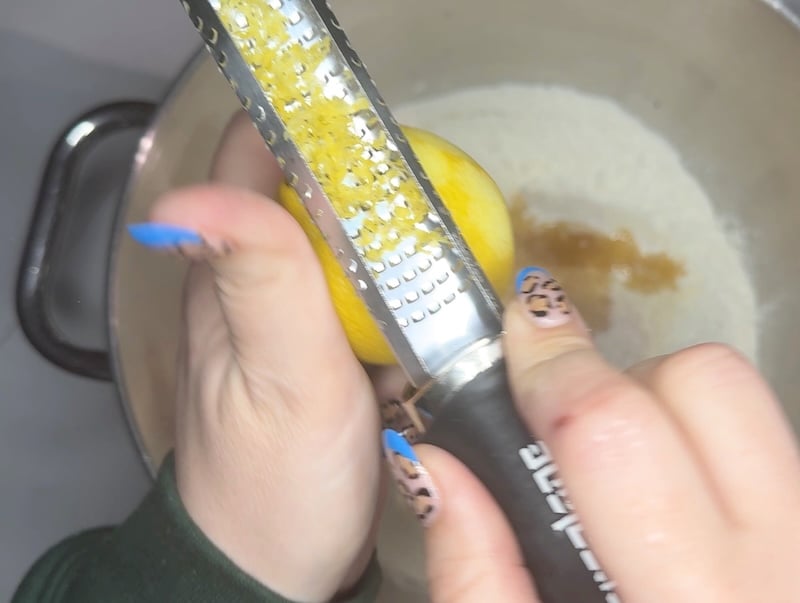
If you’re sensitive to lemon or want a purer blueberry flavor, either omit the lemon zest entirely or start with 1 teaspoon and adjust to your taste.
“These are so tasty! Great chewy texture without being tough, great real blueberry flavor. The lemon is nice too, but doesn’t overpower the blueberry flavor.” –Recipe tester from Oklahoma
Ingredient Substitutions
- Bread flour: King Arthur unbleached bread flour (12.7% protein) was the most popular among testers. Central Milling High Mountain, Bob’s Red Mill Artisan Bread Flour, and Dakota Maid all worked well. International testers had success with bread flour from Canada, Australia, the UK, and Germany. If using a lower-protein all-purpose flour — such as Costco’s Kirkland Signature all-purpose (~11.5% protein) — add 1 tbsp of vital wheat gluten or reduce the water slightly; several testers successfully used Costco’s AP with the added gluten.
- Non-diastatic malt powder: This ingredient is hard to find locally and frequently back-ordered online. It was the most common availability issue testers reported in the survey.
Your options:- Toast diastatic malt powder at 325°F (160°C) for about 5 minutes to deactivate the enzymes, allowing it to behave like non-diastatic malt powder in this recipe. It may clump while toasting, so sift before using.
- Use diastatic malt powder, untoasted, but mix the dough in the morning so you can monitor fermentation (the active enzymes speed it up).
- Omit it entirely – your bagels will stale a bit faster. One international tester successfully used non-diastatic malt liquid (similar in consistency to molasses) as a substitute.
How to Make Wild Blueberry Sourdough Bagels (Step-by-Step)
Step 1: Feed Your Starter (Day 1 Morning)
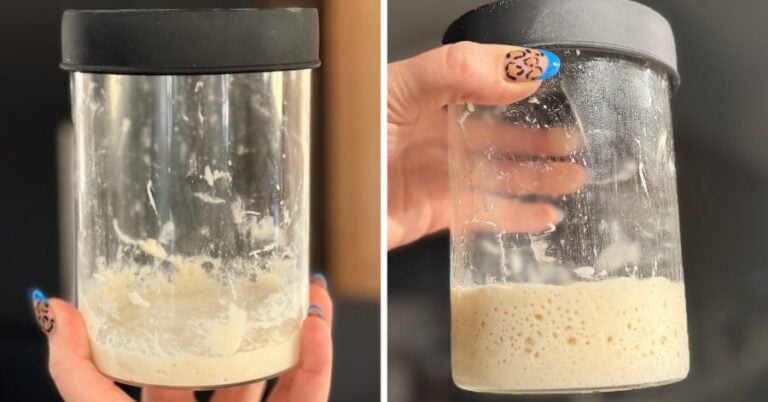
This recipe uses 100g of active starter. In the morning, mix together 10g sourdough starter, 50g water, and 50g flour. Cover loosely and let sit at room temperature for 10–12 hours until bubbly, active, and at or near its peak.
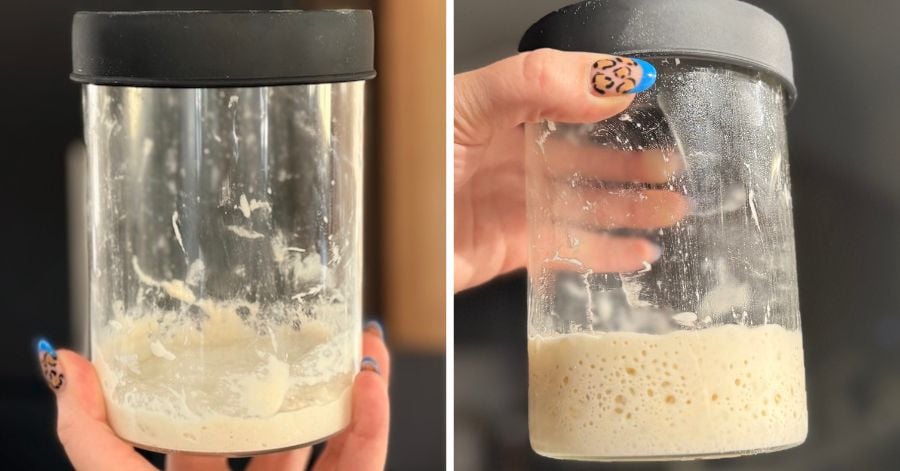
This makes slightly more starter than you need, which is intentional. Skip this step if your starter is already active and bubbly.
Step 2: Blend the Blueberries (Day 1 Evening, Before Bed)
About 10–12 hours after feeding your starter, measure 310g of frozen wild blueberries while still frozen, then thaw them. Microwaving on low for a few minutes is the fastest method — 73% of testers used this approach — but thawing them on the counter works too.
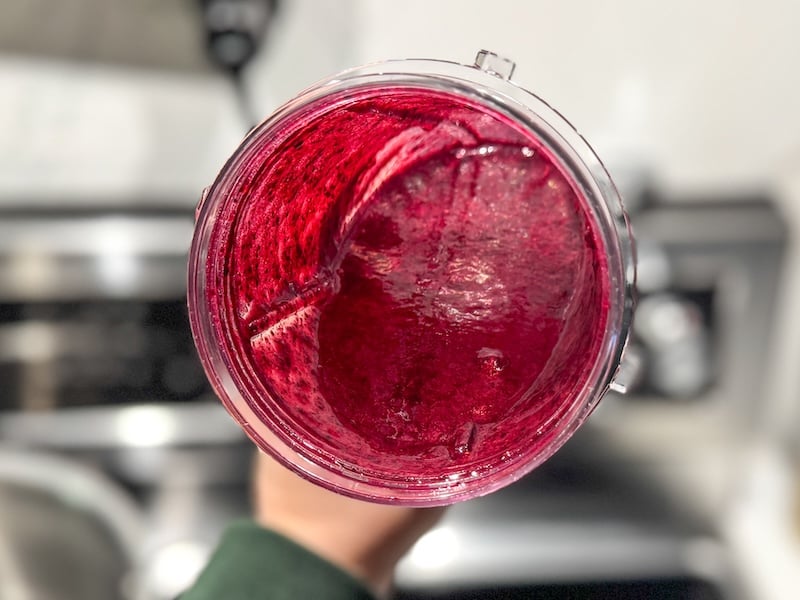
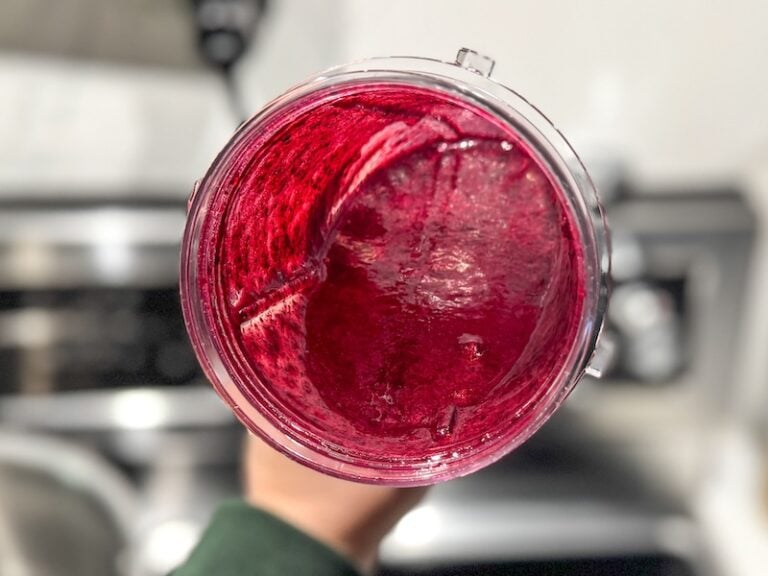
Once thawed, blend until completely liquefied into a smooth, deep purple puree.
Step 3: Mix the Dough
In a stand mixer fitted with the dough hook, combine the blueberry puree, 100g active sourdough starter, 175g water, 100g maple syrup, 825g bread flour, 25g non-diastatic malt powder (if using), 15g sea salt, 10g vanilla extract, 1 tbsp lemon zest (if using), and 25g dried wild blueberries.
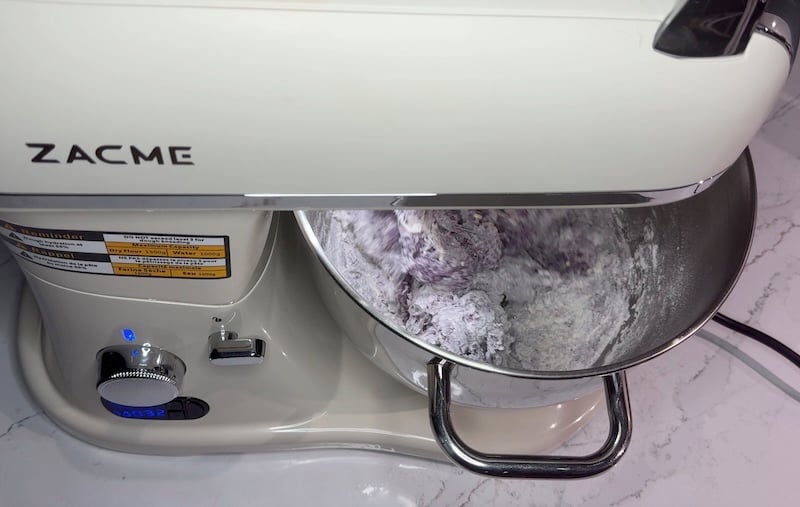
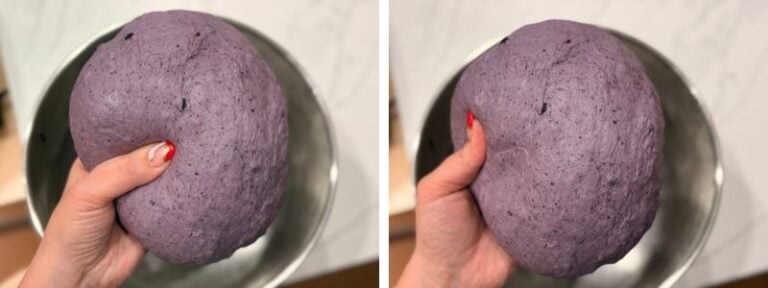
Mix on low speed (Speed 1–2) for 5–10 minutes, until smooth. The dough should be stiff and slightly tacky — think playdough.
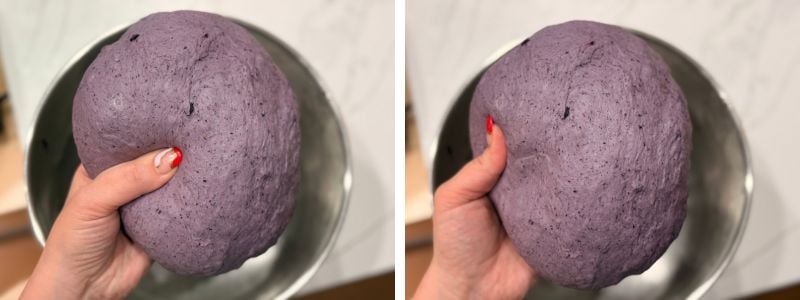
Cover and rest for 30–60 minutes. If you have time, knead again on low speed (or by hand) for 1–2 minutes. If you don’t, it’s totally fine to skip this extra knead.
Too sticky? The blueberry puree can vary in water content depending on the brand and type you used. If your dough is sticky and clings to the sides of the bowl, add flour in 1 tbsp increments until it matches the texture of my dough.
KitchenAid note: If your mixer is straining, stop and let it rest 10–20 minutes before resuming. You can also finish the kneading by hand or consider making a half batch.
Mixing by hand: Combine with a Danish dough whisk, then knead for about 10–15 minutes. Yes, it’s a heck of an arm workout, but it’s doable! Rest the dough for 30 minutes and knead for 1–2 minutes more.
Step 4: Bulk Fermentation (Overnight)
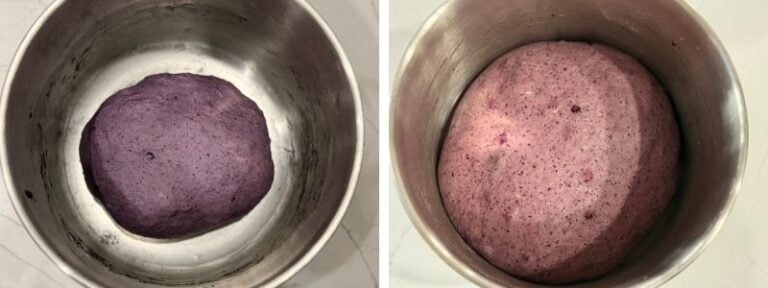
Cover and let bulk ferment on the counter overnight — 8–12 hours at 68–75°F (20–24°C). The dough should roughly double in size.
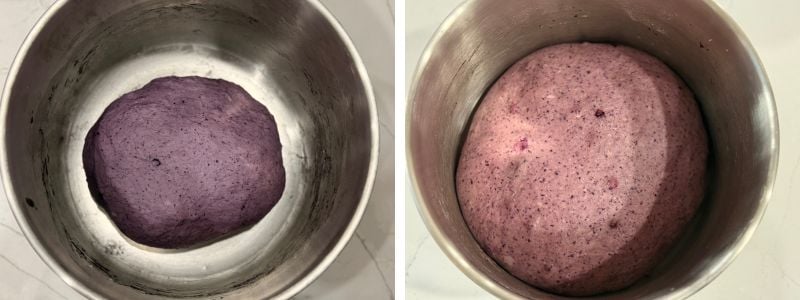
Among testers, the sweet spot was 70–73°F (21–23°C). Cooler kitchens below 65°F (18°C) may need 14–16 hours or more.
If your kitchen runs above 75°F (24°C), use the flipped timeline from the Baker’s Timeline section.
Step 5: Shape the Bagels (Day 2 Morning)
Divide the dough into 12 equal pieces, about 130g each.
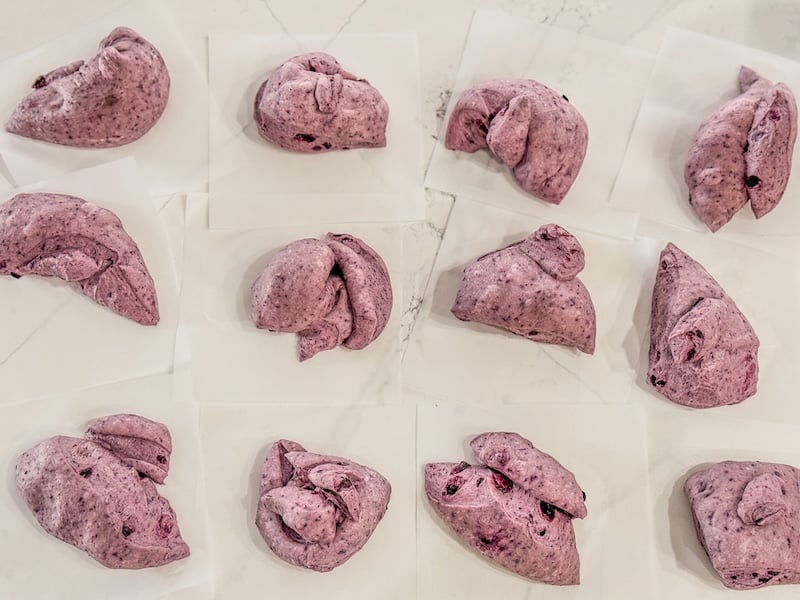
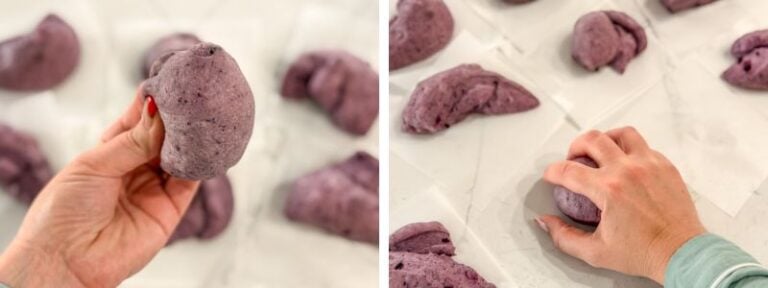
Shape each piece into a taut ball and place on individual parchment squares on a sheet tray. Lightly flour your fingers if needed.
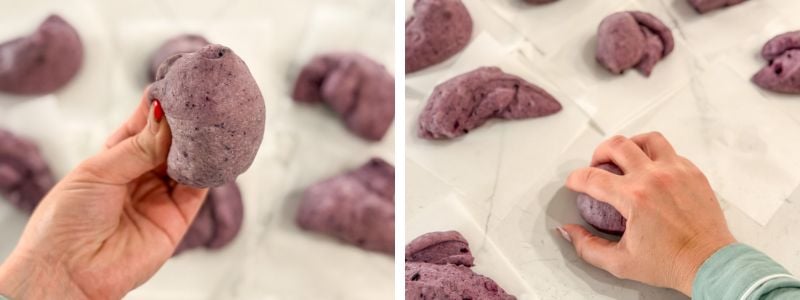
Shaping note: The dried blueberries create small bumps that make it harder to get a perfectly smooth ball — about 10% of testers mentioned this. It’s a cosmetic issue, not a structural one. The bagels still turn out beautifully.
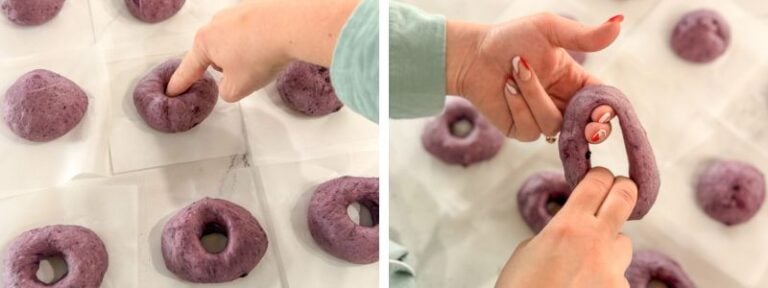
Poke a hole through the center of each ball with your finger. Use both index and middle fingers to gently stretch and rotate the hole open.
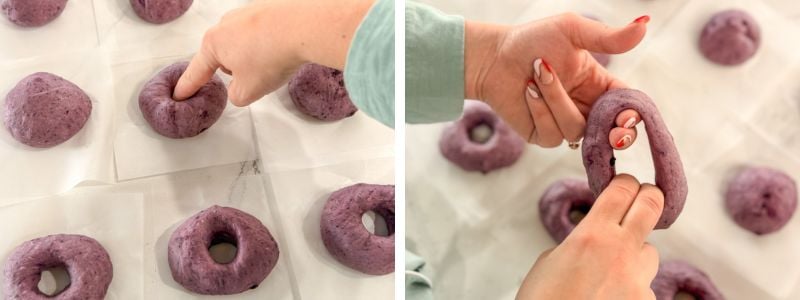
Make it about twice as large as you want the final hole to be — it will shrink during the second proof and again during boiling.
Step 6: Second Proof
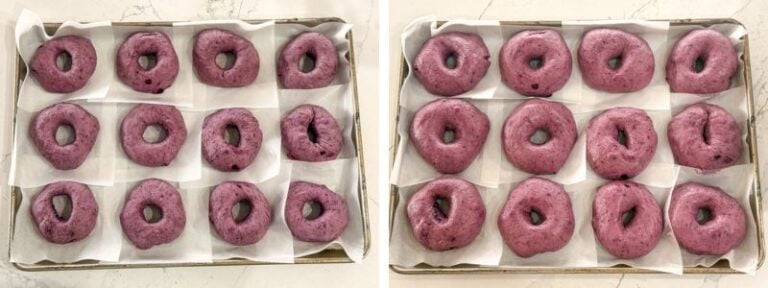
Cover the sheet tray loosely with plastic wrap or a sheet tray cover (I’m OBSESSED with my new one!!) and proof at room temperature, 68–75°F (20–24°C), for 4–6 hours, until visibly puffed and about 50% larger.
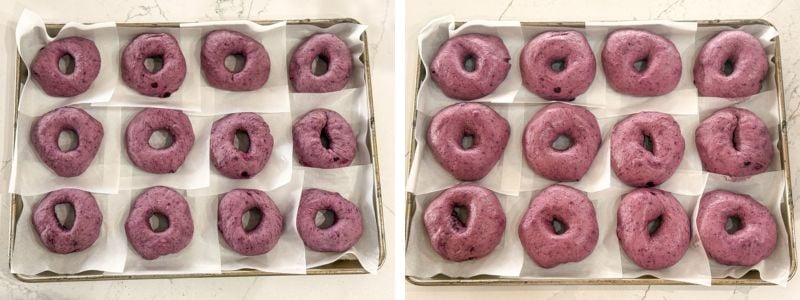
Optional cold proof: Refrigerate shaped bagels for 8–36 hours for a tangier flavor and potentially easier digestion. You can refrigerate them immediately after shaping (finish the second proof at room temp before boiling), or complete the second proof first and refrigerate until ready to boil. I prefer the former, but either method works!
Step 7: Boil
Preheat the oven to 450°F (230°C) conventional or 425°F (220°C) convection. Bring a large pot of water to a boil and add 2 tbsp maple syrup (or honey or brown sugar).
Do not add baking soda to the boiling water. It will react with the blueberry pigment, turning your bagels a greenish color.
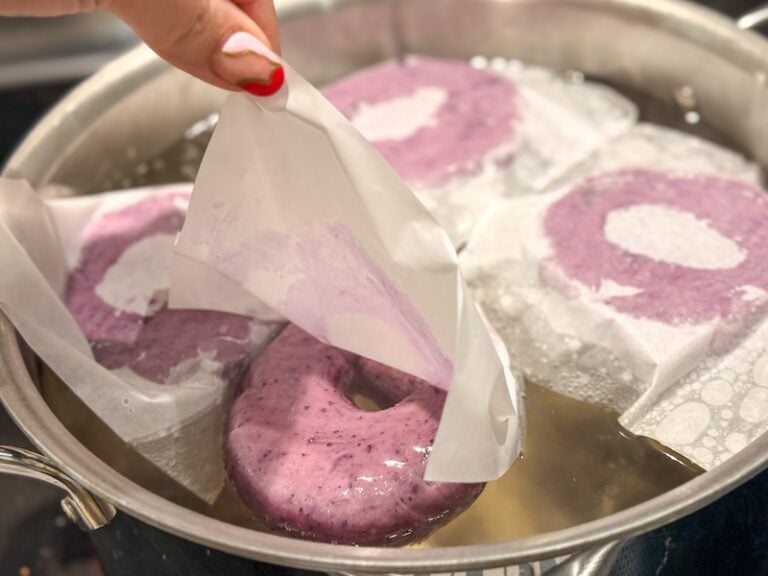
Working in batches of 4, slide the bagels (still on their parchment squares) into the water.
Important: If a bagel sinks to the bottom, it’s underproofed. Remove it, return it to the sheet tray, and give it more time to proof.
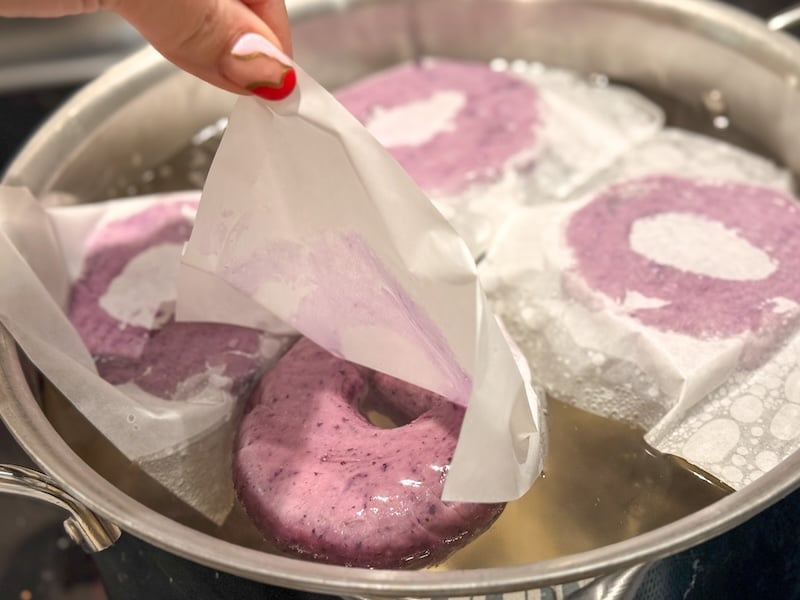
The parchment will peel off as the bagels hit the water – remove it with your fingers (be careful!) or tongs. Boil for 1 minute per side, then transfer back to the sheet tray with a slotted spoon.
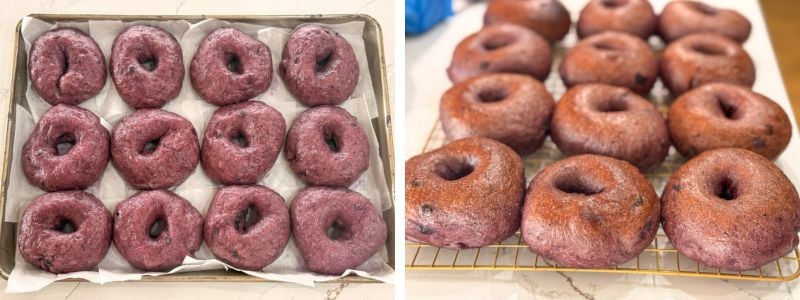
Note: When you drop bagels in, the rolling boil will settle to a simmer. This is normal – you don’t need to wait for it to return to a full boil before starting your 1-minute timer.
Step 8: Bake
Bake for 15–20 minutes, until the tops are just starting to brown and the internal temperature reaches 205–210°F (96–99°C).
Most testers landed in the 15–19 minute range. A few testers with hotter ovens needed only 13–15 minutes — watch your first batch closely.
Transfer the bagels to a cooling rack and let them cool before slicing.
Storing and Reheating
Counter storage: Keep bagels in a bread bag or airtight container at room temperature for up to 5 days. The non-diastatic malt powder contributes significantly to this shelf life — multiple testers noted their bagels stayed soft for 4+ days when it was included.
- I love these bread bags from Doe a Deer — use code THATSOURDOUGHGAL for 15% off.
- These paper bread bags from Sis & Co Collective are also great for storing on your counter or gifting.
Troubleshooting Common Bagel Problems
FAQs
Active starter only. Discard will be too unpredictable in a recipe like this one and makes troubleshooting very difficult. Feed your starter consistently for a few days beforehand and make sure it’s clearly bubbly and active before you start.
Yes, though the dough is very stiff. Mix with a Danish dough whisk, then knead by hand for 10–15 minutes. Rest 30 minutes, then knead 2–3 more minutes. Several testers also successfully used a bread machine on the dough setting.
Yes – cut all quantities in half for 6 bagels; the timeline stays the same. The 0.5x button on my recipe card will automatically adjust the ingredient amounts. The smaller batch also works better for standard KitchenAid mixers, since the dough is quite stiff.
Boiling sets the outer crust before the bagels go into the oven, which creates the chewy texture and shiny exterior that bagels are known for. It also helps them hold their shape during baking. Skipping the boiling step will result in a softer, bread-like texture instead of a classic bagel crust.
Testers who used regular frozen or dried blueberries consistently reported less intense flavor and lighter color. Wild blueberries are smaller and more concentrated in flavor, which produces the deeper purple color and stronger blueberry taste in these bagels. Trader Joe’s, Costco, and most major grocery stores carry them frozen.
The recipe includes a quick blueberry cream cheese: mix whipped cream cheese with a little lemon juice, maple syrup, and a couple of thawed frozen blueberries, smashed to taste. Testers frequently mentioned it as the perfect pairing for these bagels.
Other bagel variations to try:
- Easy Overnight Sourdough Bagel Recipe (Plain Bagels)
- Overnight Double Chocolate Sourdough Bagels
- Sourdough Cinnamon Crunch Bagels (Panera Copycat)
Overnight Wild Blueberry Sourdough Bagels
Equipment
- Personal blender for blending the blueberries
- Microplane for zesting the lemon
- Stand mixer with dough hook
- Half sheet pan or two quarter sheet trays
- Half sheet pan cover A fantastic alternative to plastic wrap!
- Parchment squares Dollar Tree has really cheap ones, too!
- Large pot for boiling
Ingredients
Feed Your Starter
- 10 g sourdough starter
- 50 g water
- 50 g flour
Main Dough
- 310 g frozen wild blueberries wild is best!
- 100 g active sourdough starter that you made from above
- 175 g water
- 100 g maple syrup or honey
- 825 g bread flour
- 25 g non-diastatic malt powder make sure it's NON-diastatic (optional; see Notes)
- 15 g sea salt
- 10 g vanilla extract or paste
- 1 tbsp lemon zest optional (enhances blueberry flavor)
- 25 g dried wild blueberries if not wild, see Notes*
For the Boiling Water
- 2 tbsp maple syrup or brown sugar or honey
Before You Begin

Instructions
Day 1: Feed Your Starter & Mix Your Dough
- Feed your starter: In the morning, feed your starter 10 g sourdough starter, 50 g water, and 50 g flour. This makes slightly more than needed. Skip if your starter is already active and bubbly.

- Blend the berries: About 10–12 hours later (before bed), measure 310 g frozen wild blueberries while still frozen; then thaw. I recommend defrosting in the microwave for speed. Once thawed, blend until liquefied.

- Tip for the next step: after pouring the blueberry mixture into your bowl, measure the water directly in the blender and swirl to rinse – this captures every last bit of the mixture for accurate measurements.
- Mix the dough: In a stand mixer fitted with the dough hook, combine the blended blueberry mixture, 100 g active sourdough starter, 175 g water, 100 g maple syrup, 825 g bread flour, 25 g non-diastatic malt powder, 15 g sea salt, 10 g vanilla extract, 1 tbsp lemon zest, and 25 g dried wild blueberries. See Notes for non-wild blueberry substitution.Knead on low speed (speed 1–2) for about 5–10 minutes, until smooth. The dough should be stiff and slightly tacky – think playdough.If your dough is sticky and clings to the sides of the bowl, add flour in 1 tbsp increments until it matches the texture of my dough.Cover and rest 30–60 minutes. Optional: knead again on low speed (or by hand) for 1–2 minutes.

- Bulk ferment: Cover and let bulk ferment on the counter overnight (8–12 hours at 68–75°F/20–24°C). The dough should about double in size.
Day 2: Shape, Boil, & Bake
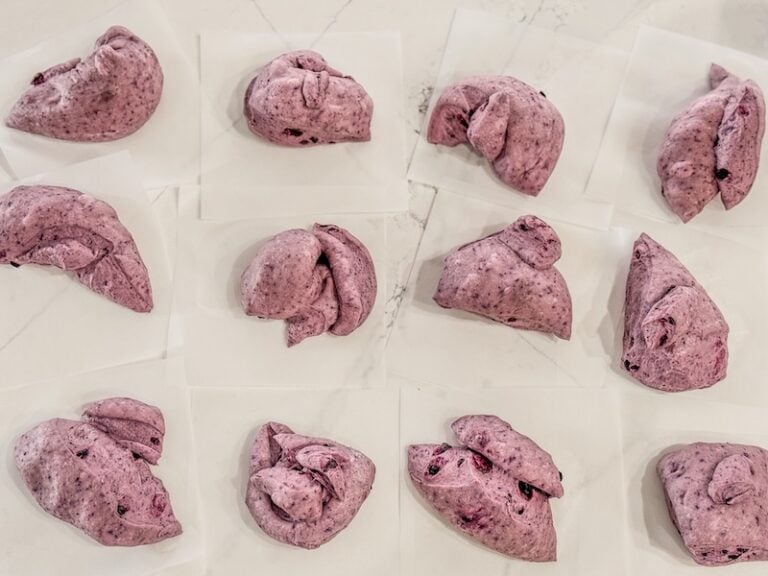
- Shape: The next morning, divide the dough into 12 equal pieces (about 130g each).
- Shape each piece into a taut ball and place on individual parchment squares. Lightly flour your fingers if needed – if dough is sticky, reduce water by 10–20g next time.
- Poke a hole through the center with your finger. Using both index and middle fingers in the hole, gently stretch and rotate to widen it. Make it twice as large as you want your final bagel hole to be – it'll shrink up during the second proof.
- Second proof: Cover the sheet tray with plastic wrap or a sheet tray cover and let rise on the counter for 4–6 hours (68–75°F/20–24°C) until visibly puffed and about 50% increased in size. For me, it took 5.5 hours at 71°F (21.5°C). A warm spot or proofing box will speed this up if desired.
- Optional cold proof: Refrigerate shaped bagels for 8–36 hours for tangier flavor/easier digestion. Either refrigerate immediately after shaping (then finish the second proof at room temp before boiling), or complete the second proof first and refrigerate until ready to boil.
- Boil: Preheat the oven to 450°F (230°C) conventional [or 425°F (220°C) convection] and bring a large pot of water to a boil. Add 2 tbsp maple syrup to the boiling water.Do not add baking soda to the boiling water. It reacts with the blueberry pigment and can turn the bagels greenish.
- Working in batches of 4, slide bagels (on parchment squares) into the water. Important: If your bagel sinks to the bottom of the pot, it is not ready for boiling. Put it back on the sheet tray and let it continue proofing.The parchment will peel off – remove it and set back on the sheet tray. Boil the bagels 1 minute per side, then transfer back to the sheet tray with a slotted spoon.Note: When you drop the bagels in, the water will adjust from a rolling boil to a simmer. This is normal. You do not need to wait for the water to return to a rolling boil to start the 1-minute per side timer.
- Bake: Bake the bagels for 15–20 minutes, or until the tops are starting to brown and the interior temps at 205–210°F (96–99°C).
- Storage: I store these bagels in a bread bag on my counter for up to 5 days. Or pre-slice, place parchment between halves, and freeze in a zip-top bag for up to 3 months.

Video

Notes
- Use diastatic malt powder instead: Toast at 325°F (160°C) for 5 minutes to deactivate the enzymes, then sift after cooling to remove any lumps. Once toasted, use it just like non-diastatic.
- Use diastatic malt powder, untoasted: Mix your dough in the morning instead of overnight so you can monitor fermentation – the active enzymes will speed it up.
- Omit it entirely: Your bagels will just stale a bit faster.
If you’re up for a challenge, here’s the sweet bagel recipe you should try next: Overnight Cinnamon Raisin Swirl Sourdough Bagels (Advanced Recipe)
Conclusion
I’m really proud of how much love went into this recipe!
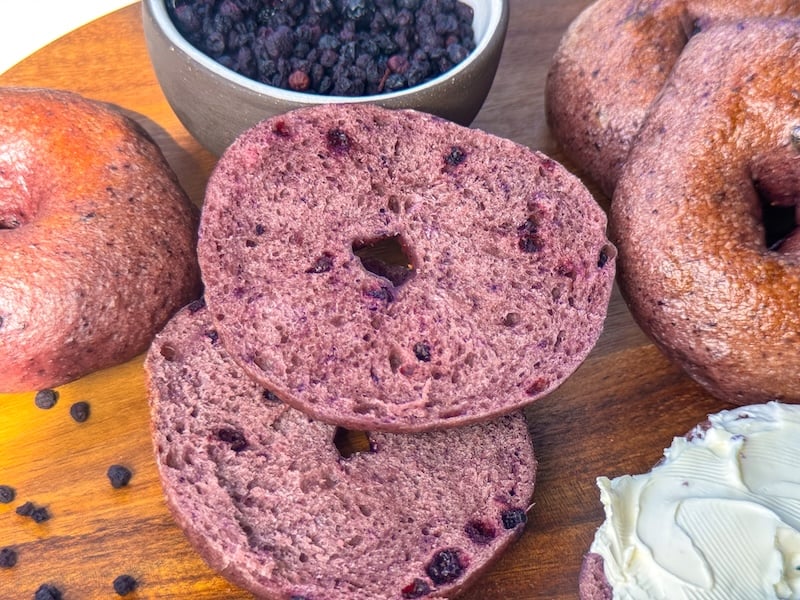
So many people are accustomed to the artificial blueberry flavor in most store-bought bagels that getting something with that same intensity, but made from real blueberries, was genuinely hard to pull off.
Six personal test rounds and two rounds of community testing later, I think we nailed it.
“These are hands down the best blueberry bagels I’ve ever had! Better than anything I’ve ever bought!!” –Recipe tester from Indiana
“Even if you’ve never made bagels before, you absolutely must try this easy-to-follow recipe! It is out of this world and packs a delicious punch of blueberry flavor melded with a hint of lemon.” –Recipe tester from St. Paul, MN
“I don’t even need to put cream cheese or butter on these. They are absolutely amazing.” –Recipe tester from Coeur d’Alene, ID
I’d love to see your purple bagels! Leave a comment below, rate the recipe, and tag me on Instagram @thatsourdoughgal.
Other sourdough breakfast recipes you might love:


Easy recipe and flavorful bagels. I used regular dried blueberries as I could not find the wild ones or frozen wild blueberries. The dough is a pleasure to work with. Bagels came out perfect and the flavor is second to none.
Lovely!!! Thanks for sharing!
Cannot recommend these enough! I had never made bagels before and these were so easy and delicious! Great flavor, soft, and chewy! I froze a few and they tasted just as good as fresh.
Beautiful!! Thanks for sharing Jessica!!
These turned out so well. Love them!
I have made this recipe multiple times already and EVERYONE I’ve shared them with is blown away by the delicious, natural blueberry flavor! They are the perfect sweetness and have that “real NYC bagel” chew (IYKYK!!) Whether eaten plain, buttered, with cream cheese – or a friend enjoyed her chicken salad on it for lunch!!! – they are a new favorite!!
Thanks so much for sharing!! I NEVER would have thought of chicken salad on a blueberry bagel but I wanna try it now
These bagels are amazing! You can really can taste the blueberries throughout. This recipe is a keeper!
Would the blueberry flavor still be strong enough if omitting the dried blueberries? I’m in Canada and having a hard time finding wild dried blueberries, which seems crazy because most are from eastern Canada.
Yes! One of my tests omitted them and while it missed that extra pop of pure blueberry, the bagels were still fantastic.
These turned out amazing! I forgot the lemon zest and they still turned out delicious 🤩
They look amazing!!
Delicious and very easy to follow.
So glad you are loving the bagels!
This was the first time I’d ever made bagels and this recipe did not disappoint! The dough was easy to work with and the blueberry flavors were there in every bite. I will be making more for sure! As always, thank you Rebekah for another great recipe.
Yay, so glad you enjoyed them!
This was my first attempt at bagels and to me, the process was easy. I made these right before going out of town and packed some up to take with me. I got great complements on them and plan on making them again soon. Thank you Rebekkah for all the work you do formulating all your recipes.❤️
Yay, you’re so welcome! Glad you enjoyed them!
I can’t wait to make these again! Perfect chewiness and lovely would blueberry yumminess!!!
So glad you enjoyed them Shelley!
Hello,
I can’t wait to make these!
I have a question on the dried wild blueberries. I’m from Toronto, Canada and able to find them at our local bulk store, but the ingredients include sugar and sunflower oil. Can I still use that or must they be unsweetened as per your recipe.
Thanks in advance!
No that will work!
I feel like such a failure! My dough was sticky and they sank when boiled. I’ll try reducing water next time like you suggested. They’re still delicious!
Aw I’m sorry!! What flour did you use? I’m happy to help troubleshoot more!
This is one of my favorite recipes you have posted. Beautiful bagels!
Aw so glad you like them!! Gorgeous!!
Those bagels are perfect!!
Even with “only” normal blueberrys, they turned out delicious. And they are really chewey for almost four days with the maltpowder. Excellent recipe.
I followed the recipe as written. These are the best bagels that I have ever made. Thank you for the recipe! I definitely will be making them again soon.
Beautiful, thanks for sharing! So glad you enjoyed them!
Love these! Lemon adds a nice touch. How much zest? Some lemons are huge. Love the dough and smell is amazing.
Taste is wonderful. Wild blueberries def taste better.
If I would want to add more blueberries, should I just add them in at the end by hand? Thanks for the working so hard on this recipe! We appreciate all that you do!
About 1 tbsp of zest! And yes you can add more of the dried blueberries – the dough can handle a bit more though shaping will be a little trickier!
These bagels are so delicious. I crave them often so I just keep them in the freezer ready to roll at any time!
Looks amazing!! Great job!!
Help! I have been anxiously waiting to make these. Everyone’s pictures look amazing. When I saw the timeline for same day blueberry, I decided to try that version, as I have the regular diastatic powder. The dough was a little sticky and they came out flat. The bagel in the upper right corner went into the oven immediately after coming out of the bath, as a test, and had a little more rise. Also the centers around the holes were a little gummy, but the crumb is good. I am sure this is user error. What can I do differently, other than go back to the overnight version?
If the dough was sticky, I reckon it had too much water. Reduce the water next time and let me know if that resolves all of these issues!
By far the best blueberry bagels I ever had
Yay, so glad you enjoyed them!
These are the best sourdough blueberry bagels I’ve ever made! I’ve tried making them a couple times before and they never had that blueberry flavor I was looking for. So happy with this recipe and my family and I love it! Thank you for your hard work!!
So glad you enjoyed them Amanda!